Physical Risk · Southeast Asia
The Drainage Test: What Bangkok's September 2026 Floods Reveal About Asset Risk
Bangkok's industrial estates held this time, but 300 mm of local rain exposed the flood that most asset-level models do not measure, while the Chao Phraya is still rising.
Shrinivash D Kannan · 30 September 2026 · 11 min read
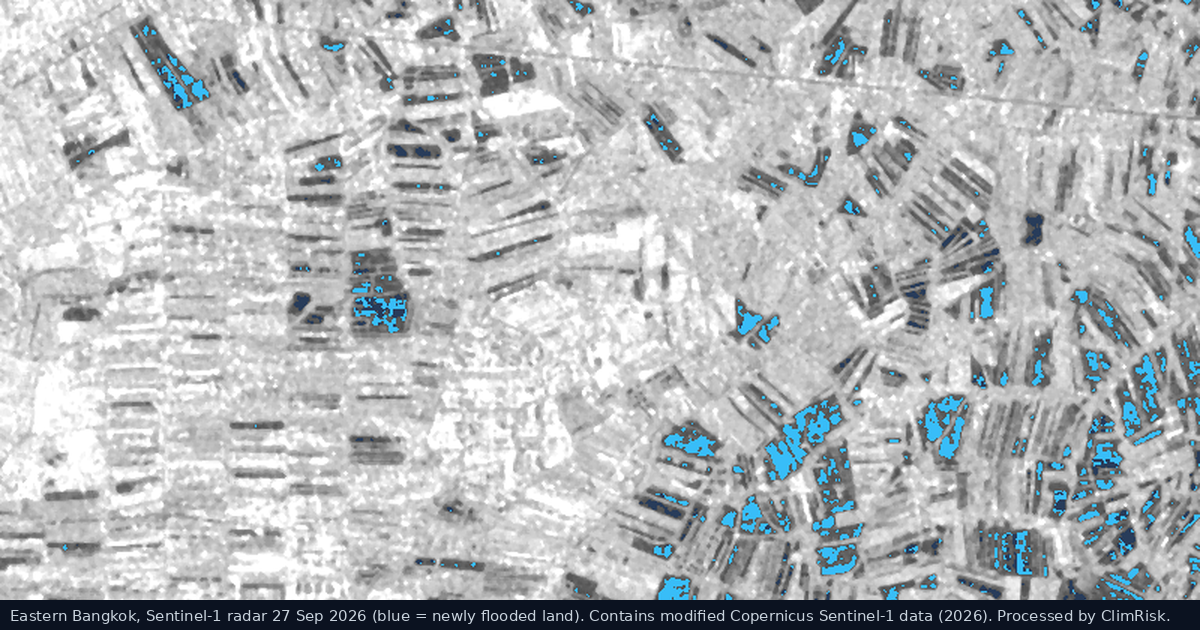
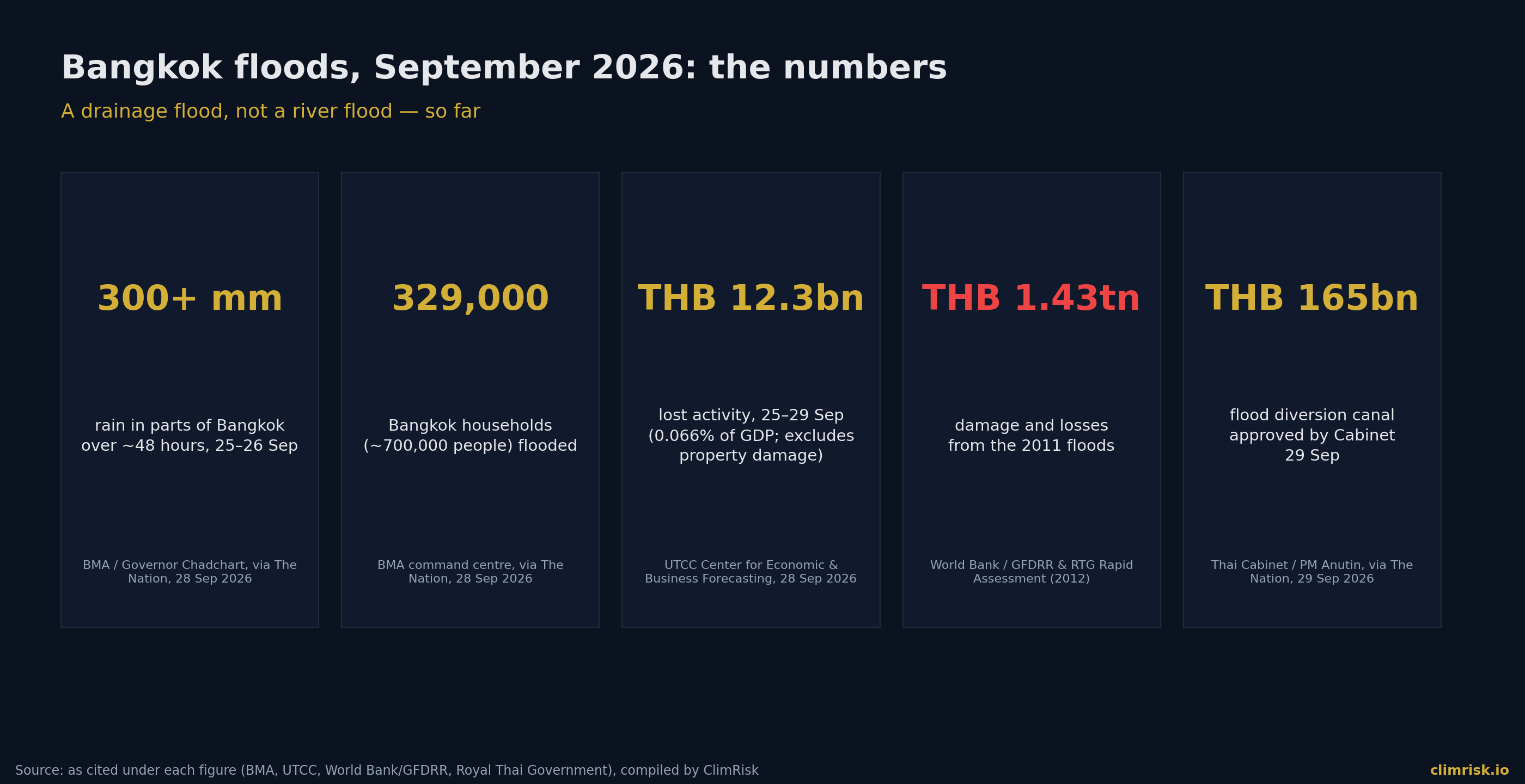
At 10:16 on the morning of 26 September 2026, Bangkok declared a flood disaster emergency. [Wikipedia / BBC 2026] Rain had been falling for about 48 hours. Some parts of the city had recorded more than 300 millimetres. [BMA via The Nation 2026] All 50 districts were declared a disaster area and thousands were forced to evacuate. [AP 2026] Flood water blocked main roads in 37 locations. [Wikipedia / THE STANDARD 2026] By Monday, the city's command centre counted roughly 329,000 households, around 700,000 people, that had been flooded to some degree. [BMA via The Nation 2026]
For anyone who financed, insured or supplied Thai industry in 2011, the word "Bangkok" next to the word "flood" still triggers a specific memory: waterlogged industrial estates in Ayutthaya and Pathum Thani, disrupted regional car production and a global shortage of hard disk drives that lasted through 2012. [Wikipedia: 2011 Thailand floods]
This time the headline number is very different. The University of the Thai Chamber of Commerce puts the cost of five days of disrupted activity at THB 12.3 billion. [UTCC 2026] The 2011 floods cost THB 1.43 trillion. [World Bank/GFDRR 2012] That is a gap of more than a hundred times.
It would be easy to read that gap as proof the problem is solved. It is not. The two events tested different parts of the system, and the part that failed this week is the part most asset-level risk models do not measure. Below, we explain the difference, map the exposure and use the ClimRisk engine to price six power plants in the lower Chao Phraya basin through 2050.
A Different Kind of Flood
The 2011 flood was a river flood. Months of heavy monsoon rain and a sequence of tropical storms filled the reservoirs of the upper Chao Phraya, and the water moved slowly south through the central plain until the barriers protecting industrial estates failed. [World Bank/GFDRR 2012]
The September 2026 flood is a rainfall, or pluvial, flood. A strengthening low-pressure system and the southwest monsoon brought heavy rain across central Thailand [US Embassy Bangkok 2026], with rain-bearing cloud passing repeatedly over the capital for more than two days. [The Nation 2026] The water did not arrive from upstream; it fell on the city and could not get out. Rangsit University's Seree Supratid, who has worked with the IPCC, made the point bluntly: the more than 300 mm fell locally, "without upstream water", and the system still could not cope. [The Nation 2026]
Two things made drainage harder. Strong monsoon winds over the inner Gulf of Thailand raised sea levels at the river mouth, slowing the outflow. [The Nation 2026] And after 2011, Bangkok invested mainly in large drainage tunnels designed for water coming from upstream, not in the neighbourhood drains that carry intense local rain to them. [The Nation 2026]
The physics points in one direction. Warmer air holds more water vapour, which is why intense rainfall scales with temperature.
SOURCE — IPCC AR6 WORKING GROUP I, SUMMARY FOR POLICYMAKERS (2021)
"At the global scale, extreme daily precipitation events are projected to intensify by about 7% for each 1°C of global warming (high confidence)."
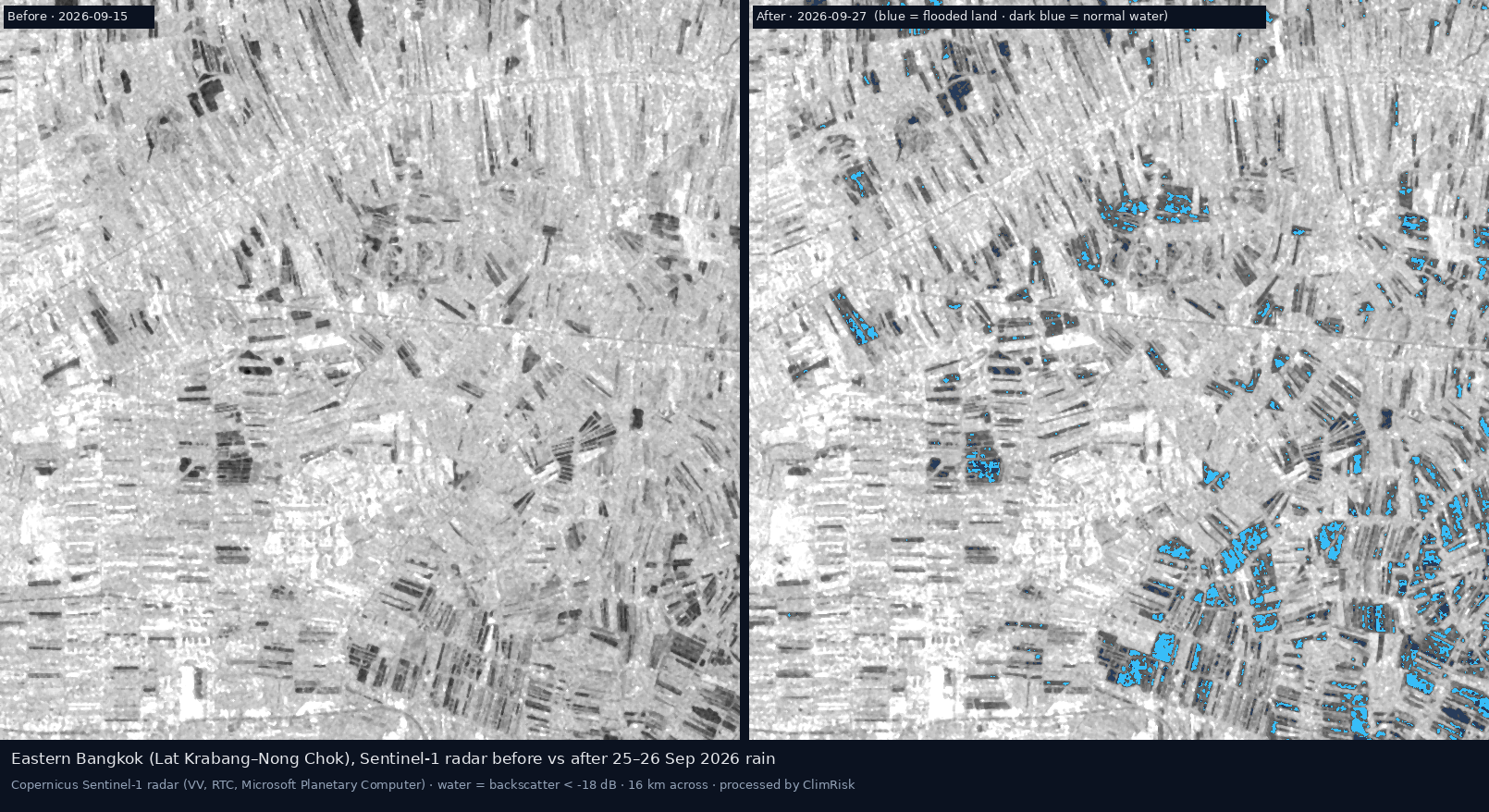
Satellite radar sees through the monsoon cloud that hid the flood from optical satellites all week. Comparing Sentinel-1 passes on 15 and 27 September over a 16 km square of eastern Bangkok, around Lat Krabang and Nong Chok, ClimRisk's processing flags about 5 km² of land that was dry before and under water after. Radar under-counts water in dense built-up streets, so this is a floor, not an estimate of the full footprint.
Two Floods, Two Orders of Magnitude
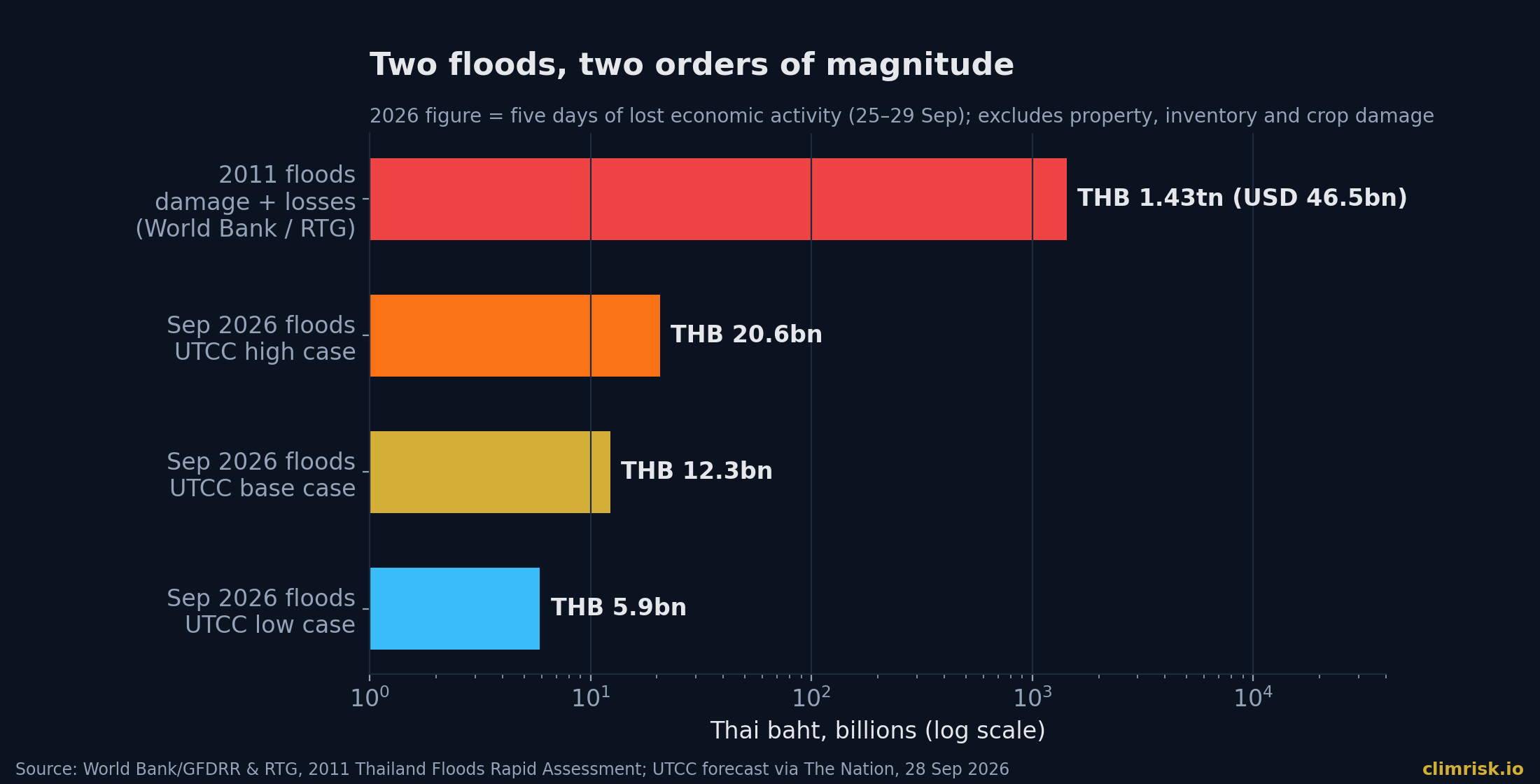
The numbers are not like-for-like, and that matters for how they are used.
The 2011 figure of THB 1.43 trillion (about USD 46.5 billion) counts both physical damage and lost output across the affected provinces. Roughly 70 percent fell on manufacturing, because six industrial estates in Ayutthaya and Pathum Thani were inundated from mid-October to November. About 90 percent of the damage and losses were borne by the private sector. [World Bank/GFDRR 2012]
The 2026 figure of THB 12.3 billion is narrower. It covers lost spending, tourism and services across Bangkok and 26 provinces for 25–29 September, equal to 0.066 percent of annual GDP, with a range of THB 5.9–20.6 billion. It explicitly excludes damage to homes, vehicles, inventories and crops, which will only be counted once the water recedes. [UTCC 2026] A separate estimate from Rangsit University puts economic damage at "at least" THB 11 billion. [Reuters via Business Insurance 2026]
UTCC's assessment makes the key distinction itself: manufacturers were hit mainly through difficulty moving workers and raw materials, "rather than direct damage to factories", which separates this event from 2011. [UTCC 2026]
Who and What Is Exposed
Bangkok alone accounts for 57 percent of UTCC's base-case loss, THB 7.0 billion, because the capital runs on trade and services that need people to move. The four surrounding provinces add THB 1.8 billion and the Eastern region THB 3.0 billion, of which THB 2.1 billion is in Chon Buri, where Pattaya's tourism and the ports depend on open roads. [UTCC 2026]
The Cabinet declared 28 and 29 September special holidays for government offices in Bangkok, Nonthaburi, Pathum Thani and Samut Prakan, areas that UTCC notes account for nearly half of the Thai economy. [UTCC 2026]
The industrial core held. On 25 September, the Industrial Estate Authority of Thailand reported the Nakhon Luang, Bang Pa-in and Ban Wa estates in Ayutthaya at "normal" alert, with the river 5.60 m, 3.42 m and 3.90 m below their embankment crests. [IEAT via The Nation 2026] In the Eastern Economic Corridor, no industrial estate had been reported as suspending production. [UTCC 2026]
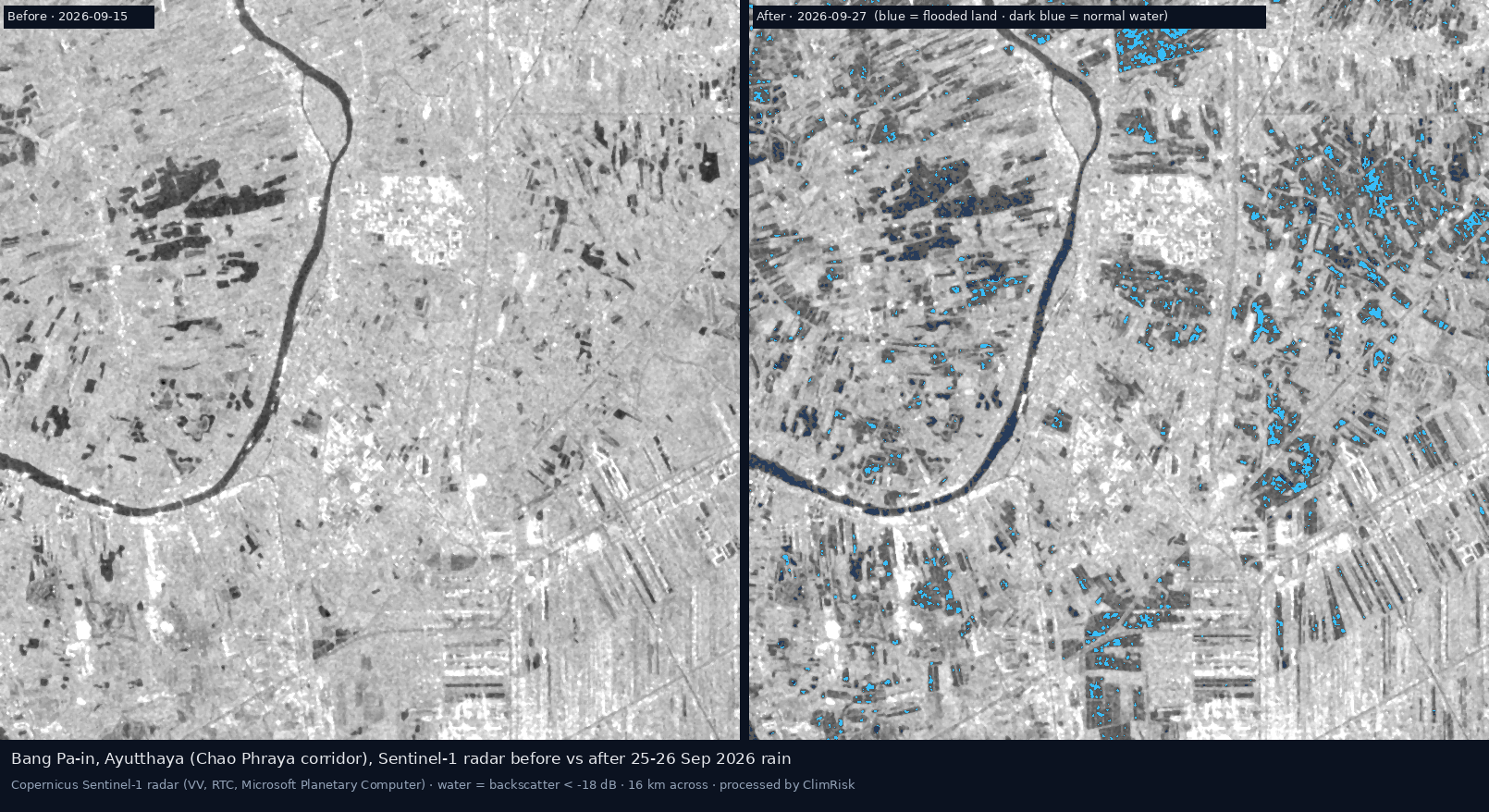
The radar view of the Bang Pa-in corridor tells the same story: about 4 km² of newly wet land within a 16 km square, almost all of it rice fields and open ground, while the estate blocks east of the river remain bright. Radar cannot see clearly inside walled, built-up estates, so this is consistent with the IEAT reports, not independent proof.
Five Financial Transmission Pathways
1. Consumer and services revenue [UTCC 2026] Retail, restaurants, fuel stations and hotels lose sales that are mostly not recovered. For listed retailers and mall owners concentrated in Bangkok, this is an earnings item, not a balance-sheet one.
2. Labour and logistics disruption for manufacturers [UTCC 2026 · FTI 2026] Plants stayed dry but workers and inputs could not reach them. The Federation of Thai Industries told members to review business continuity plans covering production, transport, raw materials, power and suppliers. Contract penalties and lost shifts are the loss channel here.
3. SME credit [UTCC 2026] UTCC's first policy request was debt repayment moratoriums or recovery loans for affected businesses. Banks with SME and consumer books in eastern Bangkok should expect forbearance requests before they see defaults.
4. Food prices [UTCC 2026] Leafy vegetable prices have started rising ahead of the 10–18 October Vegetarian Festival, and wet-season rice in the Chao Phraya basin is approaching harvest with water levels still rising.
5. Public finance [Thai Cabinet 2026] On 29 September the Cabinet set aside more than THB 4 billion for relief and approved the eight-year Chai Nat–Pa Sak–Gulf of Thailand diversion canal, reported at THB 165 billion and partly financed by borrowing. [The Nation 2026] That lands in a slowing economy: GDP growth eased to 1.9 percent in the second quarter from 2.8 percent in the first. [UTCC 2026]
What the River Could Still Do
The river test is not over. On the morning of 30 September, Chao Phraya Dam was releasing 2,200 m³/s, up from 1,950 m³/s two days earlier, and the Office of the National Water Resources warned riverside districts in six provinces, including Ayutthaya, Pathum Thani and Nonthaburi, of a further 20–30 cm rise. [ONWR via The Nation 2026 · FTI via The Nation 2026] The Royal Irrigation Department was working within a 2,000–2,500 m³/s range. [FTI via The Nation 2026]
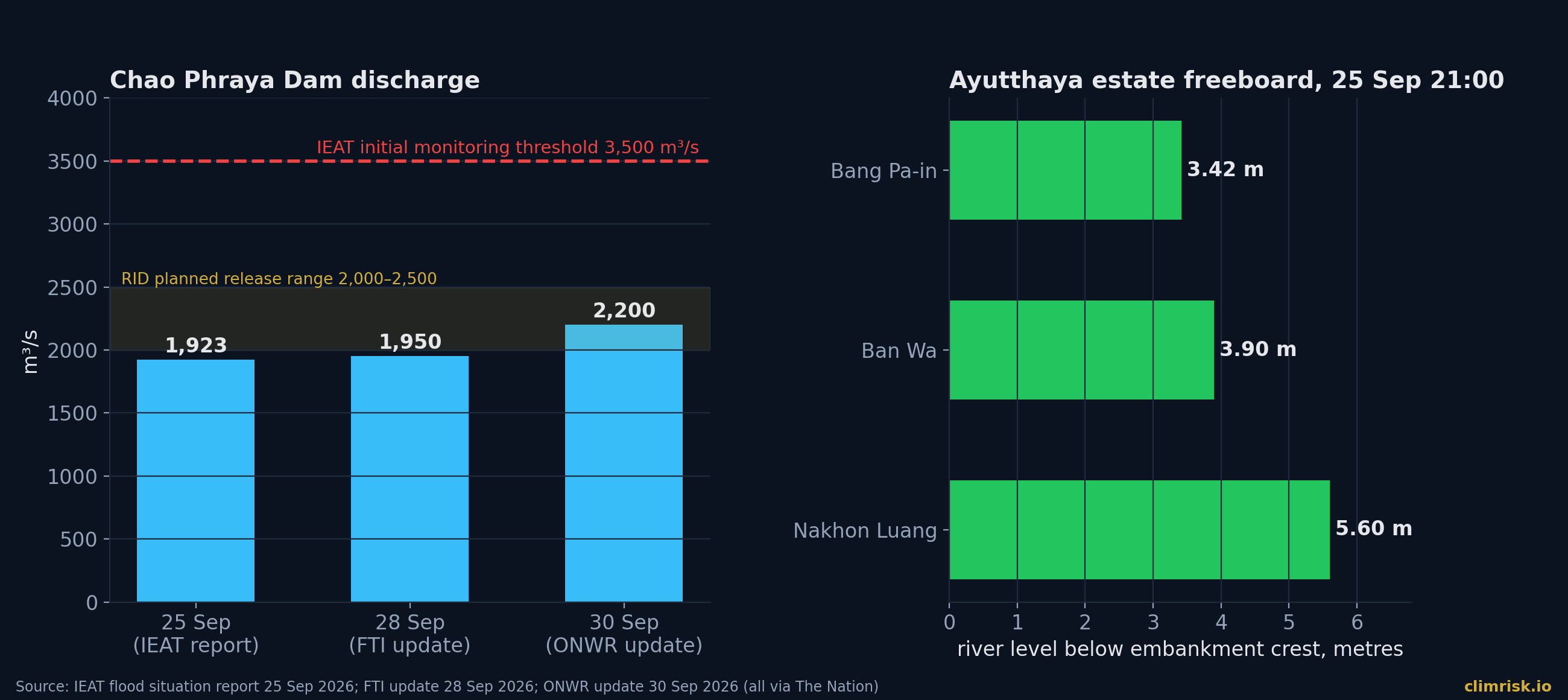
Those flows are still well below the IEAT's initial monitoring threshold of 3,500 m³/s. [IEAT via The Nation 2026] But reservoirs nationwide held 79 percent of capacity on 30 September, with the West at 92 percent and the East at 91 percent. [ONWR via The Nation 2026] The Thai Meteorological Department has issued warnings ahead of new October rain. [The Nation 2026] Full reservoirs in October are exactly how 2011 began.
The Scenario View: Six Power Plants Through 2050
To move from the event to asset value, we ran the ClimRisk engine on six gas-fired power plants from our asset register (Climate TRACE v6) in the lower Chao Phraya basin: Lat Krabang in eastern Bangkok, Bangpa-in and Rojana in Ayutthaya, Nava Nakorn in Pathum Thani, the SBIA district cooling plant in Samut Prakan, and EGAT's 1,554 MW North Bangkok station in Nonthaburi.
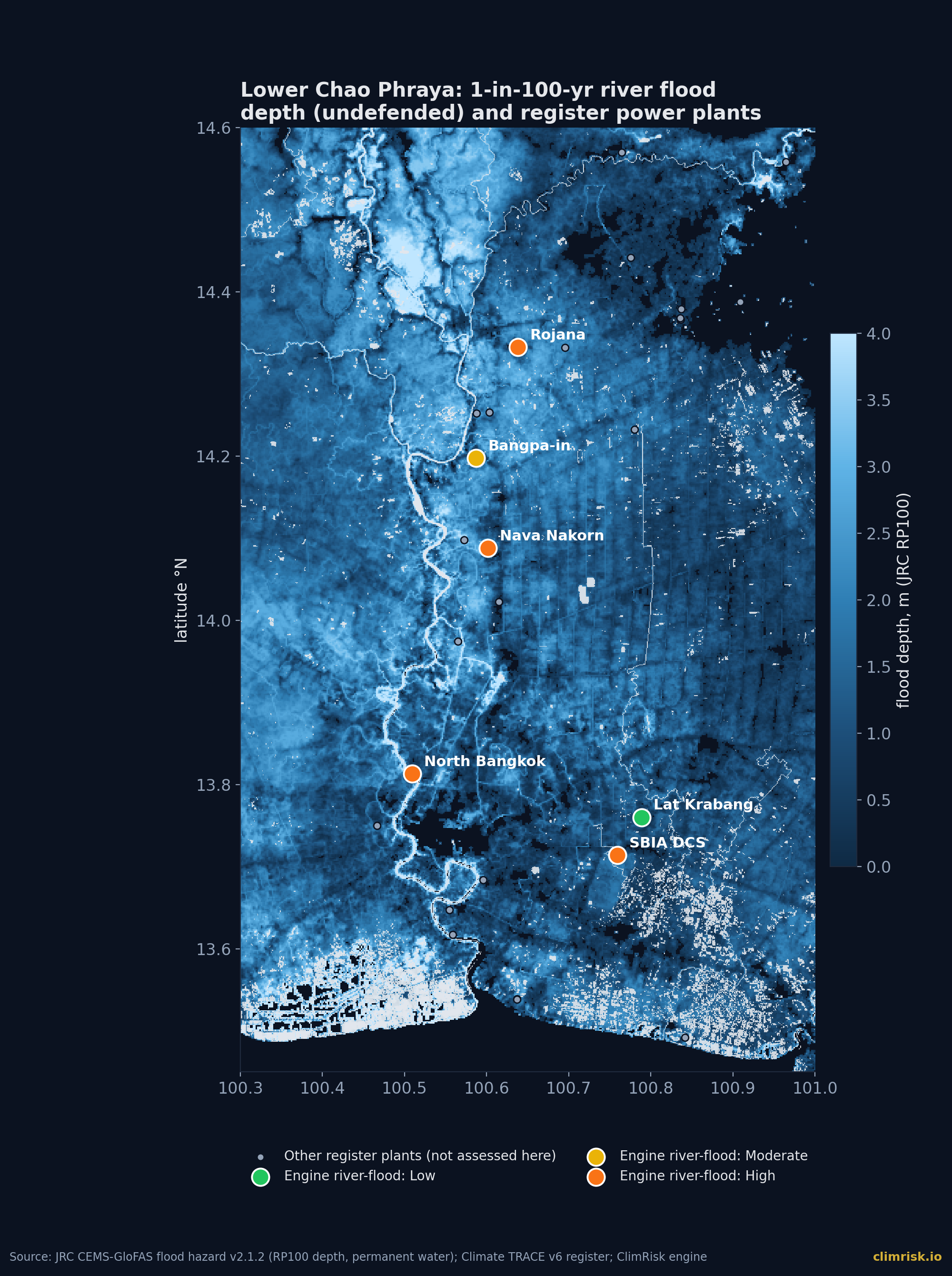
The hazard layer explains most of the result. At the Ayutthaya and Pathum Thani points we tested, the undefended 1-in-100-year river flood is about 2 m deep, while the FLOPROS database assigns these provinces a defence standard of only about 19 years. [ClimRisk engine; JRC; FLOPROS]
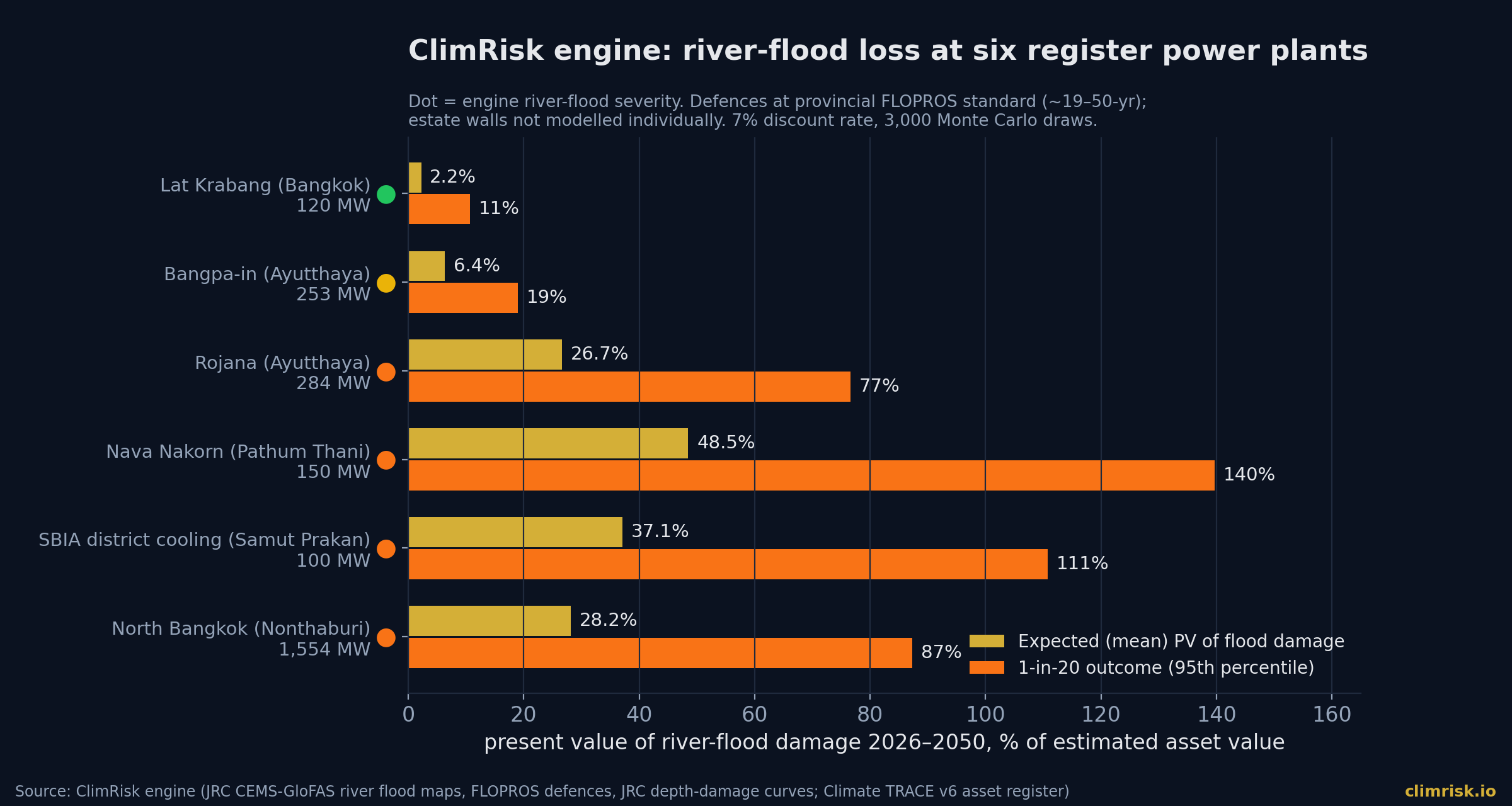
Three results stand out.
The riverside estates carry the tail. For the 284 MW Rojana plant, the engine's expected present value of river-flood damage over 2026–2050 is USD 64 million, 27 percent of an estimated USD 239 million asset value; the 1-in-20 outcome is USD 183 million, or 77 percent. For North Bangkok the mean is USD 368 million (28 percent of USD 1.31 billion) and the 1-in-20 outcome USD 1.14 billion. Across all six plants, expected flood damage comes to about USD 540 million against roughly USD 2.1 billion of estimated value.
The plant the model rates safest sits in the district hit hardest this week. Lat Krabang scores "low" for river flood: a 2.2 percent expected loss, with a 50-year defence standard. Yet Lat Krabang was among the worst-affected districts of the city, with 30,000–40,000 people flooded. [BMA via The Nation 2026] We have no report that the plant flooded. The point is that a river-flood model, however good, is silent about the hazard that actually arrived. Pluvial flooding needs its own layer.
Transition cost is real but deferred. No carbon price applies to Thai power today; the draft Climate Change Act, approved by Cabinet in December 2025, would create an ETS and a carbon tax, with enforcement expected from 2027 and an ETS pilot around 2029. [World Bank Carbon Pricing Dashboard; ICAP; Nishimura & Asahi 2026] Under the NGFS Current Policies scenario, Rojana's total climate cost (physical plus transition) has a median of USD 61 million and a 95th percentile of USD 194 million. Under Net Zero 2050 the median rises to USD 177 million, with USD 70 million of it carbon cost. Under a Delayed Transition, the engine's expected total is USD 112 million, 47 percent of asset value.
What Investors, Lenders and Operators Should Do
Separate the two flood types in every Thai credit and asset review. Ask for river-flood exposure (return period, defence standard, embankment freeboard) and pluvial exposure (site drainage capacity, local pumping, road access) as two lines, not one "flood" score.
Price access, not just damage. This week's loss came from workers, trucks and customers who could not move. For a plant that stays dry, a week of blocked roads is a business-interruption and contract-penalty question. Check whether policies and supply contracts respond to denial of access without physical damage.
Watch October, not September. The river indicators to track are Chao Phraya Dam discharge, station C.2 at Nakhon Sawan, and the IEAT 3,500 m³/s threshold. FTI advised downstream businesses to use exactly these readings. [FTI via The Nation 2026]
Credit the walls, but verify them. The IEAT estates have embankments with metres of freeboard today. A lender should ask for the design standard and maintenance record of the specific wall around the specific plant, because a provincial average is not a site fact, in either direction.
Treat the canal as a 2030s mitigant. An eight-year project approved in 2026 will not change a 2027 loss distribution. Model it as a scenario, not a baseline.
Method and Limitations
Plant results come from the ClimRisk four-stage Risk Analyst: JRC CEMS-GloFAS v2.1.2 river and Deltares coastal flood depths, FLOPROS v1 defences, JRC Asian industrial depth-damage curves, World Bank carbon-pricing data, NGFS Phase 5 pathways and a 3,000-draw Monte Carlo over 2026–2050 at a 7 percent discount rate. Emissions are assumed unabated. Asset values are benchmarks (capacity × regional unit capital cost), not book values, and carry a wide range; tail outcomes above 100 percent of value reflect repeated damage over 25 years. Estate-level walls are not modelled individually, which likely overstates river risk for plants inside well-maintained IEAT estates. Pluvial flooding is not modelled at all, which understates risk in places like eastern Bangkok. The radar water extents are a lower bound in built-up areas. UTCC's loss figure is a five-day activity estimate, not a damage assessment.
How ClimRisk Measured This
We combined official Thai sources (BMA, IEAT, ONWR, FTI, UTCC, Cabinet) with our own analysis: Sentinel-1 radar passes from 15 and 27 September to map new water through cloud, the JRC river-flood hazard for the lower Chao Phraya, and engine runs on six register power plants under seven NGFS scenarios. Every number is either cited or is a named ClimRisk engine output.
Sources
- UTCC forecasts 12.3bn-baht flood losses for September 25–29 (The Nation, 28 Sep 2026)
- Bangkok floodwater eases after affecting 329,000 households (The Nation, 28 Sep 2026)
- Bangkok's 48-hour deluge exposes limits of city drainage system (The Nation, 28 Sep 2026)
- IEAT orders 24-hour flood watch at Thai industrial estates (The Nation, 26 Sep 2026)
- FTI warns Thai firms of flood risks with water storage at 77% on Sept 28 (The Nation, 28 Sep 2026)
- ONWR updates flood-risk provinces as Chao Phraya discharge rises (The Nation, 30 Sep 2026)
- Cabinet approves THB165bn canal to strengthen Bangkok flood defence (The Nation, 29 Sep 2026)
- Thai Met Dept Issues Flood Warnings Ahead of New October Downpours (The Nation, 29 Sep 2026)
- Heavy rain and flooding in Bangkok disrupts traffic and prompts evacuations (AP, 26 Sep 2026)
- Weather Alert: Heavy Rain and Flooding throughout Thailand (U.S. Embassy Bangkok, 26 Sep 2026)
- 2026 Bangkok floods (Wikipedia)
- Thai flood damage could reach at least $327M (Business Insurance / Reuters, 29 Sep 2026)
- 2011 Thailand Floods: Rapid Assessment for Resilient Recovery and Reconstruction Planning (World Bank / GFDRR / RTG)
- 2011 Thailand floods (Wikipedia)
- IPCC AR6 WGI Summary for Policymakers (2021)
- Thai Cabinet Approves Draft Climate Change Act (Nishimura & Asahi, Jan 2026)
- Thailand ETS profile (ICAP)
- World Bank Carbon Pricing Dashboard
- JRC CEMS-GloFAS global river flood hazard maps v2.1.2
ClimRisk translates physical and transition climate risk into asset-level financial exposure. To run your own assets or portfolio through the engine, write to shri@climrisk.io or book a demo.