Use Cases
Built for your sector, not a generic dashboard.
The same CRI Engine, calibrated to what each buyer actually needs to see when they open it.
Built for Chief Risk Officers, Credit Committee Chairs, ESG Compliance Leads
Translate forward-looking physical climate hazards into precise credit risk metrics and audit-ready regulatory disclosures.
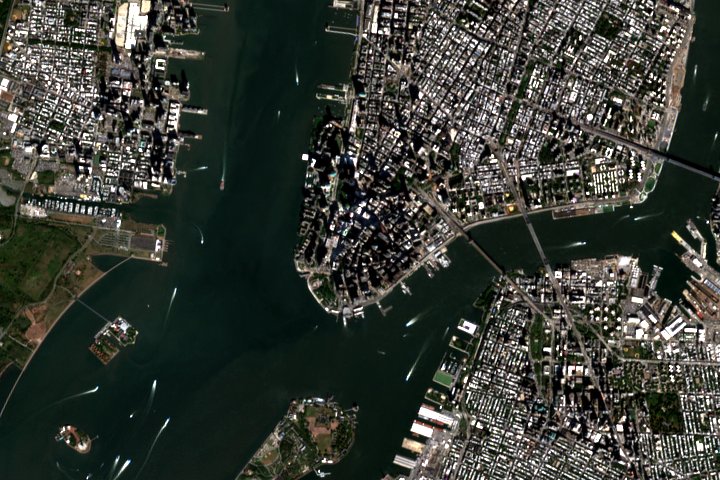
Sentinel-2 L2A, Lower Manhattan financial district, New York (6 Oct 2025), via AWS Earth Search
The Challenge
Backward-looking risk models fail to capture non-linear climate tipping points. Regulators and central banks now expect financial institutions to quantify exactly how extreme weather and chronic climate shifts move Probability of Default and Loss Given Default across an entire loan book.
Loan Book Stress-Testing
Model portfolio-level asset impairment and stress-test lending exposure across 2030, 2040, and 2050. Simulate portfolio resilience under NGFS Phase 5 scenarios.
High-Resolution Collateral Revaluation
Map credit exposure to each collateral's coordinates. Reassess the physical vulnerability of real estate, agricultural, and industrial collateral against river and coastal flood depths, cyclone wind, water stress and 25 further parametric hazards.
Audit-Ready Regulatory Disclosures
Generate reporting aligned with IFRS S2, CSRD, and ECB stress-testing mandates. Export a full portfolio's physical risk profile into a single, consolidated CSV, ready to drop into an existing risk management system.
Baseline vs Climate-Adjusted Expected Loss
Illustrative sample output, not a live client portfolio.
Scenarios Modeled
NGFS Phase 5 & IPCC AR6
Credit Metrics Adjusted
PD, LGD, VaR
Output Format
Single CSV & IFRS S2 Reports