Physical Risk · Southern Europe
The Cloudburst Test: What Catalonia's October 2026 Floods Say About Industrial Climate Risk
Barcelona logged 190.8 mm in one night, double its 2017 record. A standard river-flood model sees almost nothing at the region's plants; the carbon bill is the bigger number, and the flash flood is the one nobody has priced.
Shrinivash D Kannan · 8 October 2026 · 8 min read
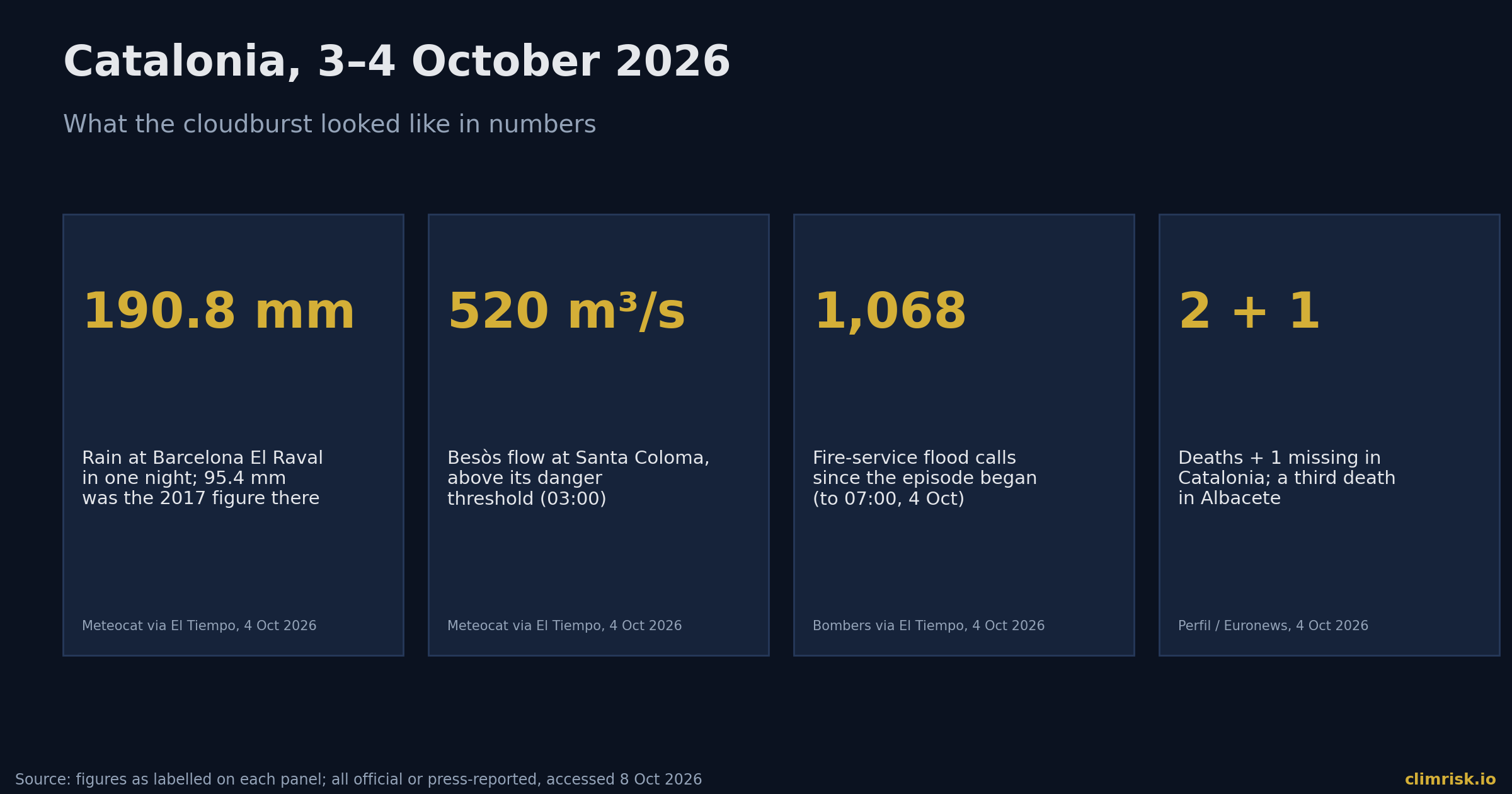
At 16:48 on Saturday 3 October 2026, a phone alert went to 20 Catalan counties telling people to suspend activities and stay off the roads from 20:00. [Euronews 2026] By 03:00 the next morning the Besòs river, which runs through Barcelona's northern suburbs, was carrying about 520 cubic metres per second at Santa Coloma de Gramenet, above its danger threshold. [Meteocat via El Tiempo 2026] The fire service had taken 682 calls, most of them about flooding. By 08:00 the total since the episode began was 1,068. [Meteocat via El Tiempo 2026]
Two people died in Catalonia and one was missing. [Perfil 2026; Euronews 2026] A third death had occurred a day earlier in Madrigueras, Albacete, where a 102-year-old woman was found in her home under more than a metre of floodwater. [The Watchers 2026]
This was not the first storm of the autumn. Valencia's airport had closed on the night of 16 September and a man died near Barcelona in that earlier episode. [AP via Claims Journal 2026] Red alerts followed on 1 October for Valencia, Castellón and Tarragona. [RusTourismNews 2026]
No economic loss estimate for this episode had appeared in the official or insurer sources we checked by 8 October. So this piece does something different. It measures the hazard from official gauges, asks what a standard flood model would have told an owner of Catalan industrial assets, and shows where that model is blind.
The Night the Gauges Broke Records
The rain fell mainly overnight between 3 and 4 October. Meteocat, the Catalan weather service, called the totals exceptional in both amount and area. [Meteocat via El Tiempo 2026]
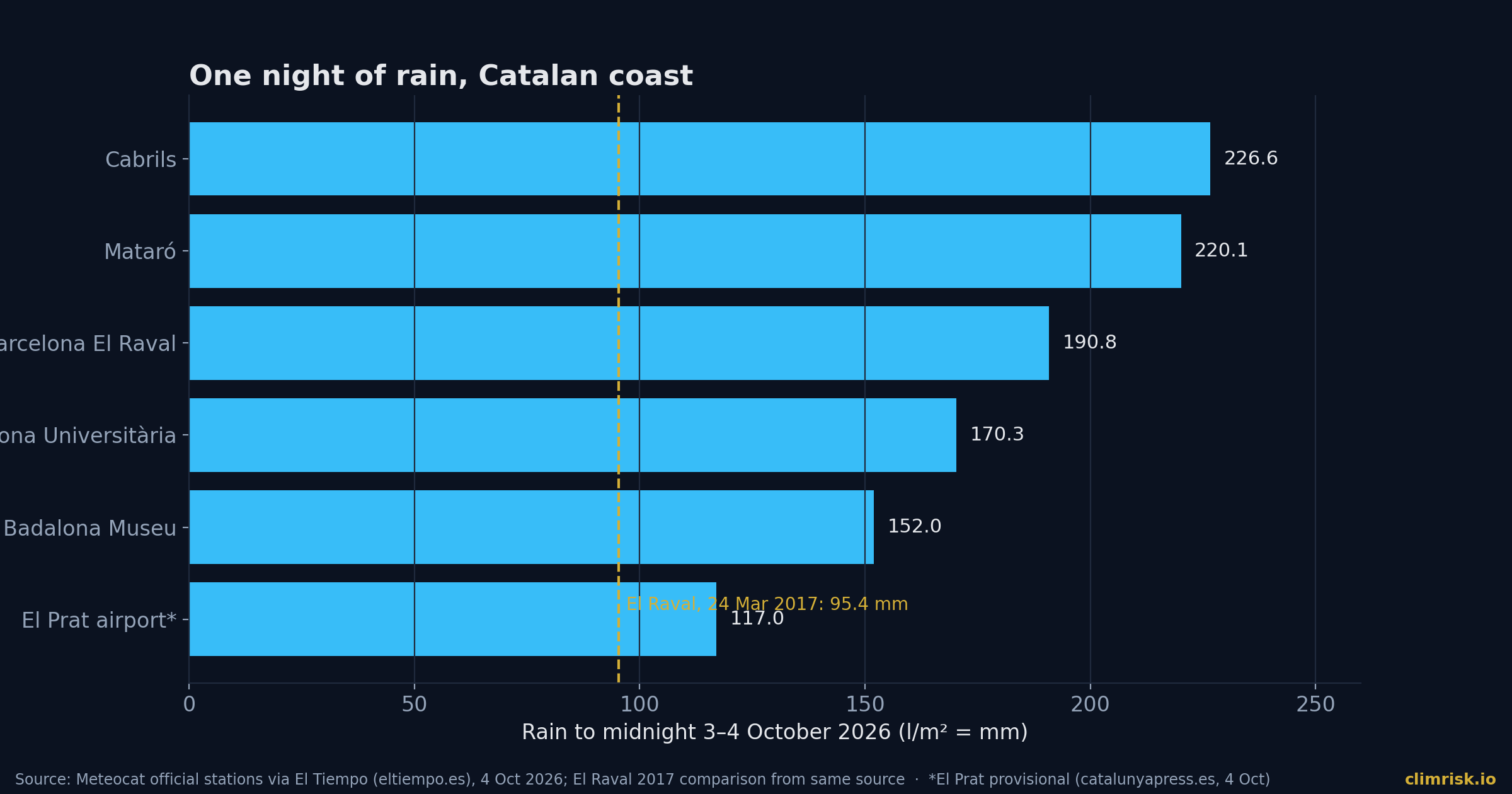
Barcelona El Raval recorded 190.8 mm to midnight, including 36.1 mm in half an hour. The previous reference the service cited for that station, 24 March 2017, was 95.4 mm. The university district on the Diagonal logged 170.3 mm, its highest in 18 years, and Badalona 152 mm, its highest in 21 years. Cabrils reached 226.6 mm and Mataró 220.1 mm. [Meteocat via El Tiempo 2026] El Prat airport, where the rain was lighter, measured 117 mm on a provisional reading. [Catalunya Press 2026]
The provisional AEMET reading at Barcelona Airport for 3 October, 135.6 mm, exceeded the previous October daily maximum of 124.8 mm set in 2002, though not the all-time record of 175.1 mm from 1987. These values have only had automatic quality checks. [Climate Explorer 2026]
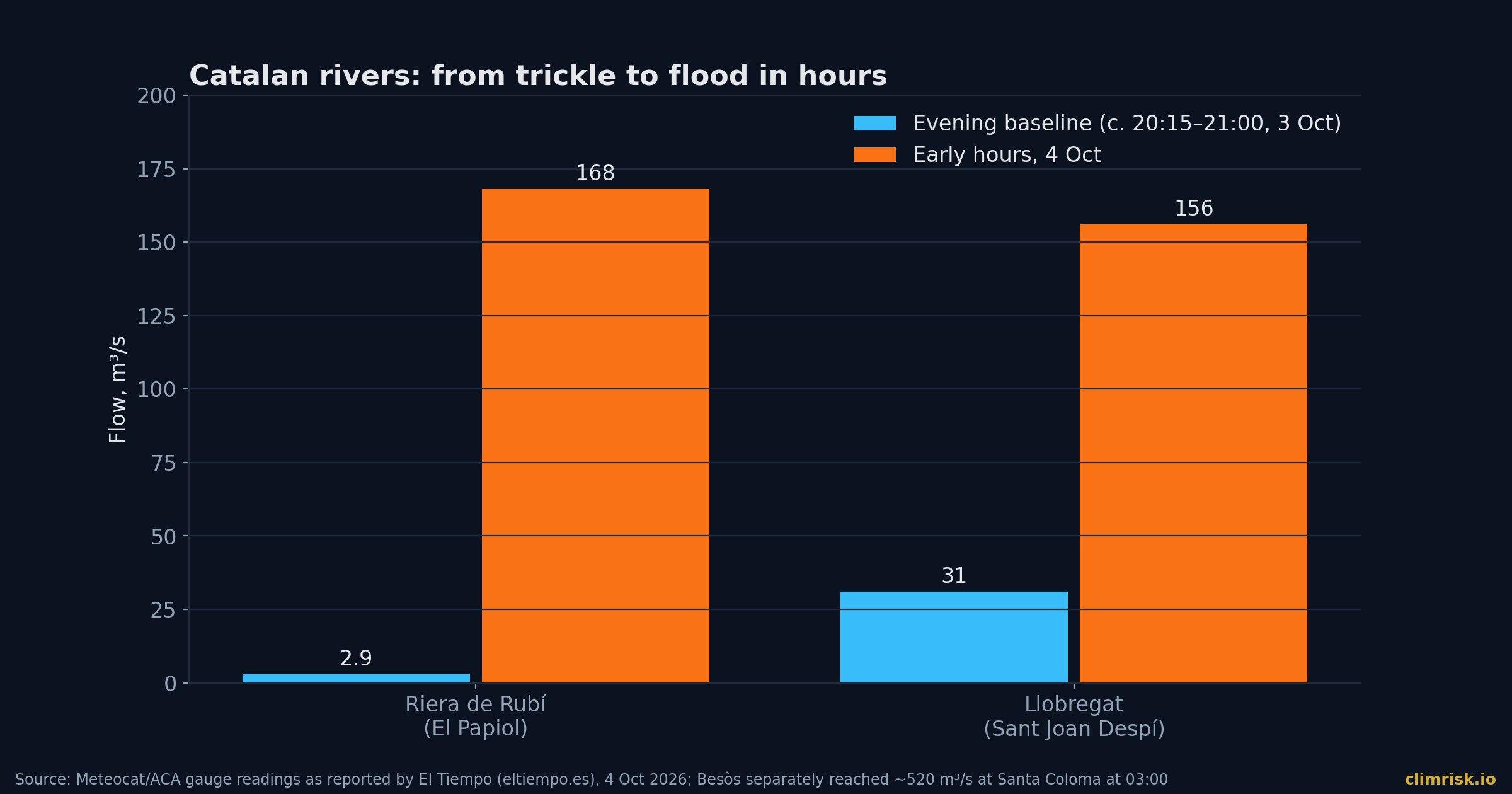
Rivers responded faster than most forecasts can. The Riera de Rubí at El Papiol went from about 2.9 m³/s at 21:00 to about 168 m³/s by 03:00. The Llobregat at Sant Joan Despí climbed from about 31 m³/s at 20:15 to 156 m³/s. [Meteocat via El Tiempo 2026]
The physical mechanism matters for finance. AEMET attributed the episode to cold air aloft meeting warm, moist Mediterranean air, with a detached upper-level low (a DANA) nearby. [AEMET via The Watchers 2026] A Catalan meteorologist quoted by 3Cat put the coastal downpours down to local convection in an easterly sea flow rather than the DANA itself. [3Cat via Climate Explorer 2026] Either way, the physics is warm sea, moist air and slow-moving storms, and the long-term trend is documented.
SOURCE — IPCC AR6 WORKING GROUP I, SUMMARY FOR POLICYMAKERS (2021)
"The frequency and intensity of heavy precipitation events have increased since the 1950s over most land area for which observational data are sufficient for trend analysis (high confidence), and human-induced climate change is likely the main driver."
Who and What Was Exposed
The visible damage was urban and logistical. Rodalies commuter rail and FGC were suspended except for a few lines, the Barcelona metro closed from midnight to 05:00, and about 500 high-speed passengers were stranded in the Camp de Tarragona. [Catalunya Press 2026] The N-II was cut between Montgat and El Masnou. Sants station took in water. [Catalunya Press 2026] On Monday more than half of the Rodalies network was still affected, and firefighters had carried out 2,440 operations including 226 rescues. [FTN News 2026]
Further south, on 2 October, Madrigueras received more than 140 mm in roughly two hours. About 90 people were rescued, four homes collapsed and more than 150 vehicles were removed. [The Watchers 2026] In the Valencia region over 400,000 pupils stayed home as municipalities closed hundreds of schools. [The Olive Press 2026]
None of this is the loss that insurers or lenders price directly, but it is the pattern that precedes it. Spain's last comparable event is a guide. The October 2024 DANA killed more than 200 people [AP via Claims Journal 2026], and by November 2025 the Consorcio had paid out over €4 billion on roughly 250,000 claims. [Spanish Government 2025]
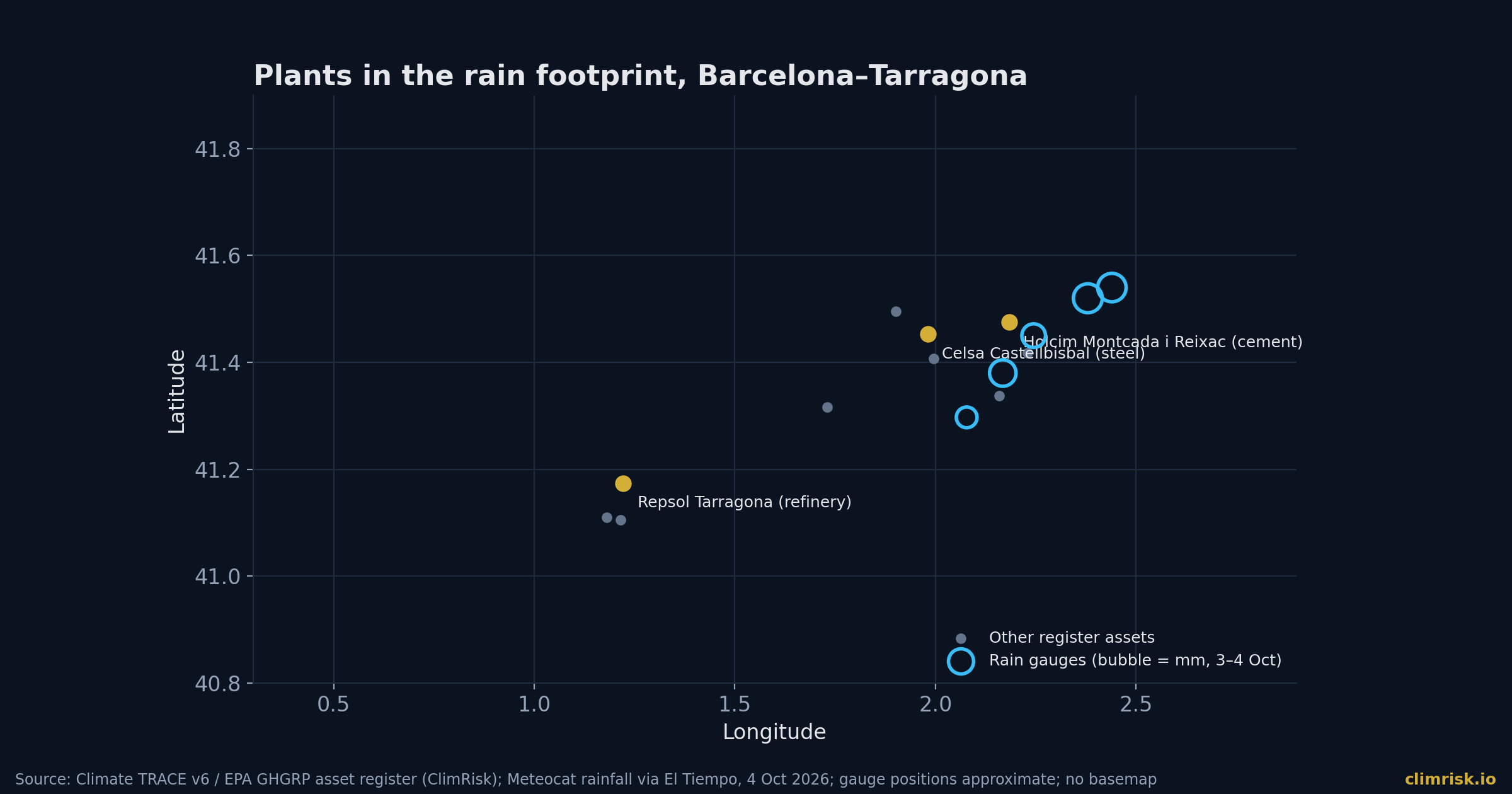
The question for an investor in industry is a different one. The Barcelona–Tarragona belt hosts cement, steel, refining and power. Our asset register holds around 20 sites between Tarragona and Girona. We ran three of them.
What the ClimRisk Engine Says
We ran the ClimRisk four-stage engine on three sites that sit under or near the storm footprint: the Holcim España cement plant at Montcada i Reixac, the Celsa steel plant at Castellbisbal, and the Repsol refinery at Tarragona. Emissions come from the register (Climate TRACE v6). Asset values are not book values. They are an emissions-based proxy of $178.9m, $65.8m and $1.22bn, with wide ranges, and are only used to scale the results.
The headline is a split. At Montcada and Tarragona the engine's river-flood layer shows no flooding at any return period up to 1-in-500 years. At Castellbisbal it shows some:
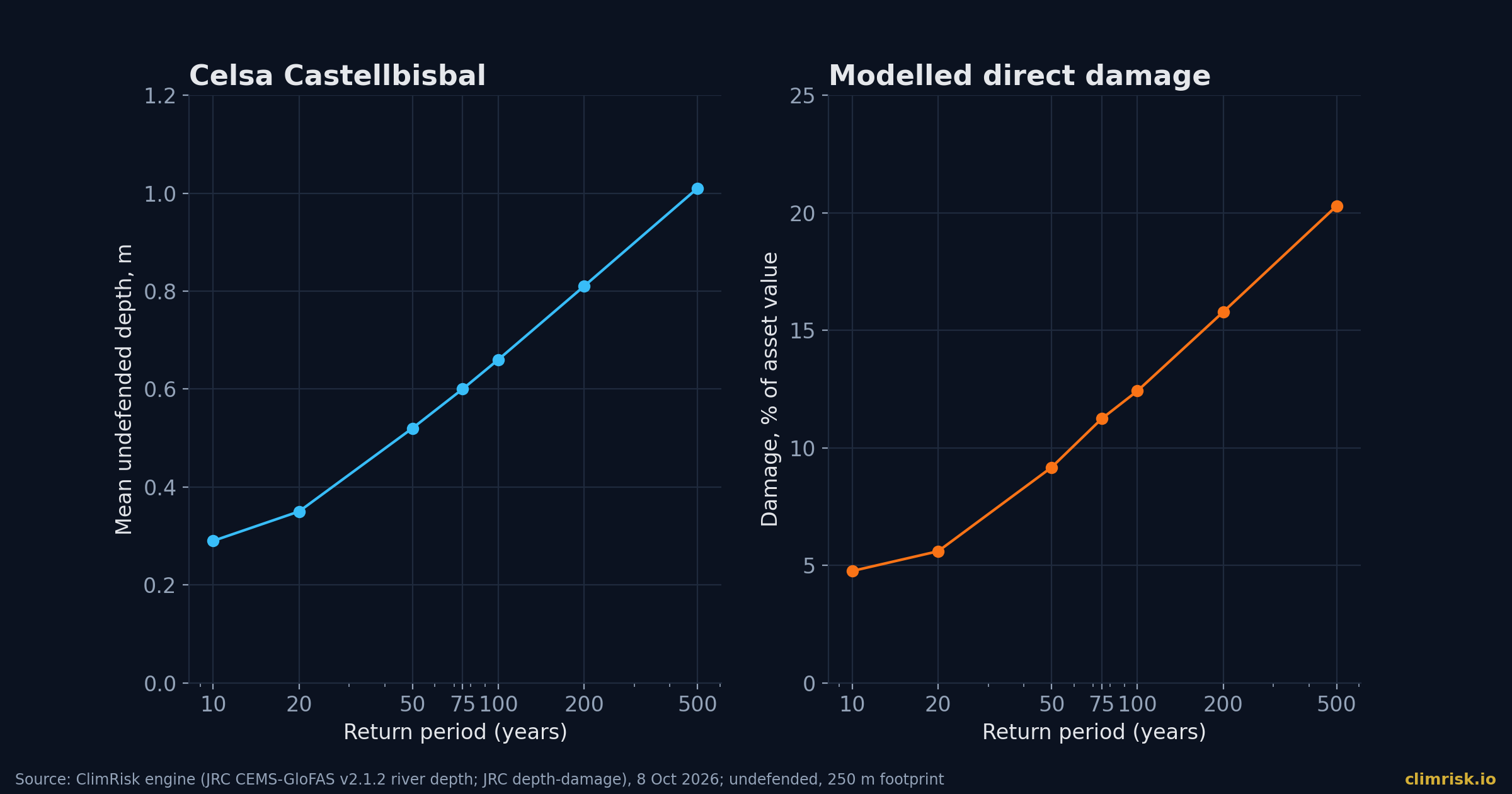
For Celsa, mean undefended depth over a 250 m footprint rises from 0.29 m at a 1-in-10-year flood to 1.01 m at 1-in-500, with modelled direct damage of 4.8 percent and 20.3 percent of value. The register's defence standard for the area (FLOPROS) is about 1-in-252. Average annual damage is 0.07 percent of value, around $83,000 a year. Over 2026–2050 the present value of river-flood damage is $1.0m on average and $7.7m at the 95th percentile. [ClimRisk engine 2026]
Now the carbon side of the same plant. Using the same Monte Carlo and assuming Celsa's 117,280 t of annual emissions stay unabated, the median present value of carbon cost to 2050 ranges from $22m under NGFS Current Policies to $88m under Delayed Transition and $201m under Net Zero 2050. [ClimRisk engine, NGFS Phase 5 2026]
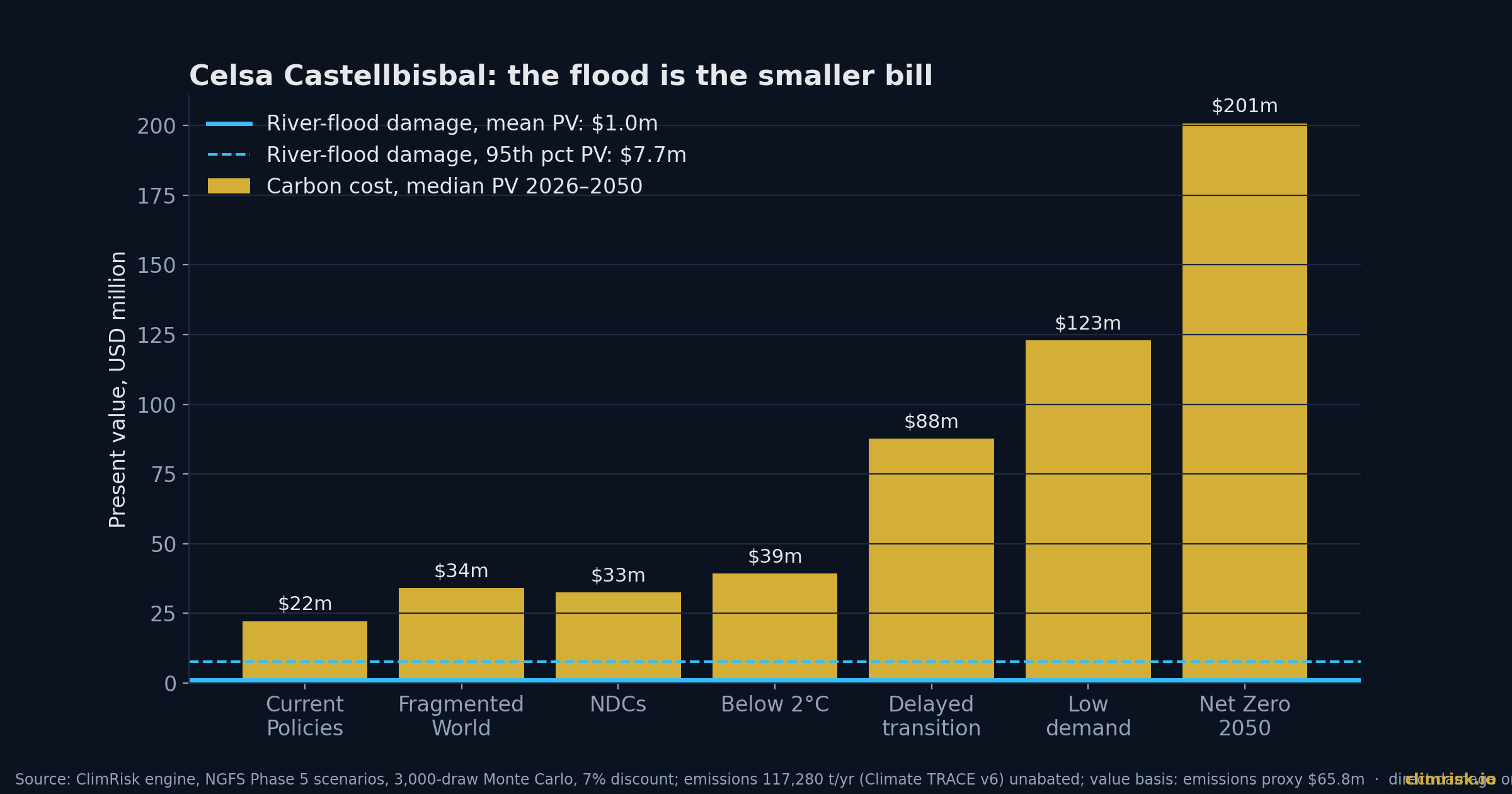
The pattern repeats at the other two. The Repsol Tarragona refinery has an unabated Delayed Transition carbon cost of about $1.7bn at the median and $3.5bn at the 95th percentile, against a modelled river-flood cost of zero. [ClimRisk engine 2026] For heavy industry in Catalonia, the engine's central financial risk is the carbon price, not the river.
That is the answer a standard model gives, and it is incomplete.
What the Model Cannot See
Look at the gauges again. The Riera de Rubí went from 2.9 to 168 m³/s in six hours at El Papiol, a few kilometres from Castellbisbal. A 90-metre global river-flood map built around large catchments does not resolve a stream like that. Nor does it model rain falling on paved ground that cannot drain. The Madrigueras flood arrived through normally dry channels after the heaviest rain had eased. [The Watchers 2026] Bangkok in September taught the same lesson. [ClimRisk 2026]
So the zero at Montcada and Tarragona means "no river flood in the map", not "no flood". Neither is evidence that these plants stayed dry or were hit. We found no reports of plant outages in this event and are not claiming any.
Three things follow for those who finance or insure these assets:
Ask for site drainage, not flood zones. A site's own stormwater capacity and its position relative to dry streambeds decides pluvial damage. Neither appears in hazard maps.
Price the supply chain. The most likely losses here are interruption: roads and rail cut for days, staff who cannot reach work. Our engine covers direct damage only.
Do not let the carbon bill hide behind the weather bill, or the reverse. For Celsa the median carbon present value is dozens of times larger than modelled river damage. But a single pluvial event can still interrupt a plant for weeks. Both belong in the credit file.
For operators: map your catchment's small watercourses, test your pumps against 90 mm in an hour (the intensity AEMET's red alert warned of on the Barcelona coast [The Olive Press 2026]), and confirm your business-interruption cover includes flash flood and utility-failure triggers.
Method and Limitations
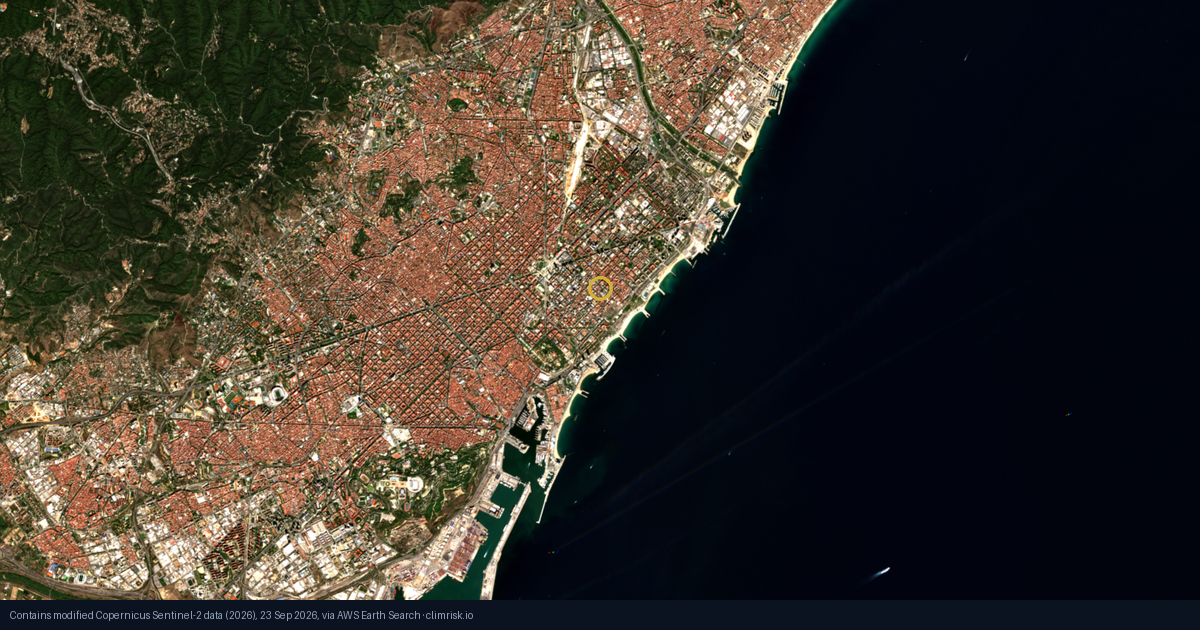
Plant results come from the ClimRisk four-stage Risk Analyst: JRC CEMS-GloFAS v2.1.2 river and Deltares coastal flood depths, FLOPROS v1 defences, JRC depth-damage curves, World Bank carbon-pricing data (EU ETS $84.9/t in 2026), NGFS Phase 5 pathways and a 3,000-draw Monte Carlo over 2026–2050 at a 7 percent real discount rate. Emissions are assumed unabated. Asset values are emissions-based proxies, not book values, and range roughly from $23m to $249m for Celsa; carbon results scale with the proxy. The engine does not model pluvial or flash flooding, business interruption or supply-chain losses. Rainfall and river readings are provisional gauge values reported by the press from Meteocat; gauge positions on the map are approximate. We could not obtain a cloud-free Sentinel-2 scene after the event as of 8 October; the cover shows Barcelona on 23 September, before the rain. No official economic loss estimate for this episode had been published when we wrote this.
How ClimRisk Measured This
We combined Meteocat and AEMET readings as reported by Spanish and international media with our own engine runs on three register plants under seven NGFS scenarios, and a Copernicus Sentinel-2 scene of Barcelona from 23 September. Every number is either cited or a named ClimRisk engine output.
Sources
- Catalonia floods: overnight emergency (Catalunya Press, 4 Oct 2026)
- Catalonia under red alert: Barcelona exceeds 190 l/m² (El Tiempo, 4 Oct 2026)
- Two people have died in Catalonia (Euronews, 4 Oct 2026)
- Torrential rain in Barcelona: two dead, one missing (Perfil, 4 Oct 2026)
- Flash flooding kills one in Madrigueras, Spain (The Watchers, 3 Oct 2026)
- Flash floods across Spain (The Olive Press, 3 Oct 2026)
- Barcelona travel disruption continues (FTN News, 5 Oct 2026)
- Spain October 2026 flash floods: EuroMeteo gauges and OPERA radar (Climate Explorer)
- Spain flooding disrupts Renfe and Euromed (RusTourismNews, 2 Oct 2026)
- Torrential rain brings deadly floods back to Spain's east coast (AP via Claims Journal, 17 Sep 2026)
- El Consorcio supera los 4.000 millones en pagos por la DANA (Spanish Government, 26 Nov 2025)
- IPCC AR6 WGI Summary for Policymakers (2021)
ClimRisk translates physical and transition climate risk into asset-level financial exposure. To run your own assets or portfolio through the engine, write to shri@climrisk.io or book a demo.