Physical Risk · Central America
Covered With Fire, Not Water: What the 2026 El Niño Drought Reveals About Central America's Power Grid and the Panama Canal
Water supplied 22 percent of Guatemala's power on 18 September, against 62 percent a year earlier, and the spot price rose 86 percent. A physical-risk screen sees almost nothing at the plants that filled the gap; the carbon bill is the number that matters.
Shrinivash D Kannan · 19 October 2026 · 9 min read
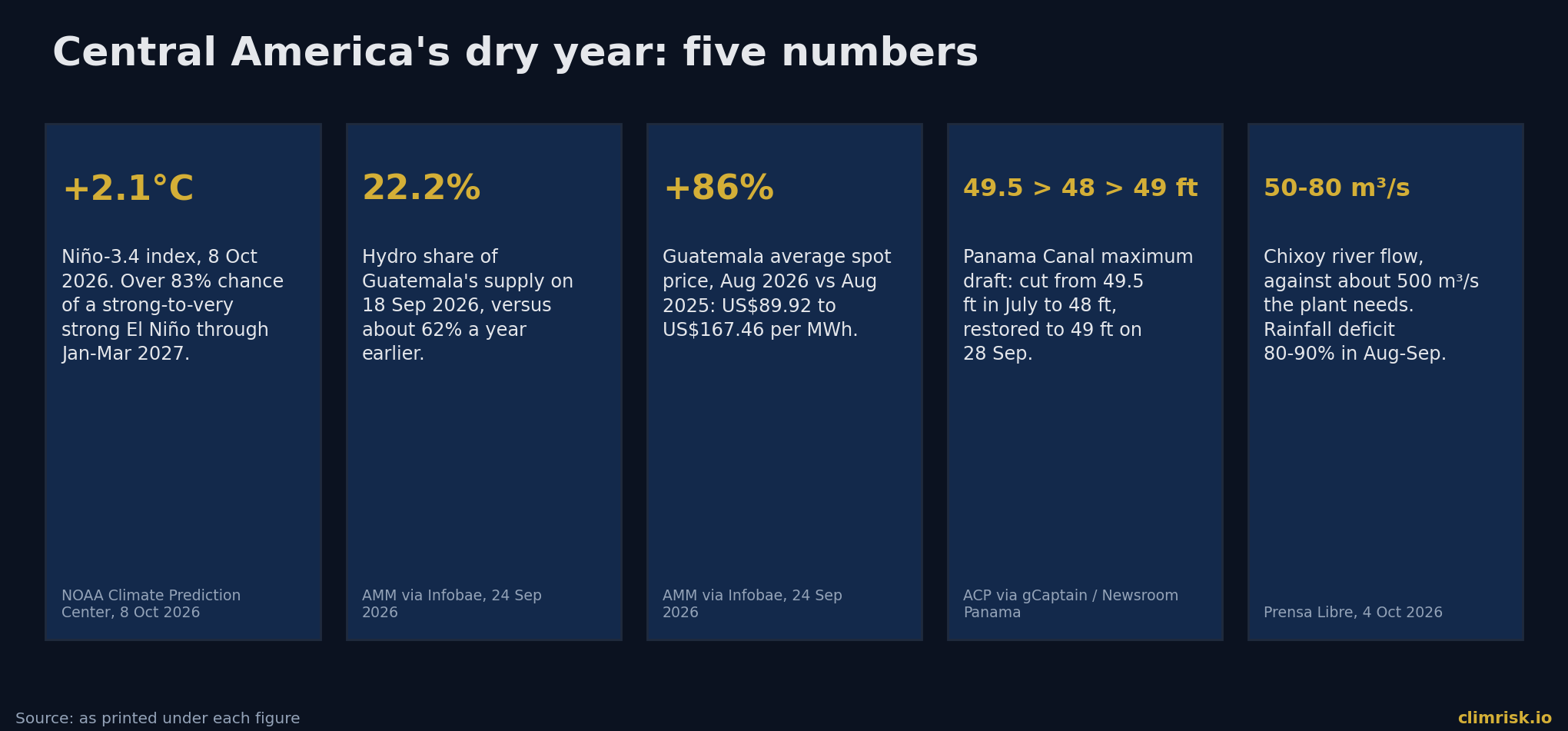
On 18 September 2026, water supplied 22.2 percent of Guatemala's electricity. A year earlier, on the same date, it supplied about 62 percent. [AMM via Infobae 2026] Steam turbines burning coal and bunker fuel filled the gap, rising from 23.5 percent of supply to 44 percent. [AMM via Infobae 2026] The energy ministry's own bulletin put it bluntly, and we quote it below.
SOURCE — GUATEMALA MINISTRY OF ENERGY AND MINES, BULLETIN (via Infobae, 24 Sep 2026)
"No la estamos cubriendo con agua. La estamos cubriendo con fuego." (We are not covering it with water. We are covering it with fire.)
This is what a strengthening El Niño looks like in a power system. It is also a useful test of how climate risk is usually modelled, because the plants that are working hardest right now are the ones carrying a carbon liability, and the standard physical-risk screen sees almost nothing wrong with them.
The Physical Mechanism
On 8 October, NOAA's Climate Prediction Center kept its El Niño Advisory in place and put the Niño-3.4 index at +2.1°C. [NOAA CPC 2026] It gave a more than 83 percent chance that a strong-to-very strong event persists through January–March 2027, and a 54 percent chance that the September–November season qualifies as a historic event (a relative index of +2.5°C or more). [NOAA CPC 2026]
SOURCE — NOAA CLIMATE PREDICTION CENTER, ENSO DIAGNOSTIC DISCUSSION (8 Oct 2026)
"El Niño strengthened further last month"... "strong-to-very strong El Niño likely through January-March 2027."
For Central America's Pacific side, El Niño means a weaker rainy season. Guatemala's weather service forecast below-average rain across the region through October, and Pacific-side rainfall has run below 60 percent of the long-run average since July. [Rio Times 2026] NOAA's 15 October hazards outlook still lists 90-day rainfall deficits above 200 mm in western Guatemala, El Salvador and most of Panama, and says low river levels have contributed to power outages. [NOAA CPC 2026b]
Governments moved early. On 25 August Panama declared a nationwide state of emergency, the third Central American country to do so. El Salvador declared its highest alert the same day, and Honduras had put 80 percent of its territory on alert for severe drought. [The Weather Network 2026]
Who and What Was Exposed
Two systems took the strain: a power grid that leans on rivers, and a shipping canal that runs on a lake.
Guatemala's grid
Hydropower normally supplies about 41 percent of Guatemala's electricity. Only one plant, Chixoy, has a large reservoir. The rest are run-of-river and follow rainfall closely. [Rio Times 2026] In the Chixoy basin the rainfall deficit was 80 percent in August and 90 percent by 9 September. Flow was 50–80 cubic metres per second, against about 500 the plant needs at full output. [Prensa Libre 2026] On 9 September the reservoir stood at 776.05 m, 3.59 m below the same date in 2025. [Infobae 2026]
Demand did not wait. Average peak demand rose from 2,084 MW to 2,301 MW, and the ministry put the rise in the highest-consumption period at 8.6 percent. [Infobae 2026] Solar helped at midday, supplying 465 MW at 11:00, and gave nothing at the 19:00 peak. [Infobae 2026] Coal exceeded 51 percent of generation in early August and bunker fuel reached as much as 15 percent. [Prensa Libre 2026]
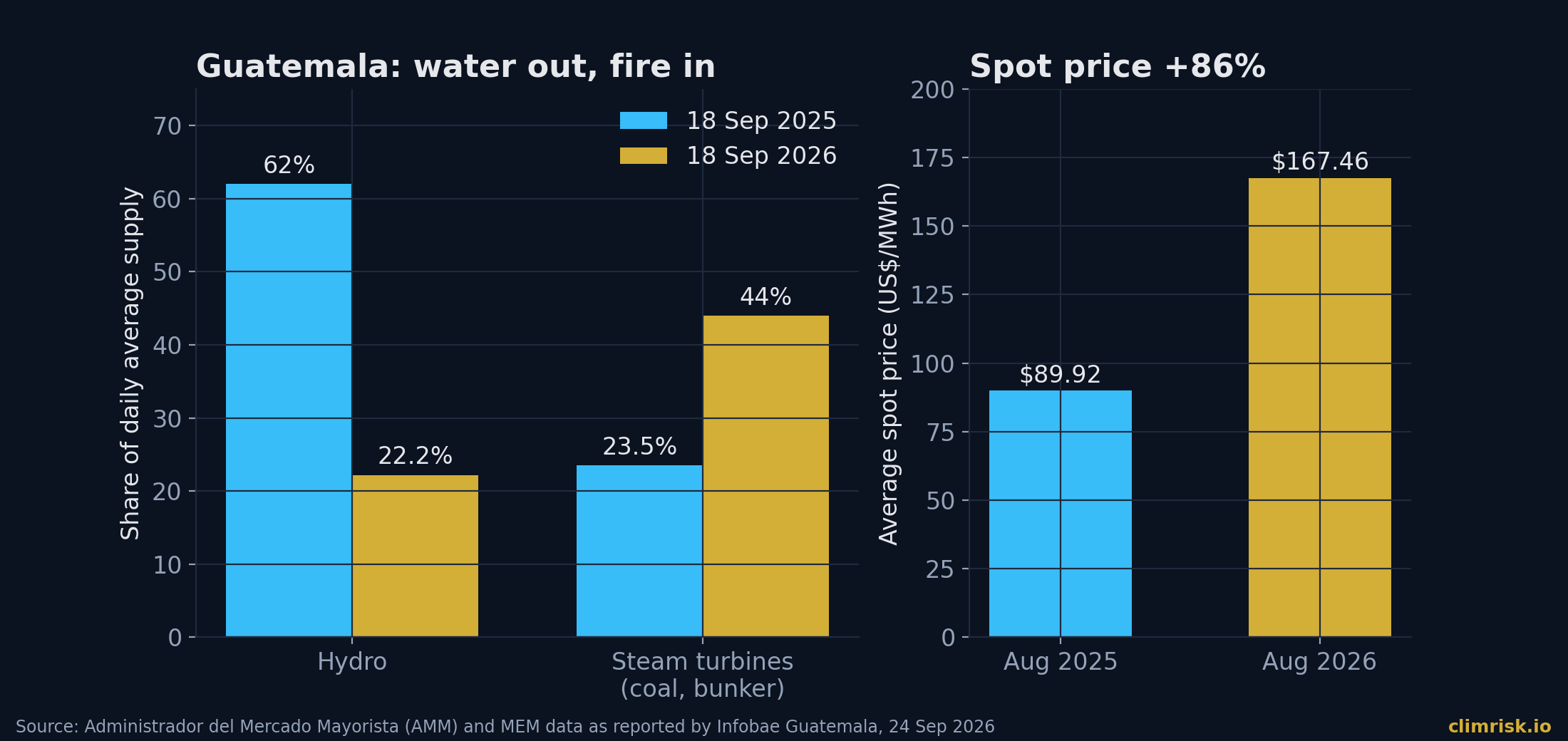
The price moved with the mix. The average wholesale spot price rose from US$89.92 per MWh in August 2025 to US$167.46 in August 2026, up 86.2 percent. [AMM via Infobae 2026] Households on regulated tariffs, which rest on supply contracts of 15 years or more, are largely shielded. Large industrial and hotel customers buying on the spot market are not. [Rio Times 2026]
Rain returned from mid-September. Chixoy climbed to 787.96 m by 4 October, up more than 11 m, and hydro's share of generation recovered to about 40 percent in the week of 20–26 September. But the plant was still running at no more than 25 percent of capacity, and the energy minister said the gain was not yet enough to raise generation or bank water for the dry season. [Prensa Libre 2026] As of that date the ministry was still weighing a formal electricity emergency. [Prensa Libre 2026]
The canal
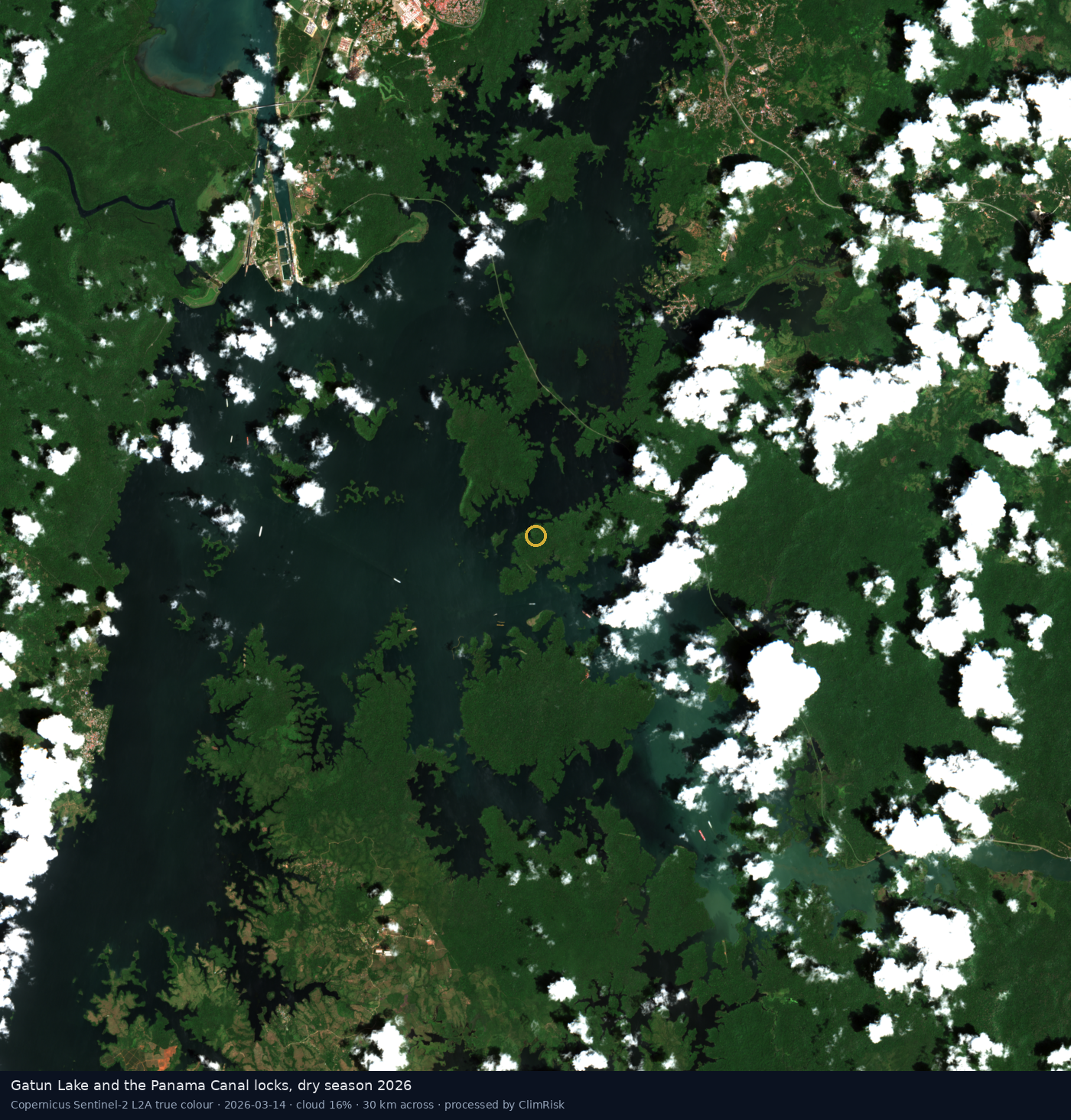
The Panama Canal Authority (ACP) had gone into the year with healthy lake storage. Heavy rain in 2025 and a wet 2026 dry season kept it above normal, and no draft limits had been needed for almost two years. [ACP 2026] In July the ACP said the probability of a severe El Niño had risen from 25 percent in April to 81 percent, and that "capacity restrictions will likely be implemented." [ACP 2026]
They were. The maximum draft for the big Neopanamax locks fell from 49.5 ft in early July to 49.0 on 24 July, 48.5 on 15 August and 48.0 ft by late August. [gCaptain 2026] The ACP first said the draft cuts would not affect daily transits, then trimmed slots anyway: Neopanamax to nine a day on 3 September and Panamax to 23 on 15 September. A planned further draft cut to 47.5 ft was scrapped. [gCaptain 2026; gCaptain 2026b]
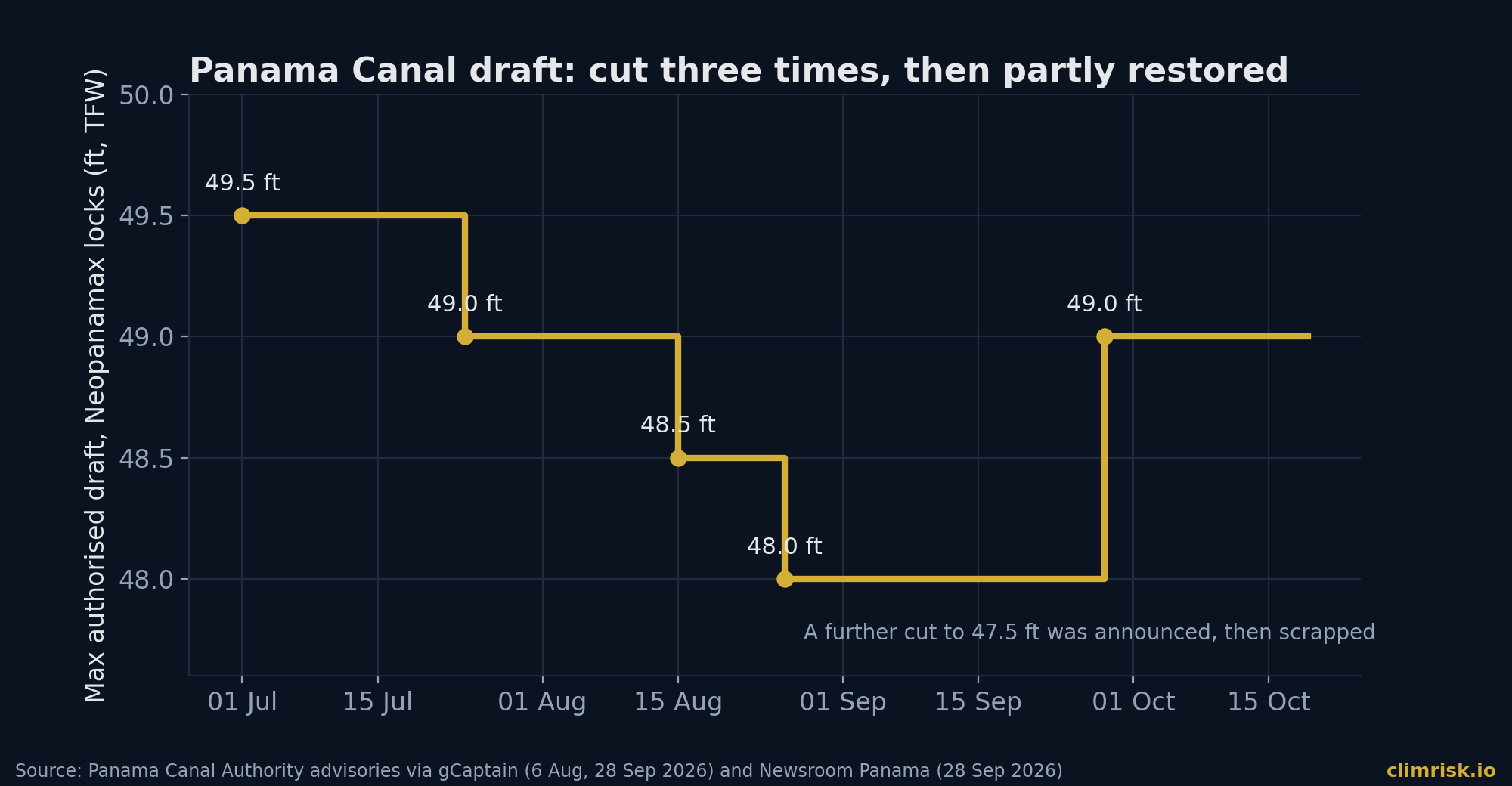
September rain changed the picture. On 28 September the ACP raised draft back to 49 ft, lifted daily slots from 32 to 33, and said a tenth Neopanamax slot would start on 15 October. It cited September rainfall, water-saving at the locks and projections for Gatún Lake. [Newsroom Panama 2026] It also said the watershed "remains in a water deficit," and that rainfall was close to historical averages. [gCaptain 2026b]
How Drought Becomes a Financial Loss
For the canal, the memory is 2023–24. In fiscal 2024 total transits fell 29 percent to 9,936. [Lloyd's List via Kuehne+Nagel 2024] Yet the ACP's administrator said the drop would not show in net income, because of higher cargo per transit, congestion surcharges and lower costs. [Lloyd's List via Kuehne+Nagel 2024] In this year's first nine months of fiscal 2026 the canal handled 10,726 transits, up 5.2 percent, and earned US$4.8 billion in revenue, up 17 percent. [ACP 2026] The lesson is that a canal can monetise scarcity. Its customers cannot: every foot of lost draft means less cargo per ship, and carriers pass that on in surcharges or reroute.
For the power system the pathways are more direct:
- Fuel and spot cost. Spot buyers paid 86 percent more in August. Thermal generators with unhedged fuel carry the opposite risk when the rain returns and dispatch falls.
- Emissions. More coal and bunker burn means more tonnes, in countries where no carbon price applies today. That feeds both reporting and, later, borrowing terms.
- Supply security. Regulators weigh an emergency declaration, which can force idle plants to stand ready and fast-track new capacity. [Rio Times 2026] About 250 MW of new generation is due before the end of 2026. [Rio Times 2026]
- Wider macro. Allianz, in its first Climate Risk Tracker, estimates a 2027 El Niño would cost the world about €392 billion (US$451 billion) in lost output. [Allianz via chemeurope 2026]
What the ClimRisk Engine Says
We ran the four-stage ClimRisk engine on three plants from our register that sit in the affected region: the San José coal station in Guatemala (139 MW, 1.31 million tonnes of CO₂ a year), the Cementos Progreso Sanarate cement plant in Guatemala (2.93 million tonnes of capacity, 1.34 Mt CO₂), and the AES Colón gas station in Panama (380 MW, 0.18 Mt CO₂). Asset values are capacity-based benchmarks of $311m, $410m and $319m, each with a wide range. Emissions are assumed unabated.
The first result is the quiet one. Modelled physical loss at all three is essentially zero. Cyclone, river and coastal flood layers all read negligible, and average annual damage is under US$2,000 for San José and effectively nil for the other two. Drought does show up as context: the WRI Aqueduct drought index scores San José 0.63 (medium–high) and Sanarate 0.59 (medium). AES Colón has no data. But the engine does not monetise drought, so those scores are not in the loss figures. [WRI Aqueduct 4.0 via ClimRisk engine 2026]
The second result is the loud one. No carbon price applies to these sectors in Guatemala or Panama today. [World Bank 2026] Under the NGFS Phase 5 scenarios, the present value of transition loss to 2050 (carbon cost plus stranding, 2026–2050, 7 percent discount rate, median and 95th percentile) is:
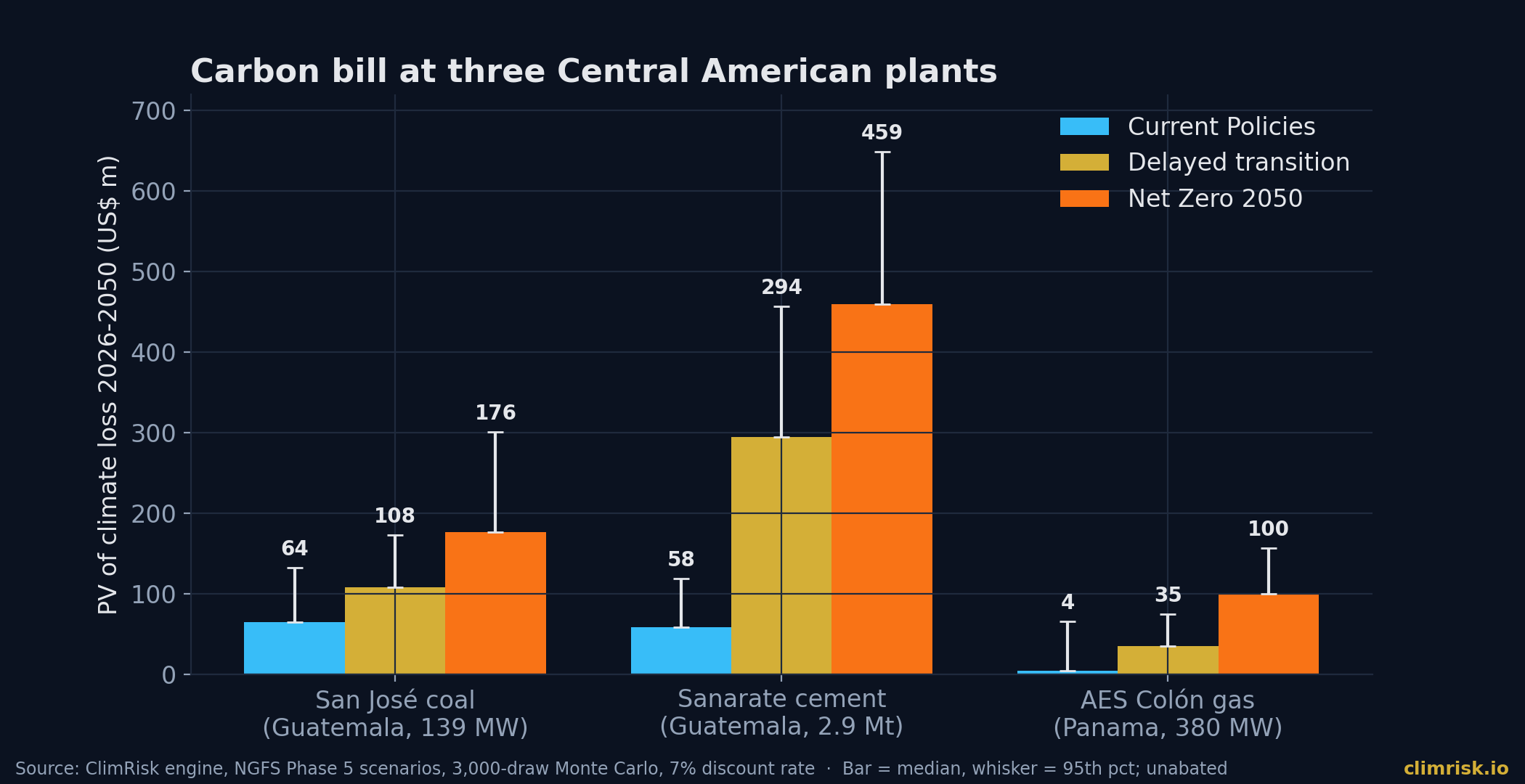
San José is $64m median under Current Policies, $108m under a Delayed transition (95th percentile $173m) and $176m under Net Zero 2050 ($300m at the 95th). Sanarate is $58m, $294m ($457m) and $459m ($649m). AES Colón is $4m, $35m ($74m) and $100m ($156m). The gas plant is the least exposed, and the coal plant and cement kiln the most. In a world that prices carbon late and hard, the plants that carried the grid through the drought are the ones that pay.
Sanarate's cement is also in the scope of the EU's carbon border mechanism, but we do not know its EU export share, so that charge is not included. [ClimRisk engine 2026] If any of the output goes to Europe, the figure is a floor.
What Investors, Lenders and Operators Should Do
For lenders to thermal plants, the drought year is a data point on dispatch, not a one-off. Ask what utilisation looked like in 2026, what fuel inventory the plant held, and whether the emergency framework will recognise fuel-storage costs when the rain returns.
For industrial buyers on the spot market, test your budget at US$167 per MWh, not US$90, and look at what fraction of load is contracted.
For owners of hydro-dependent portfolios, treat water as a variable with a distribution. In El Niño years, the share and the price both move, and the gap is filled by the most carbon-intensive plant on the grid.
For shippers using the canal, the reservation system is the only guaranteed way to a transit date. Build draft limits into route economics for the next dry season. The ACP itself said further adjustments remain possible. [gCaptain 2026b]
Above all, do not read an all-clear from a physical-risk screen that does not model drought. It is silent on the risk that mattered this season.
Method and Limitations
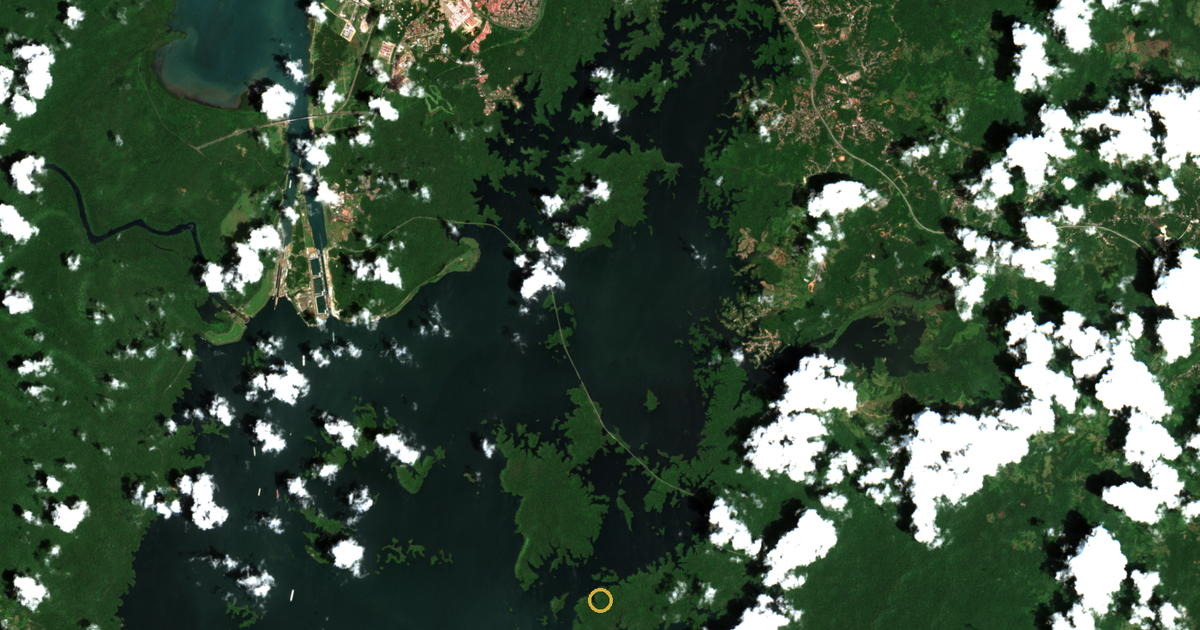
Plant results come from the ClimRisk four-stage Risk Analyst: IBTrACS cyclone history, JRC CEMS-GloFAS river and Deltares coastal flood depths, FLOPROS defences, World Bank carbon-pricing data, NGFS Phase 5 pathways and a 3,000-draw Monte Carlo over 2026–2050 at a 7 percent real discount rate. Asset values are benchmarks from capacity, not book values, and results scale with them. The engine does not model drought losses, business interruption, fuel-price exposure or credit effects. Event figures are as reported by the ACP, Guatemala's market operator and press; several come from secondary reports of official data, and several (regional rainfall, Guatemala's hydro share, spot-market exposure) come from Rio Times reports we could not check against a primary release. Where reports differed (for instance on how far the canal's draft fell in early September), we used the later, more specific source. We could not obtain a cloud-free Sentinel-2 scene of the wet season, so the satellite image is a dry-season baseline.
How ClimRisk Measured This
We combined NOAA, ACP and Guatemalan market data with engine runs on three register plants under seven NGFS scenarios, and a Copernicus Sentinel-2 scene of Gatún Lake. Every number is either cited or a named ClimRisk engine output.
Sources
- NOAA CPC ENSO Diagnostic Discussion, 8 Oct 2026
- NOAA CPC Global Weather Hazards Summary, 15 Oct 2026
- Infobae Guatemala: electricity demand up 8.6% (AMM/MEM data), 24 Sep 2026
- Prensa Libre: more rain lifts Chixoy reservoir, 4 Oct 2026
- Rio Times: Guatemala power emergency, drought cuts hydro output, 23 Sep 2026
- The Weather Network: Panama declares a state of emergency over El Niño, 26 Aug 2026
- gCaptain: Panama Canal to tighten draft limits again, 6 Aug 2026
- gCaptain: Panama Canal adds transit capacity as rainfall brings relief, 28 Sep 2026
- Newsroom Panama: Panama Canal increases daily transits to 33 and draft to 49 feet, 28 Sep 2026
- Panama Canal Authority: higher transits and tonnage amid expected El Niño, 22 Jul 2026
- Kuehne+Nagel / Lloyd's List: Panama Canal ends fiscal year 2024 with 29% plunge in transits
- chemeurope: Allianz Climate Risk Tracker, 2026 heat wave costs Germany, El Niño 2027, 16 Oct 2026
- World Bank Carbon Pricing Dashboard (data release May 2026)
- WRI Aqueduct 4.0
- Copernicus Sentinel-2 L2A via AWS Earth Search
ClimRisk translates physical and transition climate risk into asset-level financial exposure. To run your own assets or portfolio through the engine, write to shri@climrisk.io or book a demo.