Sector Deep Dive · Agriculture
Assessing Physical and Transition Climate Risk in Agriculture: European Olive Oil Cooperatives
Physical risk quantification for one of Europe's most climate-exposed agricultural sectors.
Shrinivash D Kannan · 15 July 2026 · 8 min read
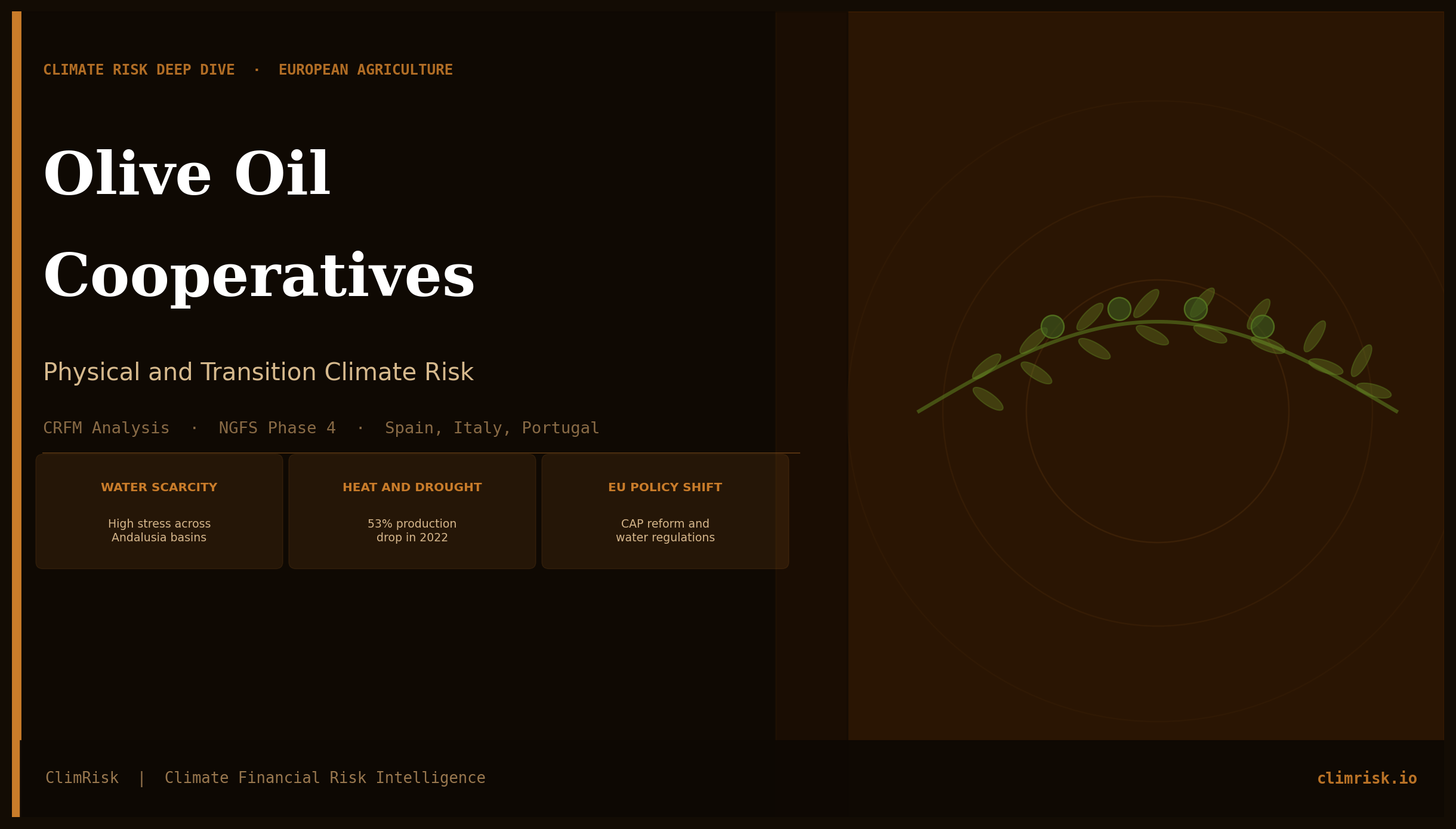
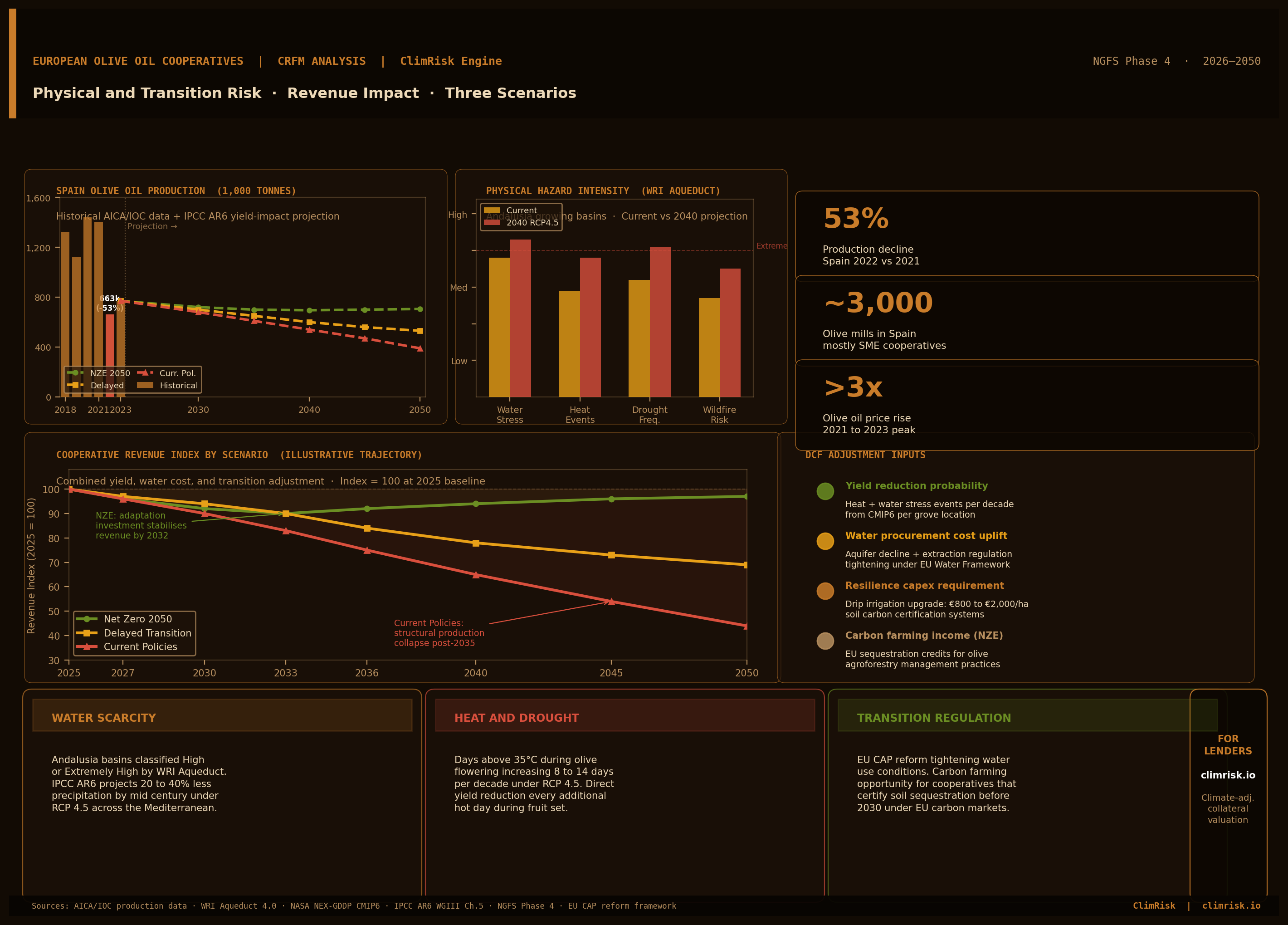
In 2021 Spain produced roughly 1.4 million tonnes of olive oil.
In 2022 it produced 663,000 tonnes.
Same land. Same trees. Same farmers. The difference was a drought that WRI Aqueduct had already flagged as a high probability event for Andalusia years before it arrived.
Wholesale olive oil prices went from around €3 per kilogram in 2021 to over €9 per kilogram by late 2023. Every small cooperative that had hedged its forward sales at the old price absorbed the loss. Every buyer that had locked in supply at the old price celebrated. The farmers paid the difference.
This is not a future risk story. This already happened. And the question every lending bank, every agricultural investor, and every cooperative board should now be asking is what the next 25 years look like under each NGFS scenario.
Why Small Scale Agriculture Is the Most Underserved Climate Risk Category
The climate risk conversation in finance runs almost entirely through large listed companies. TCFD filings from Nestlé, Carlsberg, Unilever. CSRD reports from multinationals with dedicated sustainability teams. The institutions financing those reports have full risk teams.
The 3,000 olive oil mills in Spain do not. Neither do the 800,000 olive farming families across the Mediterranean basin. Neither do the regional agricultural cooperative banks lending to them.
These are businesses with revenues of €1 million to €50 million, land as their primary asset, water as their primary operational input, and climate as the single biggest variable in their revenue line. They have no climate risk models. Most have no scenario analysis at all.
This piece runs the European olive oil sector through a structured CRFM framework covering physical hazard exposure, transition risk under three NGFS scenarios, and what both mean for cooperative revenue and asset value through 2050.
The Physical Risk Picture
Olive cultivation in the Mediterranean is one of the most climate-exposed agricultural systems on the planet. Not because olive trees are fragile — they are not — but because the specific climate conditions that define peak production are directly in the path of what IPCC AR6 projects for the region.
Water stress is the dominant hazard
Andalusia produces approximately 80% of Spanish olive oil. WRI Aqueduct currently classifies the majority of Andalusian agricultural basins as High or Extremely High water stress. These are not projected future conditions. They are the current baseline.
IPCC AR6 Working Group II projects the Mediterranean basin will experience precipitation decline of 20 to 40% by mid century under RCP 4.5. Under RCP 8.5 the range extends to 40 to 60% in the most affected zones. The Guadalquivir basin, which irrigates the densest concentration of olive groves in the world, is in the upper part of that range.
Irrigation accounts for roughly 60 to 70% of water consumption in intensive olive production. As aquifer levels decline and regulatory withdrawal limits tighten under EU water framework directives, the cost and availability of irrigation water is changing structurally. This is not a one-off drought event. It is a permanent shift in the operating environment.
Heat stress during flowering
Olive trees flower in spring, typically May to June across southern Spain. Sustained temperatures above 35 degrees Celsius during the flowering period reduce fruit set significantly. Based on CMIP6 ensemble projections for Andalusia, the number of days above 35 degrees Celsius in May and June increases by 8 to 14 days per decade under RCP 4.5, and by 15 to 22 days per decade under RCP 8.5. Each additional hot day during flowering is a direct yield reduction event.
The 2022 season that cut production by 53% was preceded by an exceptionally hot and dry flowering period. That combination will become more frequent, not less.
Frost and late freeze events
This one surprises people. As average temperatures rise, the pattern of late season cold snaps becomes more erratic. Young olive growth in February and March is vulnerable to frost after premature warm spells trigger early budding. Southern France, Northern Italy, and higher altitude Spanish groves all experienced significant frost damage events in 2021 that cost growers heavily. IPCC projects these events increase in frequency through mid century before declining as overall warming suppresses frost windows after 2040.
Wildfire proximity
This is an asset value risk more than a production risk. The Mediterranean basin saw record wildfire extent in 2021 and 2022. WRI and the European Forest Fire Information System data shows grove destruction events in Portugal, Greece, and Spain accelerating. A cooperative whose groves are in a high fire risk zone faces both direct asset destruction risk and insurance cost escalation that directly compresses operating margins.
Transition Risk Under Three NGFS Scenarios
The transition risk picture for olive oil cooperatives is structurally different from heavy industry. There is no large Scope 1 or Scope 2 carbon cost exposure. An olive grove is not a steel mill or a power plant.
The transition risks here are regulatory, subsidy-related, and market-driven.
Net Zero 2050
Under this scenario the EU Common Agricultural Policy reform accelerates. Water abstraction limits tighten by 2028 and 2033 under EU Water Framework Directive revisions. Carbon farming becomes a real income stream as sequestration credits for agroforestry management enter EU carbon markets. Cooperatives that invest in drip irrigation efficiency, soil carbon programmes, and water recycling infrastructure are rewarded both through lower input costs and through direct credit payments.
The near-term transition cost is real. Upgrading from flood to precision drip irrigation across a medium-sized cooperative costs €800 to €2,000 per hectare in capex. Carbon farming certification requires measurement, reporting, and third-party verification systems that most small cooperatives do not currently have. These are manageable numbers but they require capital access and planning.
Under NZE 2050 the cooperatives that make these investments before 2030 are in a structurally stronger position by 2035. Those that do not face both the physical risk consequences and the regulatory pressure simultaneously.
Delayed Transition
Near-term policy stays loose. Water abstraction limits take longer to tighten. CAP payments continue flowing with fewer sustainability conditions attached. The physical risk however continues accumulating regardless of policy. Mediterranean precipitation does not wait for carbon regulation.
This scenario is the most dangerous one for cooperative balance sheets because it removes the urgency signal that would otherwise drive investment in resilience infrastructure. The cooperatives least likely to adapt are concentrated in this scenario. The climate risk crystallises in the physical column, not the regulatory column, and it does so at the worst possible time as capital access tightens for an industry that has underinvested in resilience.
Current Policies
No meaningful additional carbon pricing. Water regulation stays at current pace. But the physical risk trajectory under this pathway is the harshest. Global temperature rise reaching 2.5 to 3 degrees Celsius by 2100 means Mediterranean precipitation decline in the upper range of IPCC projections. For Andalusia that means structural production capacity reduction that no irrigation investment can fully offset.
Under this scenario a significant portion of current high-intensity olive production in the lowest-elevation, highest-heat-stress zones of Spain and Morocco becomes economically unviable before 2050. The land does not disappear. The economics of running irrigation-intensive olive production on it do.
What Goes Into the DCF for a Cooperative
Running a climate-adjusted DCF for a small olive oil cooperative means modelling four adjustment terms.
The first is yield reduction probability by year based on heat stress and water stress projections for the specific grove locations. The second is water procurement cost escalation as aquifer levels decline and extraction becomes more expensive or more regulated. The third is capex requirement for resilience investment — irrigation upgrades, shade netting, drought-tolerant rootstock transitions. The fourth is the transition income opportunity from carbon farming credits if the cooperative certifies its soil management practices.
The output is a cooperative-level enterprise value and revenue trajectory under each NGFS scenario. The spread between NZE 2050 and Current Policies for a well-located Spanish cooperative running today is not trivial. The difference in terminal asset value by 2045 between a cooperative that invested in resilience before 2030 and one that did not is the number every regional agricultural bank should want to know before it renews a ten-year land-backed loan.
Why This Matters for Lenders and Investors
Agricultural SMEs across Europe are financed primarily by regional cooperative banks, agricultural credit institutions, and EU-backed development finance. The European Investment Bank, Caisse des Dépôts, ICO in Spain, and hundreds of regional Raiffeisen banks hold these loans on balance sheet.
None of them currently have asset-level climate-adjusted valuations for the agricultural land securing those loans. They have historical yield data, land registry values, and qualitative sustainability assessments. They do not have a forward financial model showing what the loan collateral is worth under Net Zero 2050 versus Current Policies in 2035.
The gap matters because agricultural land values in high water-stress Mediterranean zones are already beginning to diverge from historical pricing trends. IPCC-consistent projections would accelerate that divergence materially. A bank holding a portfolio of agricultural loans in Andalusia, Puglia, or the Alentejo without climate-adjusted valuations on the underlying collateral is carrying physical climate risk it has not priced.
What ClimRisk Built for This
The CRI engine runs at the asset level. It takes grove locations, maps each location to WRI Aqueduct water risk data and NASA NEX-GDDP CMIP6 heat projections, runs yield impact modelling under three NGFS scenarios, and produces a full financial output — cooperative revenue trajectory, enterprise value impact, and capex requirement for resilience investment — delivered within 48 hours.
The same engine that runs a multinational food company across 200 assets runs a 400-hectare Spanish cooperative across 12 grove parcels. The methodology is the same. The output is the same format. The price is not the same.
That is the point. Climate financial risk does not scale with company size. The vulnerability of a small cooperative to a water stress event is structurally higher than the vulnerability of a diversified multinational. The analysis should be available at the same standard.
We are currently building out agricultural sector coverage for EU-based lenders and development finance institutions. If you are financing, investing in, or advising European agricultural businesses and want asset-level financial impact analysis, I would like to speak with you.
Production and pricing data in this article references AICA (Agencia de Información y Control Alimentarios) Spain 2022 and 2023 olive oil production statistics, International Olive Council trade data, and FAO commodity price monitoring, all publicly available. Physical hazard projections reference WRI Aqueduct 4.0, NASA NEX-GDDP CMIP6, and IPCC AR6 Working Group II Chapter 5. NGFS Phase 4 carbon price pathways are publicly available from the Network for Greening the Financial System.
Shrinivash D Kannan Founder, ClimRisk Climate financial risk intelligence — built for the numbers era of disclosure.
ClimRisk translates physical and transition climate risk into asset-level financial exposure. To run your own assets or portfolio through the engine, write to shri@climrisk.io or book a demo.