Transition Risk · Building Materials
Holcim After the Split: A Carbon Bill, Not a Weather Bill
With North America spun off and the Philippines being sold, Holcim's climate exposure is concentrated in Europe's carbon market, where free allowances for cement run out in 2034 under current law.
Shrinivash D Kannan · 1 October 2026 · 10 min read
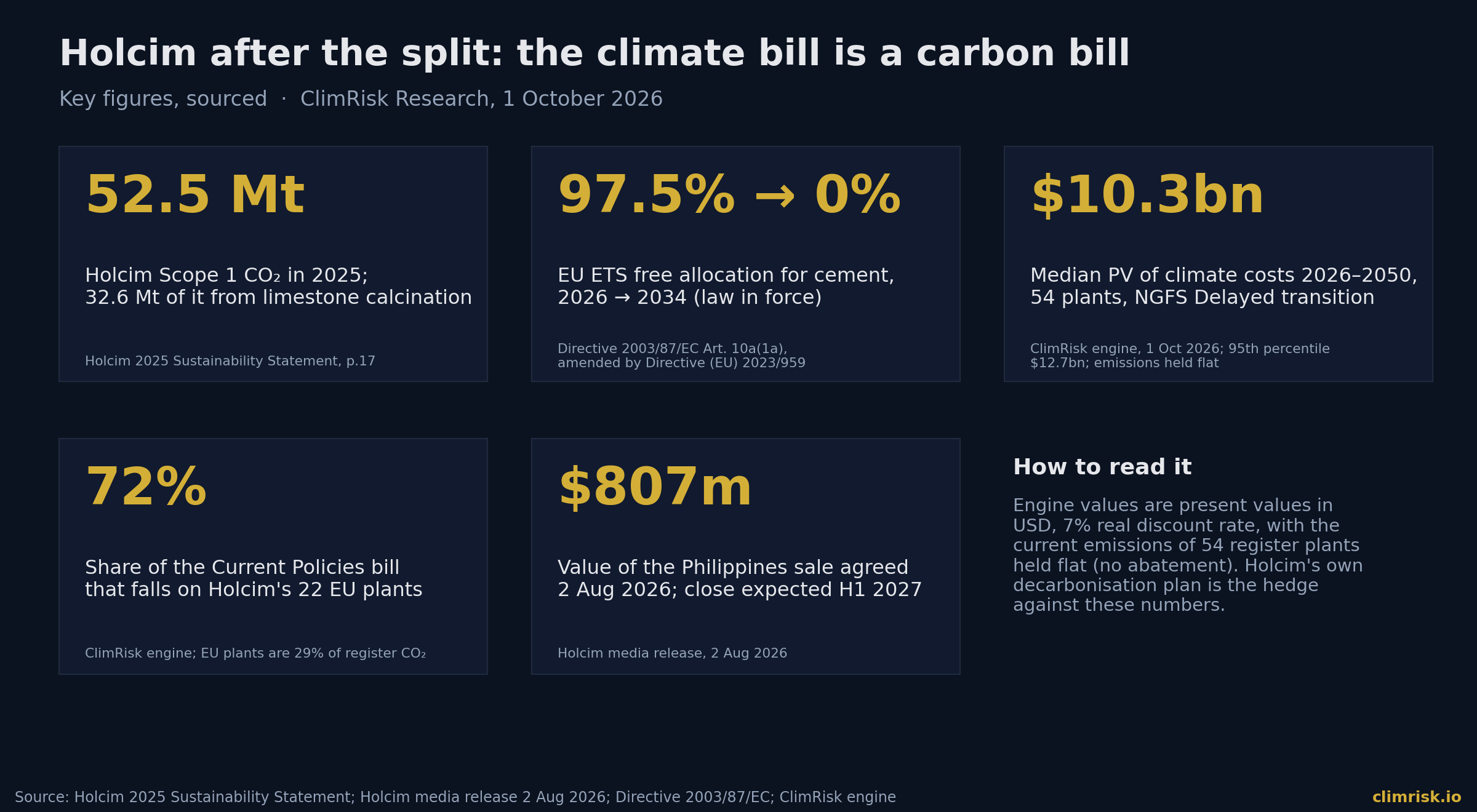
Yesterday, 30 September 2026, was the deadline for every installation in the EU Emissions Trading System to surrender one allowance for each tonne of CO₂ it emitted in 2025. [EPA Ireland 2026] In the week before the deadline, allowances cleared at auction at €85.50 a tonne. [Emba Power 2026]
For a cement company, that date is not paperwork. Cement is one of the few industries where most of the CO₂ does not come from burning fuel. It comes from the rock itself. When limestone is heated to make clinker, it releases CO₂ as a chemical by-product, and no switch to renewable power removes it.
Holcim makes the point in its own numbers. In 2025 the group reported 52.5 million tonnes of Scope 1 emissions. Of that, 32.6 million tonnes came from raw-material calcination and 15.7 million tonnes from fuel burned in cement kilns. [Holcim Sustainability Statement 2025]
This is a different Holcim from the one most climate models were built on. On 23 June 2025 the group spun off its North American business as Amrize. [Amrize / SEC filings 2025] On 2 August 2026 it agreed to sell its Philippines business for USD 807 million. [Holcim 2026] What remains is a group anchored in Europe, Latin America and the Middle East and Africa, with net sales of CHF 15.7 billion in 2025. [Holcim FY2025 results]
We ran that footprint through the ClimRisk engine. The result is clear: for Holcim, climate risk is overwhelmingly a carbon bill, not a weather bill. And the size of that bill depends far more on Brussels than on the weather.
What Changed: A Smaller, More European Holcim
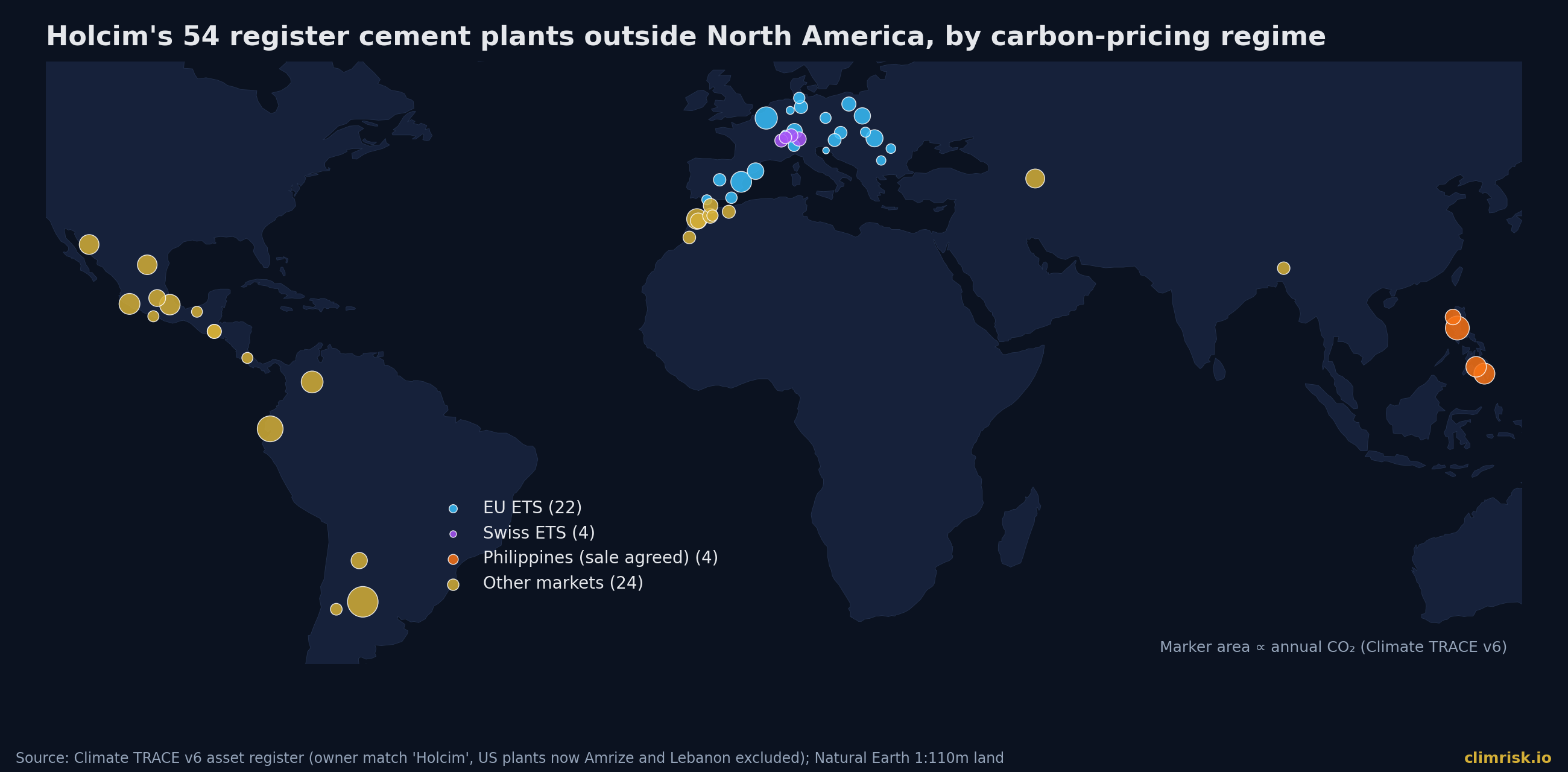
The spin-off matters for anyone using an asset-level model. Many datasets still list US plants under Holcim names. In our register, 29 of the 84 assets matched to Holcim are in the United States, and many are now Amrize plants. We removed them, together with Lebanon, which Holcim sold in the first half of 2026. [Holcim H1 2026 results]
That leaves 54 cement plants in 23 countries. Together they emit 29.0 million tonnes of CO₂ a year according to Climate TRACE, which is roughly 60 percent of the 48.3 million tonnes Holcim reports for cement production. The rest sits mainly in plants registered under other names, so treat our totals as a floor.
The financial picture is strong. Holcim reported recurring EBIT of CHF 2,876 million in 2025, an 18.3 percent margin. [Holcim FY2025 results] In the first half of 2026, recurring EBIT reached CHF 1,438 million and management raised full-year guidance. [Holcim H1 2026 results] Net financial debt stood at CHF 7.3 billion at mid-year, up from CHF 3.8 billion at the end of 2025, in a half-year in which the Xella and Cementos Pacasmayo acquisitions closed. [Holcim H1 2026 results]
None of that is in question. The question is how much of the next 25 years of cash flow is exposed to carbon pricing that has not yet arrived in full.
The Physical Picture: Mostly Quiet, With One Exception
We started with physical hazards. For each plant the engine reads river flood depths from the JRC global flood maps, coastal flood depths from Deltares, the protection standard from FLOPROS, and 45 years of tropical cyclone tracks from IBTrACS.
For 47 of the 54 plants, the expected annual physical loss rounds to zero. Cement plants tend to sit next to their quarries, often on high ground and away from rivers. Holcim's European kilns screen as negligible for river, coastal and cyclone damage.
The exceptions are in the tropics. Three Mexican plants (Caleras, Ixtaczoquitlán and Acapulco) and three Philippine plants register low to moderate cyclone exposure. The Philippines matters because the western North Pacific is where the IPCC has documented a structural shift in storm behaviour.
SOURCE — IPCC AR6 WORKING GROUP I, SUMMARY FOR POLICYMAKERS (2021)
"It is likely that the global proportion of major (Category 3–5) tropical cyclone occurrence has increased over the last four decades, and it is very likely that the latitude where tropical cyclones in the western North Pacific reach their peak intensity has shifted northward."
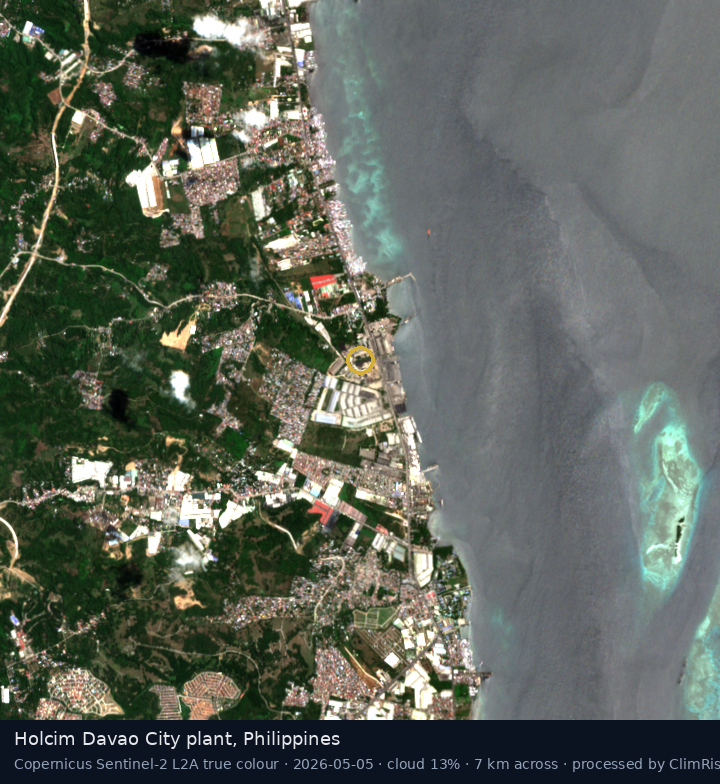
The single plant that stands out is Davao City, on the waterfront of Davao Gulf. The engine flags it as high coastal flood exposure with no recorded protection standard. Here we want to be precise about what we know. In the portfolio run, which uses the register's site elevation, Davao's expected annual coastal loss is 1.4 percent of its benchmark value. A stand-alone run on the 90-metre terrain model puts it near 14 percent, because at that resolution the site pixel floods even in a two-year event. A spread that wide is a reason to survey the site, not a number to book.
What matters for investors is the direction. The plants with the most physical exposure in the portfolio are also the ones Holcim has agreed to sell. Once the Philippines deal closes, expected in the first half of 2027, the remaining group's physical risk profile becomes even quieter.
The Transition Picture: Where the Money Is
Transition risk is a different story. Here the engine combines each plant's emissions, the carbon-pricing instruments in force at its location (from the World Bank Carbon Pricing Dashboard), and the seven NGFS Phase 5 scenarios, run through a Monte Carlo simulation of 1,500 draws from 2026 to 2050.
Two assumptions drive the numbers, and both are deliberately conservative. Emissions are held at today's level unless sector demand falls, so there is no credit for Holcim's decarbonisation plan. And between 20 and 80 percent of the carbon cost is assumed to be passed on to customers, with 50 percent the most likely value.
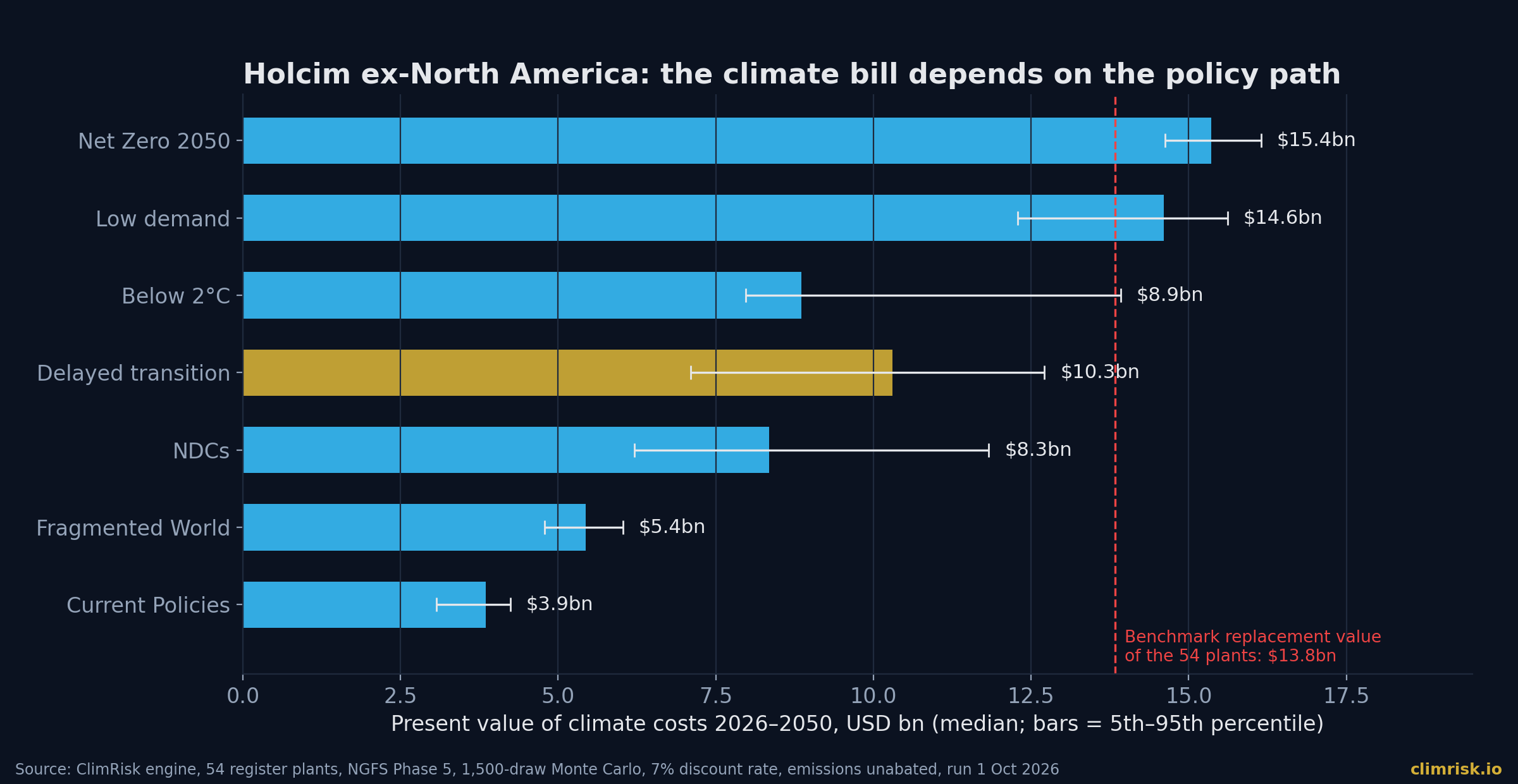
The ranges are wide, and that is the point:
- Current Policies: median USD 3.9 billion in present value, 5th–95th percentile USD 3.1–4.2 billion.
- Delayed Transition: median USD 10.3 billion, range USD 7.1–12.7 billion.
- Net Zero 2050: median USD 15.4 billion.
For scale, the benchmark replacement value of the 54 plants is USD 13.8 billion. Under Net Zero 2050 and Low Demand, the carbon bill on unabated kilns exceeds what the plants are worth. The engine then assumes an owner would close a plant rather than keep paying, which caps each plant's transition loss at its value. In other words, the "do nothing" version of Holcim does not survive a fast transition. That is the scenario the company's capital plan exists to avoid.
Why Europe Carries the Near-Term Bill
The split between regions is the most useful result for a credit analyst.
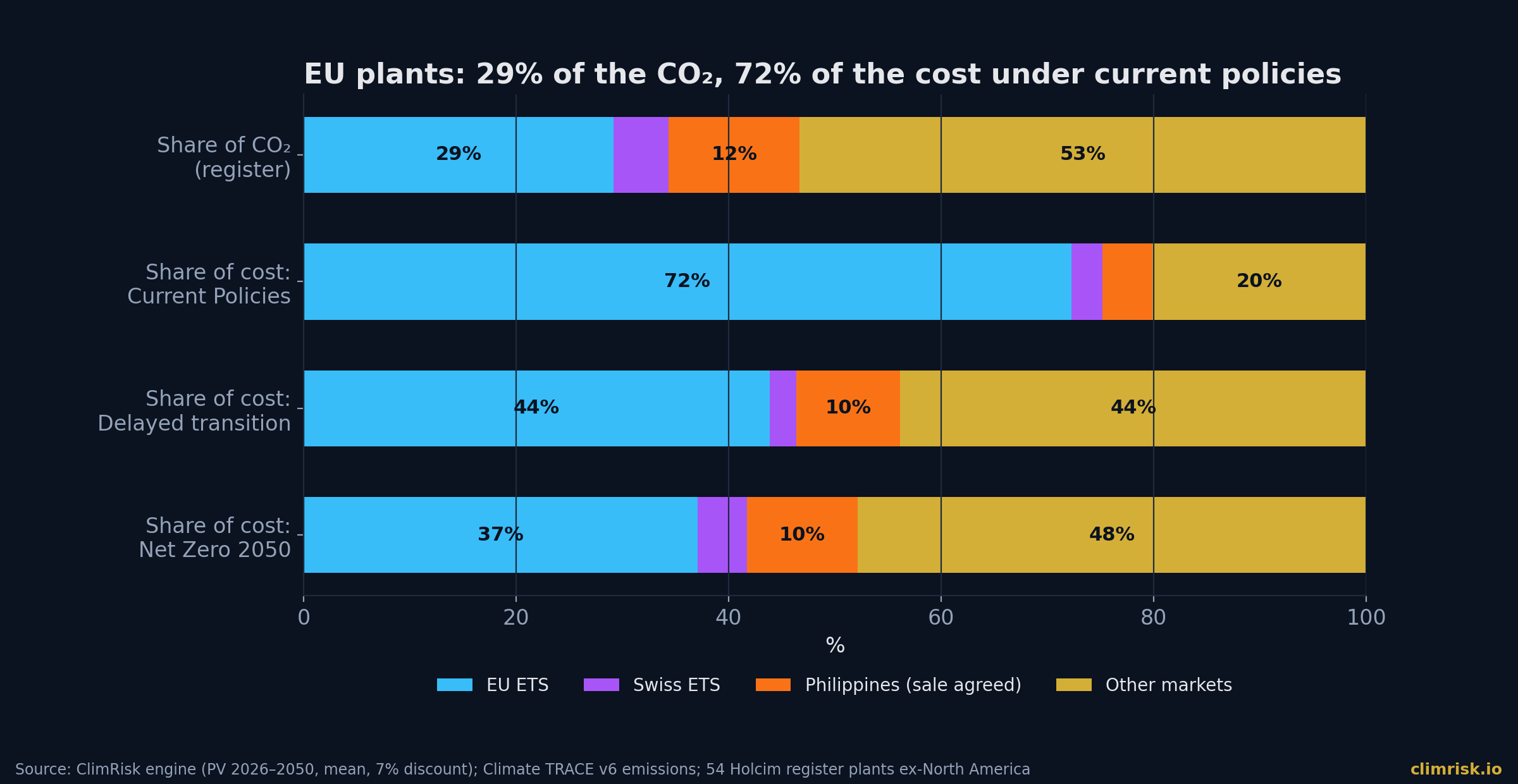
Holcim's 22 EU plants emit 29 percent of the register's CO₂. Under Current Policies they carry 72 percent of the cost. The reason is simple: the EU is where a carbon price of around USD 85 a tonne already applies to cement [World Bank Carbon Pricing Dashboard], and where the law already says what happens next.
Under the EU ETS, cement has received most of its allowances for free. That is changing. As the Carbon Border Adjustment Mechanism entered its definitive phase on 1 January 2026, free allocation for cement began to fall: to 97.5 percent in 2026, 51.5 percent in 2030 and zero in 2034. [Directive 2003/87/EC as amended 2023; CBAM Guide 2026] That schedule is in the engine for every EU plant.
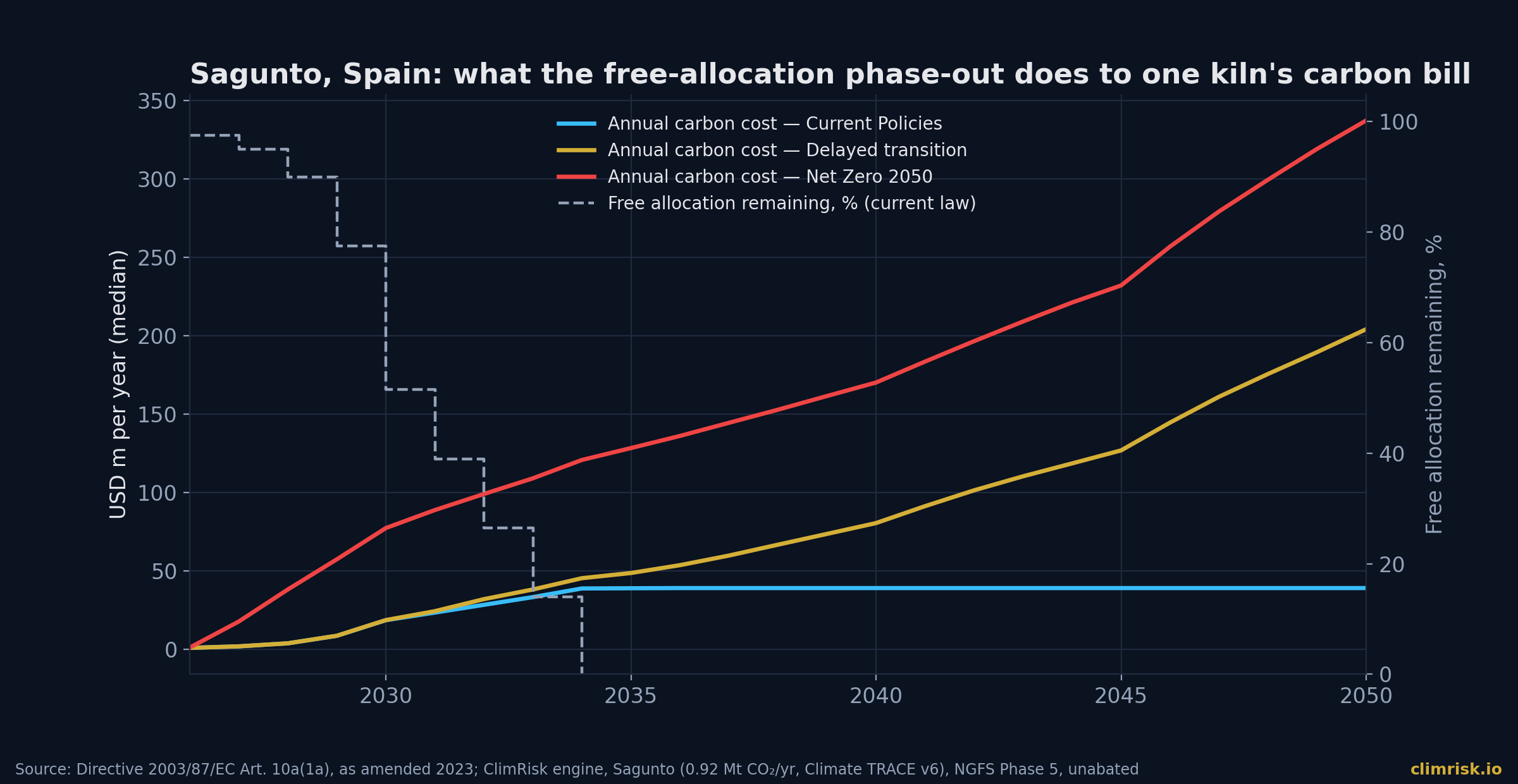
Take Sagunto, near Valencia, which emits about 0.92 million tonnes a year. Its median annual carbon cost after pass-through is around USD 1 million in 2026. Even under Current Policies, with no rise in the carbon price, that climbs to about USD 39 million a year from 2034, purely because free allowances disappear. Under a Delayed Transition it reaches about USD 80 million a year by 2040. The present value of the bill is USD 449 million under a Delayed Transition (95th percentile USD 619 million), against a benchmark plant value of USD 470 million.
Outside Europe, the Current Policies bill is small, because carbon prices in Mexico, Colombia and Argentina are a few dollars a tonne and Morocco, Ecuador and the Philippines have none. Under Delayed Transition and Net Zero 2050, NGFS prices rise everywhere and the "other markets" share climbs to 44 to 48 percent. So the non-EU exposure is real, but it is scenario risk. The EU exposure is largely written into law.
The Policy Wildcard
There is one important caveat on that law. On 17 July 2026 the European Commission proposed revising the ETS. The proposal would slow the phase-out of free allocation for CBAM sectors and push the end date from 2034 to 2038. [Linklaters 2026; CemNet 2026; CBAM Guide 2026] From 2031, free allowances would depend on companies taking part in EU-based decarbonisation investment plans. [CemNet 2026]
This is a proposal, not law. Parliament and Council still have to agree it, with political agreement expected in early 2027. [CemNet 2026] If adopted as drafted, it would lower the near-term carbon cost for every EU cement producer, including Holcim. It would also make the free allowances conditional on investment.
That is why we kept current law in the base run and treat the proposal as a scenario. A lender modelling Holcim's European plants should run both.
Holcim's Hedge: Obourg and the Clinker Ratio
Holcim is not standing still, and the engine's "emissions held flat" assumption is a stress test, not a forecast.
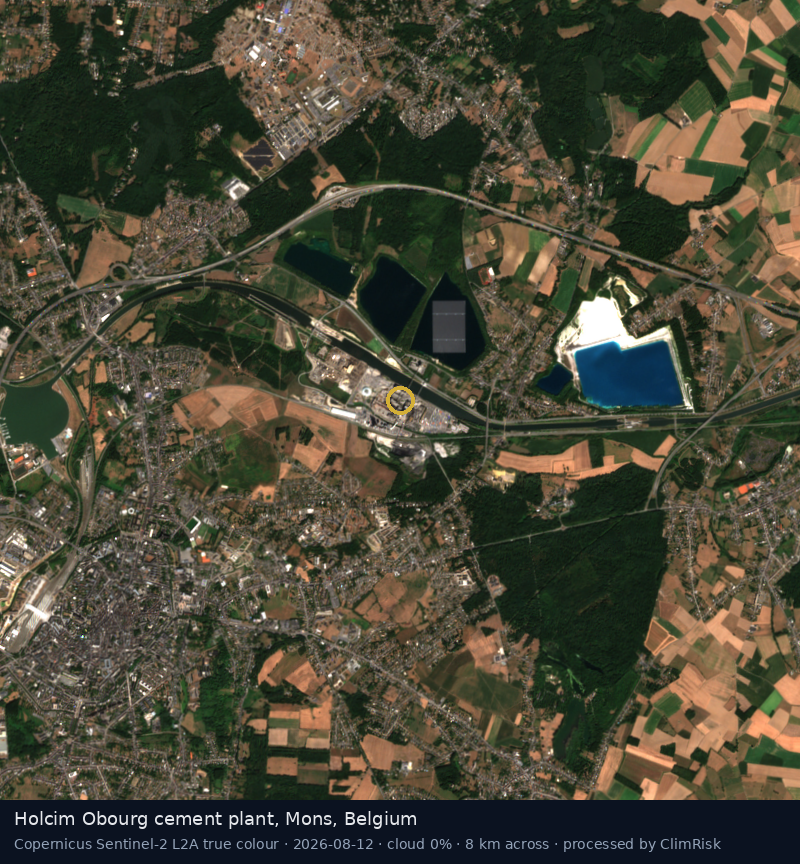
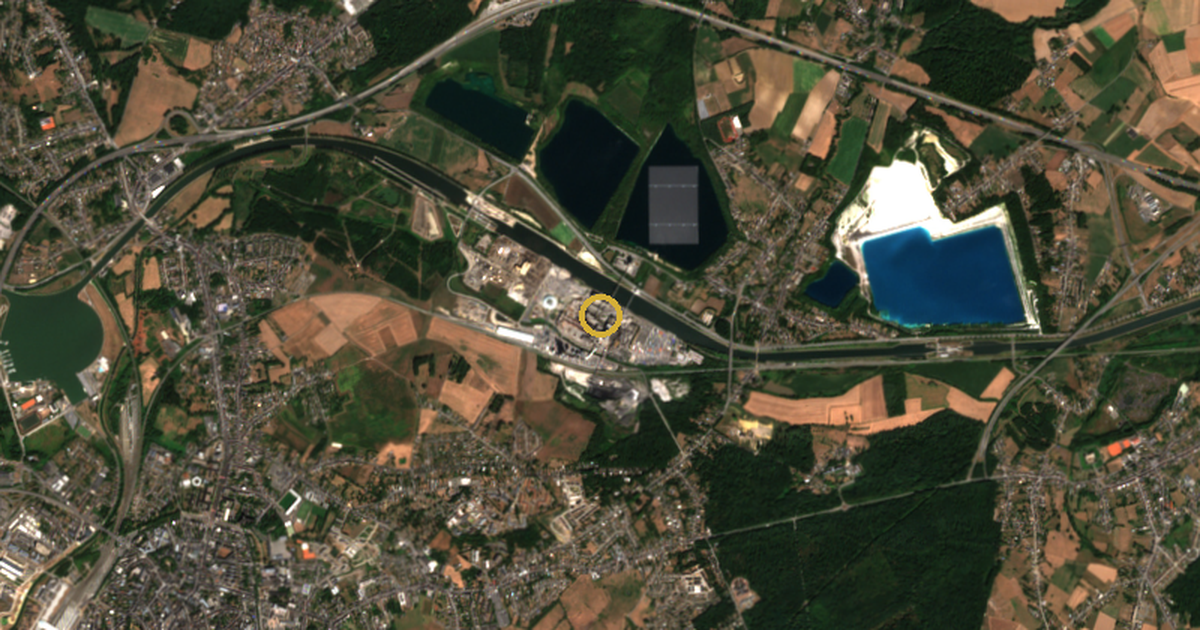
Obourg in Belgium is the clearest example. Under the GO4ZERO project, Holcim is replacing the kiln with an air-oxyfuel kiln, which it says cuts CO₂ per tonne of clinker by nearly 30 percent, and then adding carbon capture. The aim is to store around 1.1 million tonnes of CO₂ a year under the North Sea from 2029. [Holcim GO4ZERO] The first phase is scheduled for completion in the first half of 2027. [Holcim FY2025 results]
Our engine values Obourg's unabated carbon bill under a Delayed Transition at USD 359 million in present value, against a benchmark value of USD 340 million. Seen that way, the GO4ZERO investment of over €500 million [Holcim GO4ZERO] is less a sustainability project than a way of keeping a European kiln economic.
The cheaper lever is product mix. Low-carbon ECOPlanet cement reached 40 percent of cement net sales in the first half of 2026. [Holcim H1 2026 results] Every point of clinker replaced by calcined clay or other materials reduces the calcination emissions that drive the bill.
Holcim's own sustainability statement frames the dependency clearly.
SOURCE — HOLCIM 2025 SUSTAINABILITY STATEMENT
"The competitive deployment of such technologies and products requires a level global playing field for carbon costs."
What Investors and Lenders Should Do
Re-base the model. Any climate analysis of Holcim built before June 2025 includes the North American plants. Rebuild it on the current footprint, and flag the Philippines as held for sale.
Separate law from scenario. The EU free-allocation phase-out is legislated. Carbon prices in Latin America and North Africa are scenario assumptions. Price the first as a base case and the second as sensitivity.
Run the Commission proposal as a scenario. A slower phase-out to 2038 would cut near-term EU carbon costs. Model it alongside current law until Parliament and Council decide.
Track abatement plant by plant. Ask which kilns have a funded capture or kiln-replacement plan, and when it starts. Obourg, with a 2029 target, is a different credit than a plant with no plan.
Verify the coastal flag at Davao. It matters for the buyer and for Holcim's residual stake of about 31 percent, which it will exit over three to five years. [Holcim 2026]
Method and Limitations
Plant results come from the ClimRisk four-stage Risk Analyst run on 1 October 2026. Physical hazards use IBTrACS cyclone tracks, JRC CEMS-GloFAS river flood maps, Deltares coastal flood maps and FLOPROS defences. Carbon prices in force come from the World Bank Carbon Pricing Dashboard. Transition paths are NGFS Phase 5. Present values cover 2026–2050 in USD at a 7 percent real discount rate.
Emissions are held at today's level (no abatement). Cement cost pass-through is drawn between 20 and 80 percent. Asset values are benchmarks (capacity × regional unit capital cost), not book values. The engine caps each plant's transition loss at its value, on the assumption that a plant would close rather than pay more than it is worth. Chronic heat, water stress, business interruption and climate-driven changes in hazard frequency are not included. The register covers about 60 percent of Holcim's reported cement emissions, and ownership is matched by name, so some plants are missing.
How ClimRisk Measured This
We combined Holcim's own filings (2025 results and sustainability statement, H1 2026 results, the Philippines release) with EU law and recent policy reporting, then ran 54 register plants through the ClimRisk engine under seven NGFS scenarios. We added deep-dive runs on Sagunto, Obourg and Davao, and mapped the footprint with Climate TRACE coordinates and Copernicus Sentinel-2 imagery. Every number is either cited or is a named ClimRisk engine output.
Sources
- Holcim full-year 2025 results media release (27 Feb 2026)
- Holcim 2025 Sustainability Statement
- Holcim half-year 2026 results media release (31 Jul 2026)
- Holcim signs agreement to divest its business in the Philippines (2 Aug 2026)
- Holcim GO4ZERO CCUS project, Obourg
- Spin-off of Holcim's North American business (Amrize)
- Amrize Ltd Form 8-K, completion of spin-off (SEC, 2025)
- EU ETS free allocation phase-out 2026–2034 (CBAM Guide, updated 15 Aug 2026)
- European Commission proposes a more pragmatic ETS (CemNet, 23 Jul 2026)
- EU ETS: Commission publishes proposal for the revised Emissions Trading System (Linklaters, Jul 2026)
- Carbon allowances post marginal first weekly decline in six weeks (Emba Power, 28 Sep 2026)
- Stationary operators – EU ETS compliance (EPA Ireland)
- IPCC AR6 WGI Summary for Policymakers (2021)
- World Bank Carbon Pricing Dashboard
- NGFS Climate Scenarios Phase 5
- Climate TRACE asset emissions
ClimRisk translates physical and transition climate risk into asset-level financial exposure. To run your own assets or portfolio through the engine, write to shri@climrisk.io or book a demo.