Sector Deep Dive · Luxury Goods
Assessing Physical and Transition Climate Risk in Luxury Goods: Kering Group
Physical and transition risk across a luxury goods supply chain, quantified asset by asset.
Shrinivash D Kannan · 20 July 2026 · 9 min read
In 2019 and 2020, Australia burned.
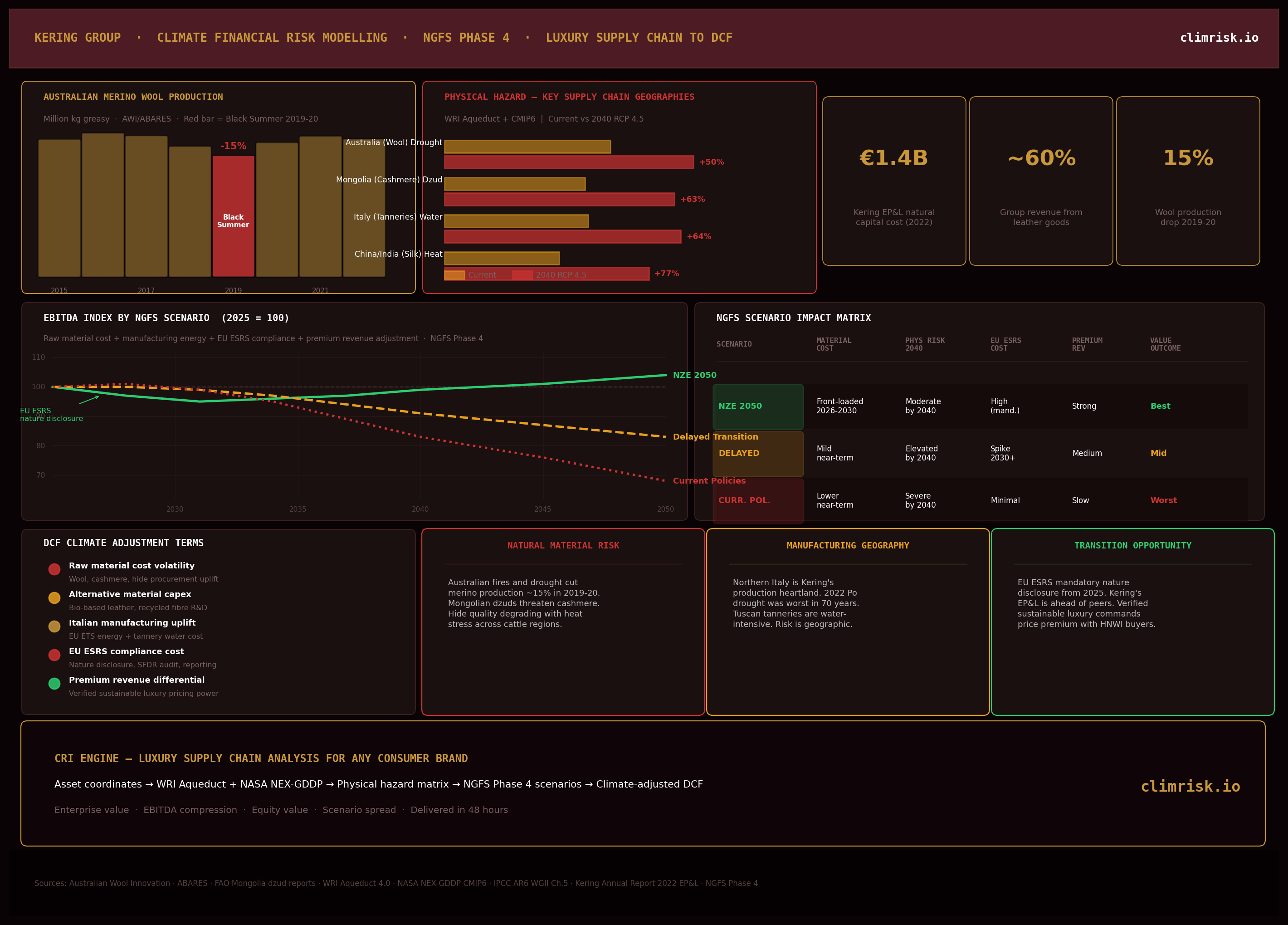
The Black Summer fires scorched over two million hectares across the merino wool belt of New South Wales and Victoria. That same season, the worst drought in decades had already weakened pasture quality and reduced flock sizes. Australian wool production fell by approximately 15% from its pre-drought baseline. Premium merino prices spiked. Every luxury house that puts the words "100% merino" or "Australian wool" on a garment felt it in procurement costs.
Most did not disclose it as a climate risk.
Kering is the world's second-largest luxury conglomerate by revenue. Gucci, Saint Laurent, Bottega Veneta, Balenciaga, Brioni, Boucheron. Revenue of approximately €17.6 billion in FY2023. The business is built on physical materials — leather, cashmere, silk, wool, precious metals — sourced from agricultural and biological systems that are directly exposed to climate stress.
This piece runs Kering through a structured Climate Financial Risk Modelling framework. Physical hazard at the supply chain and manufacturing level, transition risk under three NGFS scenarios, and what both mean for EBITDA and enterprise value through 2050.
Why Kering Is a Particularly Interesting Case
Most climate risk discussion in fashion focuses on fast fashion. Carbon footprint, synthetic fibres, overproduction, textile waste. The policy and media pressure sits there.
Luxury is different. And the climate exposure is different in a way that matters financially.
In fast fashion, the product is largely substitutable. In luxury, the product is the material. The authenticity of physical inputs — that this is real calf leather, real Mongolian cashmere, real Tuscan hand-stitching — is the source of pricing power. A Gucci bag commands a 95% gross margin partly because of what it is made of and where it is made. Climate risk that degrades those inputs or disrupts that geography is not peripheral. It is a threat to the core value creation mechanism of the business.
Kering understands this better than most. They developed the Environmental Profit and Loss account, which valued Kering's natural capital dependency at approximately €1.4 billion in 2022. That number sits outside the income statement. The question for investors is whether it sits inside the DCF.
Physical Risk: Where Kering's Supply Chain Sits
Wool and cashmere supply concentration
Merino wool comes overwhelmingly from Australia and New Zealand. Cashmere comes overwhelmingly from Mongolia and Inner Mongolia, which together account for roughly 60 to 70% of global raw cashmere supply.
Both geographies are under documented and increasing physical climate stress.
Australia's wool belt has experienced three severe drought periods since 2000, each more intense than the last by several metrics. The 2019 to 2020 Black Summer fires destroyed grazing land across key producing regions and came on top of a multi-year drought that had already reduced flock sizes. WRI Aqueduct classifies parts of New South Wales and Victoria as experiencing increased drought probability through 2040 under moderate warming scenarios.
Mongolia faces a structurally different but equally severe risk: dzuds. A dzud is a climate disaster specific to Central Asia — summer drought followed by an abnormally harsh winter that kills livestock that have insufficient fat reserves. The 2010 dzud killed approximately 20% of Mongolia's total livestock, including a significant proportion of cashmere-producing Changthangi and Cashmere goat herds. IPCC AR6 Working Group I projects increased precipitation variability across Central Asia, raising the frequency of the summer drought conditions that precede dzuds.
For Brioni, Gucci, and Saint Laurent — all of which use cashmere in knitwear collections — this is not a distant supply chain abstraction. It is a raw material availability and cost question.
Premium leather quality degradation
Leather is the dominant material in Kering's revenue mix. Gucci, Bottega Veneta, and Saint Laurent generate the majority of their revenue from leather goods. The physical climate exposure on leather operates differently from wool and cashmere — it is not primarily about supply volume. It is about quality.
Cattle heat stress affects hide quality in ways that are well documented in veterinary and tanning industry literature. Sustained temperatures above thermal comfort thresholds cause physiological stress responses that reduce blood flow to the skin, resulting in thinner hides with weaker fibre structure. Heat-related insect and tick pressure causes scarring. The proportion of raw hides that grade as premium quality has declined over the past decade in major cattle-raising regions including Brazil, the US Midwest, and parts of Argentina.
Premium leather goods require premium raw hides. As climate stress reduces the fraction of global hide production that meets luxury grade standards, the procurement cost of top-grade raw material rises relative to commodity grades. This is a margin compression mechanism that operates silently and does not show up in standard industry reports.
Italian manufacturing and tannery water dependency
Kering's manufacturing heartland is Northern Italy. Gucci's leather goods production is centred in Tuscany. Bottega Veneta manufactures in Vicenza. Brioni tailoring is based in Penne, Abruzzo. Italian artisanal production is not a marketing narrative — it is a genuine production system with genuine geographic concentration.
The 2022 Po River drought was the worst in 70 years. Water levels fell to levels that restricted industrial water use across Emilia-Romagna and Lombardy. Tuscan tanneries, which process the raw hides for Kering brands, are water-intensive operations. Dyeing, tanning, and finishing processes require significant volumes of clean water that in a prolonged drought event become constrained and costly.
IPCC AR6 projects continued drying trends across the Mediterranean and Southern Alps region under moderate warming. The European Environment Agency has flagged Northern Italy as one of the highest-risk regions in Europe for drought frequency and intensity increase through 2040.
Silk supply chain heat sensitivity
Gucci's silk accessories — scarves, ties, printed silk garments — are sourced from sericulture operations primarily in China's Sichuan and Jiangsu provinces, and from Indian producers in Karnataka. Silkworms have a narrow thermal tolerance. Optimal cocoon production occurs around 24 to 26 degrees Celsius. Sustained temperatures above 30 degrees cause elevated silkworm mortality and reduced cocoon quality. As temperatures in these key producing provinces increase, the productive window for premium silk production contracts.
Transition Risk: Three NGFS Scenarios
Net Zero 2050
The EU Corporate Sustainability Reporting Directive requires mandatory nature and biodiversity disclosures under ESRS E4, effective for large companies from 2025 reporting periods onwards. For Kering this means mandatory quantified disclosure of their biodiversity and water dependencies — extending the EP&L logic they pioneered into a mandatory regulatory framework with audit requirements and legal liability.
Carbon pricing on European manufacturing energy directly affects Italian production facilities under this pathway. EU ETS carbon prices under Net Zero 2050 reach approximately €130 per tonne by 2030, which increases energy costs for Kering's Italian manufacturing network.
The transition cost has an offsetting revenue dynamic. High-net-worth individual consumer research consistently shows strong willingness to pay premiums for verifiably sustainable luxury products. Brands that can demonstrate genuine supply chain transparency, low environmental impact, and certified material provenance have pricing power upside in a world that decarbonises fast. Kering's investments in alternative materials — including partnerships with bio-based leather developers and recycled cashmere processors — position them ahead of most peers on this.
Delayed Transition
Near-term regulatory cost is lower. EU ESRS phase-in is slower and enforcement is weaker. Carbon pricing is modest until post-2030.
But physical supply chain deterioration accumulates without the urgency signal that accelerated transition creates. Mongolian cashmere supply faces increasing dzud risk. Australian wool production faces continued drought pressure. Italian tanneries operate under increasing water stress without regulatory frameworks that incentivise adaptation investment.
The risk for Kering under Delayed Transition is competitive asymmetry. Brands that adapt supply chains early develop sourcing capabilities and supplier relationships that cannot be replicated quickly. A delayed transition removes the urgency but not the underlying physical risk trajectory, creating a steeper cliff when adaptation becomes necessary.
Current Policies
The harshest physical risk trajectory with no transition support framework. Cashmere, wool, and leather supply chains face compounding climate hazards. Premium material availability contracts. Procurement costs rise. Italian manufacturing faces water and energy cost pressure without EU-level policy frameworks that support adaptation.
Luxury demand is more resilient to cost shocks than mass market goods — but not immune. As material quality degrades and sourcing costs compound, the margin structure of premium leather goods faces sustained pressure that does not self-correct without supply chain restructuring.
Financial Impact: What Goes Into the DCF
A climate-adjusted DCF for Kering captures five adjustment terms per year per scenario.
The first is raw material cost volatility — the probability and magnitude of wool, cashmere, and premium hide price spikes under physical hazard events, translated into procurement cost uplift and gross margin compression. The second is alternative material transition capex — investment in bio-based leather, recycled fibre processing, and supply chain redundancy. The third is Italian manufacturing energy and water cost uplift from EU ETS and drought-driven water scarcity. The fourth is EU ESRS and nature disclosure compliance cost — audit, reporting, and legal infrastructure for mandatory biodiversity and water disclosure. The fifth is the premium revenue adjustment — the pricing power differential for verified sustainable luxury products relative to the market in each scenario.
Kering's enterprise value as of 2023 was approximately €30 billion. The scenario spread on raw material procurement costs alone, between a well-hedged supply chain under NZE and an unhedged position in Current Policies, is not trivial across a 25-year DCF horizon. The EP&L cost of €1.4 billion in 2022 represents approximately 4% of market capitalisation sitting entirely outside consensus financial models.
What the Data Tells Us About Kering's Position Today
Kering is ahead of the luxury sector on environmental accounting. Their EP&L methodology, their investment in bio-based alternatives through Kering Ventures, and their supplier traceability programme are genuine capabilities, not disclosure exercises.
The gap is between accounting and pricing. The EP&L quantifies the natural capital cost. The DCF does not incorporate it. Investors are valuing Kering on revenue and EBITDA trajectories that treat raw material supply chains as stable and Italian manufacturing geography as permanent. Neither assumption holds across 25-year climate scenarios.
The luxury sector proposition is that materials matter, provenance matters, and authenticity matters. Climate change is not an abstraction for a business that depends on what the Australian wool belt produces, what Mongolian goat herders can sustain, and what Tuscan tanneries can process. It is a structural input to every product the business sells.
What This Means for Investors
Kering offers a case where the climate risk is concentrated in the supply chain rather than in direct operations, where the physical risk is already observable in historical procurement cost spikes, and where the company has done more environmental accounting work than almost any peer — yet that work is not in consensus financial models.
The question for an equity investor is not whether Kering survives climate change. It will. The question is what the risk-adjusted return looks like when raw material cost volatility, manufacturing geography risk, and regulatory transition costs are priced into the same DCF as revenue and margin projections.
Introducing ClimRisk
At ClimRisk, we built the Climate Risk Intelligence engine to automate exactly this analysis.
The engine takes a company's asset and supply chain footprint, maps physical hazard exposure using WRI Aqueduct and NASA NEX-GDDP projections, runs transition cost and demand scenarios under three NGFS pathways, and delivers a climate-adjusted enterprise value and EBITDA impact in 48 hours.
The output is a financial model. Not a score, not a rating, not a narrative report with no numbers. A DCF with climate adjustment terms that can be interrogated, stress-tested, and compared across companies in the same sector.
If you manage capital in, lend to, or advise consumer goods or luxury businesses with natural material supply chain exposure and you want the actual financial numbers behind the scenario narratives, I would like to speak with you.
Physical hazard projections reference WRI Aqueduct 4.0, NASA NEX-GDDP CMIP6 ensemble projections, and IPCC AR6 Working Group I Chapter 11 and Working Group II Chapter 5. Australian wool production data from Australian Wool Innovation and ABARES. Mongolian cashmere production and dzud data from FAO Emergency Centre for Transboundary Animal Diseases and World Bank Mongolia Agricultural Risk reports. Italian drought data from European Environment Agency drought assessments and ISPRA 2022 reports. Silk production thermal sensitivity from CSIRO and FAO sericulture research. Kering Environmental Profit and Loss account published in Kering Annual Report 2022. NGFS Phase 4 carbon price pathways publicly available from the Network for Greening the Financial System.
Shrinivash D Kannan Founder, ClimRisk Climate financial risk intelligence — built for the numbers era of disclosure.
ClimRisk translates physical and transition climate risk into asset-level financial exposure. To run your own assets or portfolio through the engine, write to shri@climrisk.io or book a demo.