Sector Deep Dive · Manufacturing
Assessing Physical and Transition Climate Risk in Manufacturing: Michelin Group
A CRFM deep dive into physical and transition exposure across a global manufacturing footprint.
Shrinivash D Kannan · 15 July 2026 · 9 min read
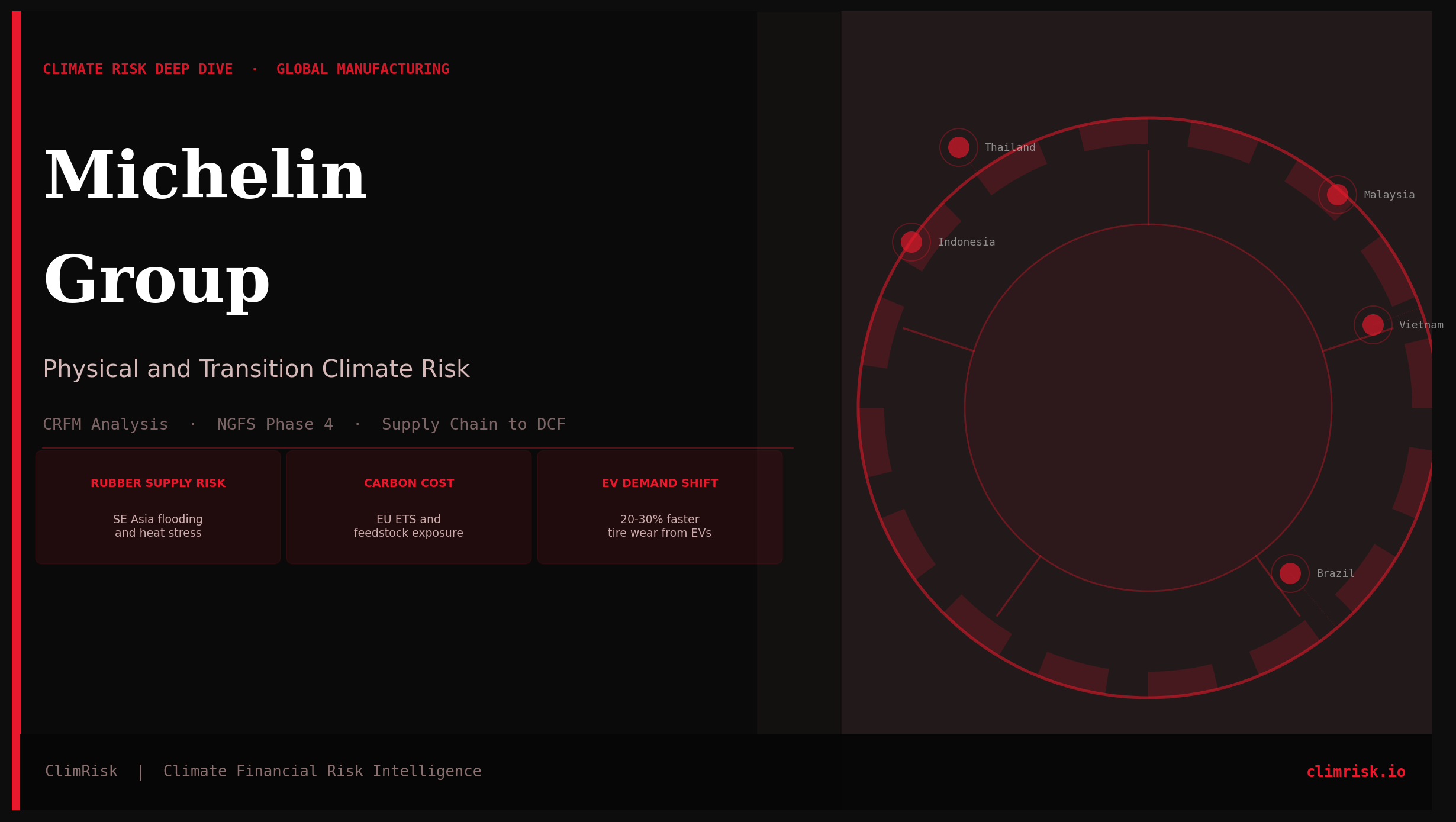
In 2011 floods submerged one third of Thailand.
Thailand produces roughly 35% of the world's natural rubber. In the months that followed, natural rubber prices spiked, supply chains stalled, and every tire manufacturer on the planet felt it in their cost of goods.
Michelin is the world's largest tire manufacturer by revenue. Every tire it produces starts with natural rubber. And the vast majority of that rubber grows in three countries — Thailand, Indonesia, and Malaysia — all of which sit in the part of the world that IPCC AR6 flags as facing increased extreme precipitation, flood frequency, and heat stress through 2050.
That is not a future risk. It is a supply chain reality that already repriced in 2011, and will reprice again.
This piece runs Michelin through a structured Climate Financial Risk Modelling framework — physical risk at the supply chain and asset level, transition risk under three NGFS scenarios, and what both mean for EBITDA and enterprise value through 2050.
Why Michelin Is a Particularly Interesting Case
Most climate risk analysis in manufacturing focuses on direct emissions. Scope 1 and 2. Factory energy use, logistics, direct combustion. These matter for Michelin and the company has science-based targets on them.
But the real climate financial exposure in tire manufacturing is structural, and it sits upstream in the supply chain.
A tire is roughly 41% rubber compounds — split between natural rubber and synthetic rubber derived from petrochemicals. Natural rubber cannot be fully substituted. It has unique thermal and mechanical properties that synthetic materials cannot replicate at scale, particularly for high-performance, truck, and aviation applications. Michelin has committed to 100% sustainable materials in its tires by 2050. That commitment is genuine but the transition away from conventionally sourced natural rubber is a multi-decade programme, not a near-term switch.
So the physical climate risk on natural rubber supply is embedded in Michelin's cost structure for the foreseeable future. And the regions that supply that rubber are among the most physically exposed on the planet.
Physical Risk: Where Michelin's Supply Chain Sits
Southeast Asian rubber supply concentration
Thailand, Indonesia, and Malaysia together account for roughly 70% of global natural rubber production. Michelin sources from all three. These are not marginal positions. They are the backbone of the raw material supply for one of the most capital-intensive manufacturing businesses in Europe.
Running these geographies through WRI Aqueduct and NASA NEX-GDDP CMIP6 projections produces a clear picture.
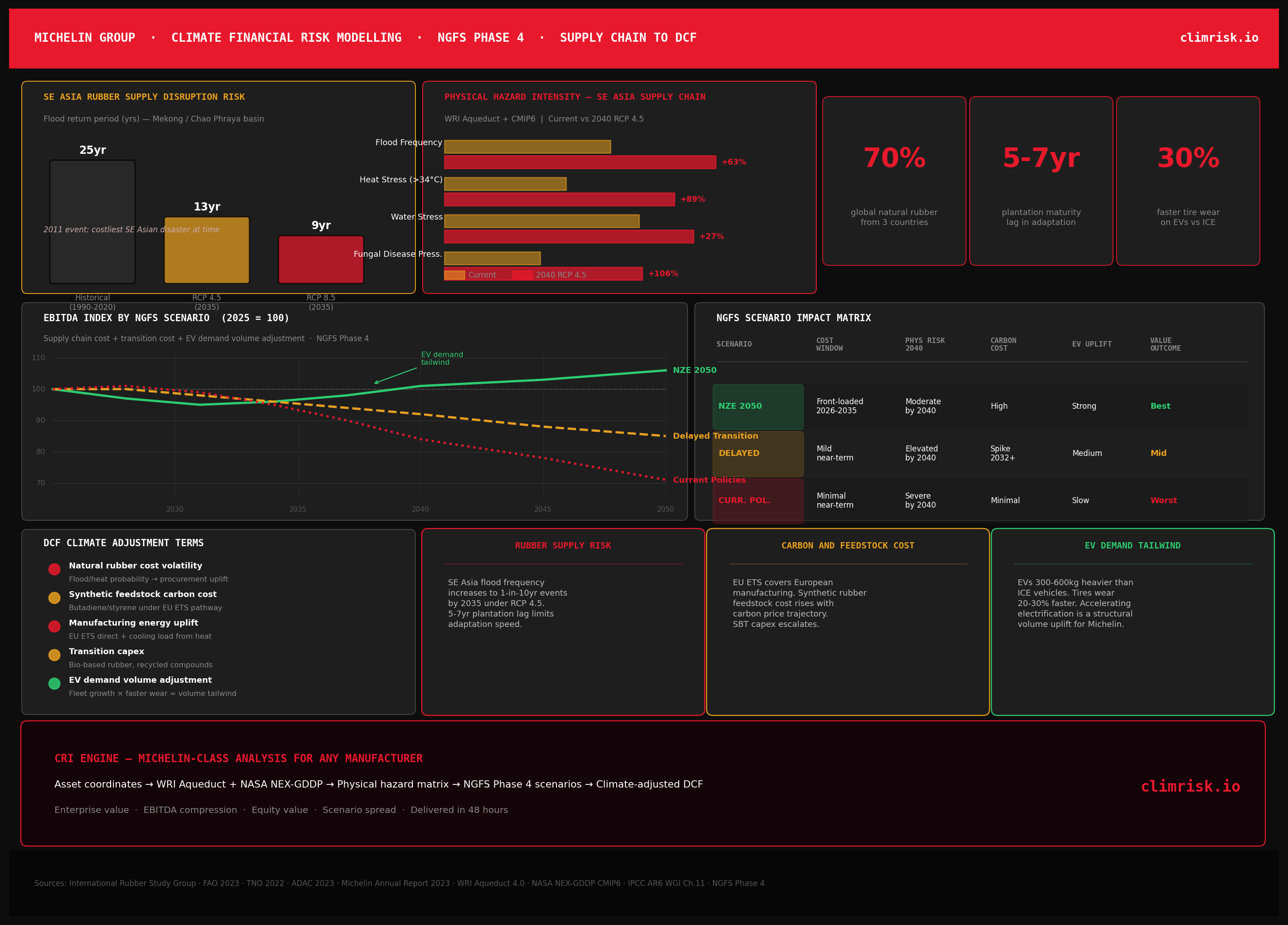
Flooding is the primary acute physical hazard across the Thai and Indonesian rubber belt. The 2011 Thailand flood event was the costliest natural disaster in Southeast Asian history at the time and directly disrupted rubber supply. Based on CMIP6 ensemble projections under RCP 4.5, extreme precipitation events in the Mekong and Chao Phraya river basins increase in frequency and intensity through 2040. The probability of a repeat 2011-scale flood event increases from roughly once per 25 years historically to once per 10 to 15 years under moderate warming by 2035.
Heat stress is the secondary physical hazard and it operates differently. Hevea brasiliensis, the rubber tree, is a tropical crop with specific thermal requirements. Sustained temperatures above 34 to 35 degrees Celsius inhibit latex flow and reduce yield. As ambient temperatures in the rubber belt increase by 1.2 to 1.8 degrees Celsius under RCP 4.5 by mid century, the yield window at lower altitude plantations contracts. Higher altitude replanting is possible but takes 5 to 7 years for a new rubber plantation to reach productive maturity. That is a structural lag in any adaptation response.
Fungal disease pressure increases with climate stress. White root disease and South American Leaf Blight are both sensitive to temperature and humidity shifts. As climate conditions in Southeast Asian rubber zones shift, disease pressure on established plantations is projected to increase. Michelin has its own plantation operations in Brazil — intended partly as a diversification against exactly this risk — but Brazilian plantations remain a small fraction of total supply.
Manufacturing site exposure
Michelin's production footprint spans 29 countries. The European plants in France, Germany, Serbia, Spain, and Poland face increasing heat wave frequency and intensity. None of these represent existential threats but they do represent an operational cost line that rises. Manufacturing facilities require controlled temperature environments for compound mixing and curing. Additional cooling load from rising ambient temperatures translates directly into energy cost uplift that compounds year on year.
The more significant manufacturing exposure sits in Asia and Latin America. Michelin has significant production capacity in Thailand and China. Both markets face the physical hazards described above for supply chain, and additionally face water stress at manufacturing sites. Tire manufacturing is a water-intensive process — cooling, mixing, cleaning. WRI Aqueduct classifies several provincial locations in Thailand where Michelin operates as High water stress.
Transition Risk: Three NGFS Scenarios
Net Zero 2050
The carbon price trajectory under this scenario reaches approximately €130 per tonne CO2 by 2030. For Michelin this affects two things directly.
First, European manufacturing. Michelin's French, German, and Spanish facilities operate under or adjacent to EU ETS carbon pricing. Energy-intensive manufacturing processes — particularly mixing, vulcanisation, and high-temperature compound processing — carry a direct carbon cost exposure that escalates with the price path.
Second, synthetic rubber feedstock. Synthetic rubber is derived from petrochemical feedstocks, principally butadiene and styrene. As carbon pricing escalates and energy transition proceeds, the price of these petrochemical inputs is affected both directly through carbon costs on upstream production and indirectly through energy price volatility. Michelin's target to shift toward bio-based and recycled rubber compounds is a direct strategic response to this exposure, but the transition carries material capex requirements.
The positive signal under Net Zero 2050 for Michelin is the EV transition. Electric vehicles are heavier than equivalent internal combustion engine vehicles — typically by 300 to 600 kilograms due to battery pack weight. Heavier vehicles exert greater torque at launch and greater braking forces. Independent studies and OEM data both show EV tires wearing 20 to 30% faster than equivalent ICE tires. For a tire manufacturer, faster wear rates in a growing EV fleet is a structural demand tailwind. Michelin has invested significantly in EV-specific tire compounds and rim diameters to capture this.
Under Net Zero 2050, the transition to EVs accelerates. Michelin's volume exposure is net positive but the margin structure changes as premium EV-specific products increase in share and standard replacement market dynamics shift.
Delayed Transition
Lower near-term carbon prices reduce the urgency of synthetic rubber feedstock transition. But the physical risk trajectory worsens relative to NZE because delayed policy means more committed warming by mid-century. The supply chain physical risks described above — Southeast Asian flooding, heat stress on rubber yields, water stress at manufacturing sites — all intensify under this pathway.
EV adoption is also slower under Delayed Transition, which means the demand tailwind from EV tire wear takes longer to materialise. The net effect for Michelin is lower near-term cost pressure from carbon pricing, offset by higher physical risk accumulation and slower capture of EV demand growth.
Current Policies
No material additional carbon pricing. Physical risk trajectory is the harshest. Global warming of 2.5 to 3 degrees Celsius by 2100 under this pathway means extreme precipitation events in Southeast Asia in the upper range of IPCC projections. Rubber supply disruption becomes more frequent and more severe. Water stress at Asian manufacturing sites deteriorates through the 2030s. Heat stress on European manufacturing intensifies.
Paradoxically, EV adoption is slowest under Current Policies — which means the demand tailwind from EV tire wear is slowest to develop. Michelin ends up with maximum physical risk and minimum benefit from the structural demand shift that electrification creates.
Financial Impact: What Goes Into the DCF
A climate-adjusted DCF for Michelin captures five adjustment terms per year per scenario.
The first is natural rubber cost volatility — specifically the probability and magnitude of supply disruption events from Southeast Asian flooding and heat stress, translated into procurement cost uplift and margin compression. The second is synthetic rubber feedstock cost under carbon price escalation. The third is manufacturing energy cost uplift from both EU ETS and heat-driven cooling load increases at plant level. The fourth is capex requirement for material transition — bio-based feedstock development, plantation diversification, recycled rubber processing. The fifth is the demand volume adjustment from EV fleet growth and associated tire wear rate uplift.
Under Net Zero 2050, the EBITDA impact is front-loaded in the cost terms (2026 to 2033) and then partially offset by EV demand volume growth and lower carbon cost as the energy transition matures in European manufacturing. Under Current Policies, cost uplift is modest near-term but physical risk in the supply chain accumulates into a structural cost and reliability problem by 2035 to 2040.
Michelin's enterprise value as of 2023 was approximately €20 billion. The scenario spread on the supply chain cost trajectory alone — between a well-hedged natural rubber position in NZE and an unhedged position in Current Policies — is not trivial across a 25-year DCF horizon.
What the Data Tells Us About Michelin's Position Today
Michelin is better positioned than most tire manufacturers on transition risk. Their 2050 sustainable materials target, active investment in bio-based rubber, and diversification of plantation geography in Brazil are genuine strategic moves, not disclosure exercises.
The physical supply chain risk is the more complex exposure. The geographic concentration of natural rubber in Southeast Asia cannot be diversified quickly. New plantations take 5 to 7 years to mature. Alternative crops do not replicate natural rubber's material properties at scale. This is a structural supply chain constraint that makes Michelin's raw material cost line more sensitive to Southeast Asian climate events than the company's overall diversification would suggest.
The EV demand story is the most underappreciated financial upside in a climate scenario for Michelin. In a world that decarbonises fast, Michelin's end market grows structurally because EV tires wear faster. That is a climate transition that works in their favour on the demand side, even as it increases cost pressure on manufacturing and feedstocks.
What This Means for Investors
Michelin is a business with deep exposure to one of the most climate-concentrated agricultural supply chains in the world, strong but incomplete diversification away from it, and a product that becomes more frequently purchased as the world electrifies.
A standard equity model without climate adjustment is missing all three of those dynamics. The supply chain cost volatility under physical scenarios, the feedstock and manufacturing cost under carbon price scenarios, and the demand volume uplift under EV penetration scenarios all affect the free cash flow trajectory materially through 2040.
The question is not whether Michelin survives climate change. It will. The question is what the risk-adjusted return looks like when those three factors are priced into the same DCF rather than treated as qualitative footnotes in a sustainability report.
Introducing ClimRisk
At ClimRisk, we built the Climate Risk Intelligence engine to automate exactly this analysis.
The engine takes a company's asset and supply chain footprint, maps physical hazard exposure using WRI Aqueduct and NASA NEX-GDDP projections, runs transition cost and demand scenarios under three NGFS pathways, and delivers a climate-adjusted enterprise value and EBITDA impact in 48 hours.
The output is a financial model. Not a score, not a rating, not a narrative report with no numbers. A DCF with climate adjustment terms that can be interrogated, stress-tested, and compared across companies in the same sector.
If you manage capital in, lend to, or advise manufacturing businesses with commodity supply chain exposure and you want the actual financial numbers behind the scenario narratives, I would like to speak with you.
Physical hazard projections reference WRI Aqueduct 4.0, NASA NEX-GDDP CMIP6 ensemble projections, and IPCC AR6 Working Group I Chapter 11 and Working Group II Chapter 4. Natural rubber production data from International Rubber Study Group and FAO 2023 commodity statistics. EV tire wear data from published OEM and independent studies including TNO 2022 and ADAC 2023 findings. Michelin financial data from Michelin Group Annual and Sustainability Report 2023, publicly available. NGFS Phase 4 carbon price pathways are publicly available from the Network for Greening the Financial System.
Shrinivash D Kannan Founder, ClimRisk Climate financial risk intelligence — built for the numbers era of disclosure.
ClimRisk translates physical and transition climate risk into asset-level financial exposure. To run your own assets or portfolio through the engine, write to shri@climrisk.io or book a demo.