Physical Risk · India
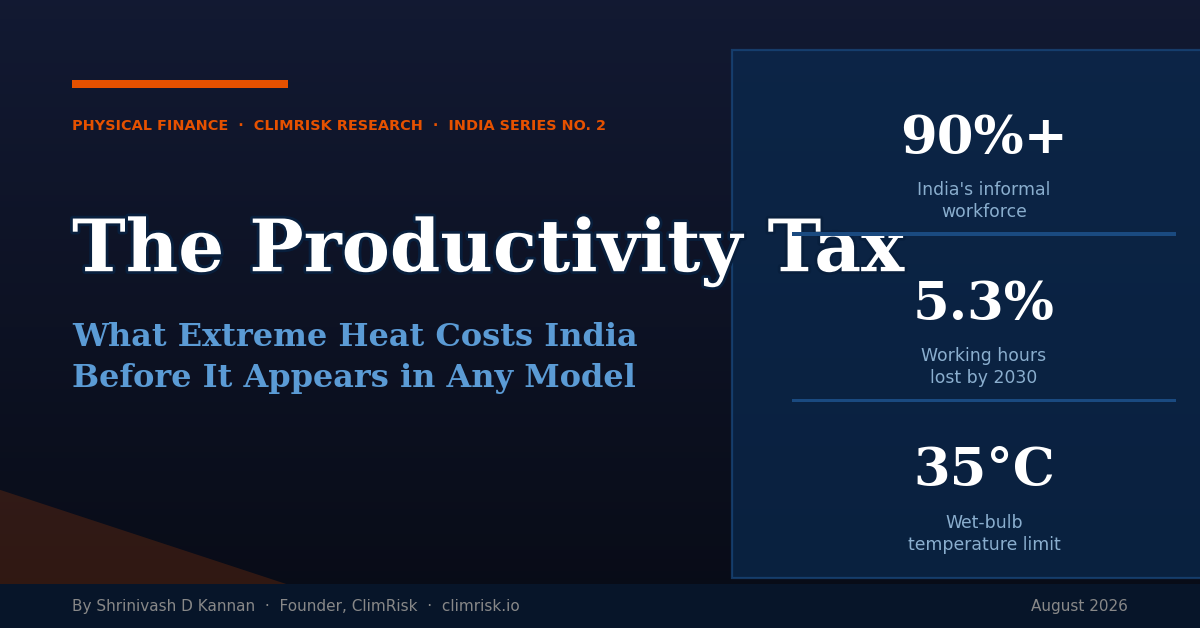
The Productivity Tax
In May 2024, temperatures crossed 45°C simultaneously across Rajasthan, Uttar Pradesh, and Haryana. The labor-productivity cost of that heatwave, modelled.
Shrinivash D Kannan · 21 August 2026 · 10 min read · Also on Substack
On 29 May 2024, the India Meteorological Department recorded temperatures above 45°C across large parts of Rajasthan, Uttar Pradesh, and Haryana simultaneously. [IMD Heat Watch 2024] Heat-related deaths were reported in Delhi, Odisha, and Bihar. Schools were shut. Outdoor construction work ceased before 10am. The NDMA issued advisories across eleven states. [NDMA 2024]
None of this appeared in any quarterly earnings model for an Indian FMCG company, real estate developer, or agricultural lender. The loss was invisible — not because it was small, but because the analytical frameworks used by most financial institutions do not have a systematic method for converting atmospheric temperature into financial output.
This article builds that method. It traces the physical mechanism by which extreme heat suppresses labour output, maps the six financial transmission pathways along which that suppression travels, and uses ILO and NGFS Phase 4 data to show what the loss looks like under three warming scenarios through 2050.
The Physical Mechanism: Why Heat Kills Productivity Before It Kills Workers
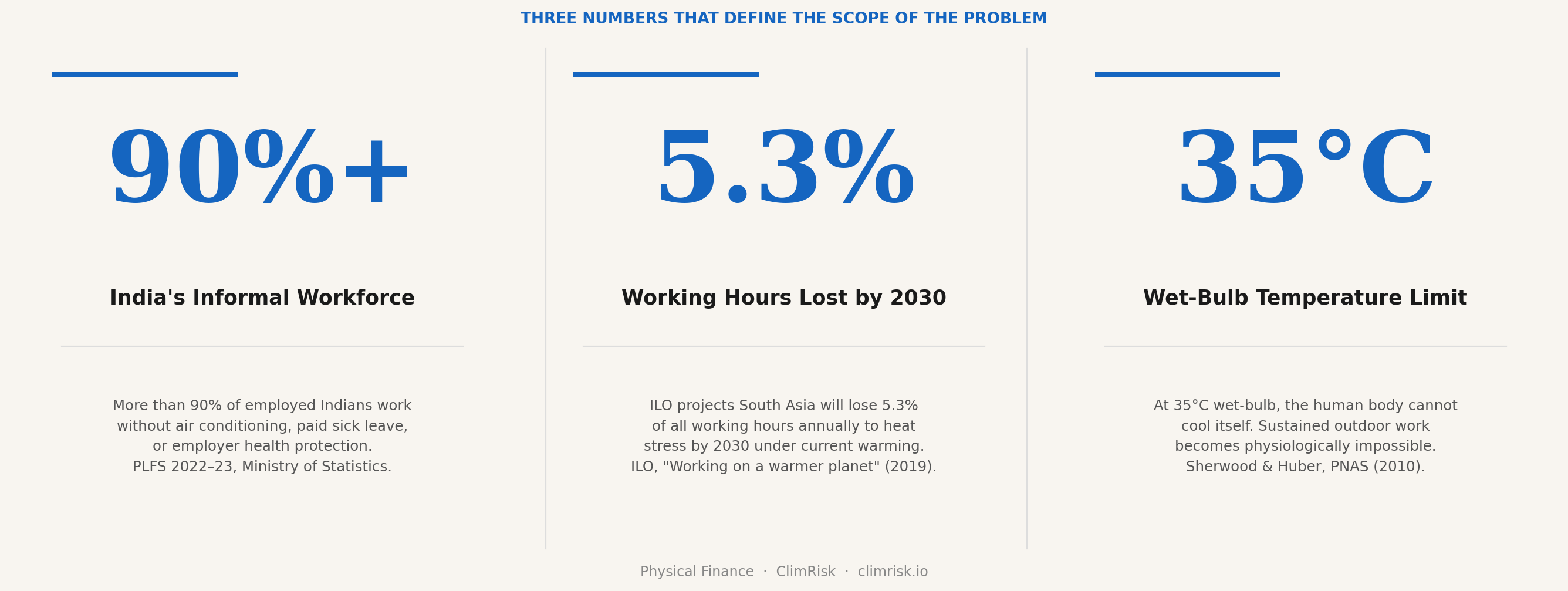
The human body maintains a core temperature of approximately 37°C. When ambient temperature and humidity rise, the body diverts blood flow from muscles to the skin surface. [IPCC AR6 WGII Ch.16] Physical work capacity falls. Reaction time slows. At a wet-bulb globe temperature (WBGT) above 28°C, outdoor workers at moderate intensity lose an estimated 50 percent of their sustainable work capacity. [ILO 2019: WBGT >28°C = 50% capacity loss at moderate work rate]
Wet-bulb temperature accounts for humidity — it is the lowest temperature a surface can reach through evaporative cooling. At 35°C wet-bulb, the human body cannot cool itself even in full shade with unlimited hydration. [Sherwood & Huber, PNAS 2010] No amount of rest prevents core temperature from rising toward dangerous levels. Work must stop.
SOURCE — IPCC AR6 WORKING GROUP II, CHAPTER 16 (KEY RISKS)
"Heat stress is among the most broadly impactful physical climate hazards for human health and labour productivity." Labour productivity losses from heat stress are projected to increase non-linearly with warming. At 1.5°C, global losses reach approximately 2.2 percent of working hours. At 2.0°C, they reach 3.8 percent. The losses are geographically concentrated in tropical regions — agriculture, construction, utilities, and informal manufacturing.
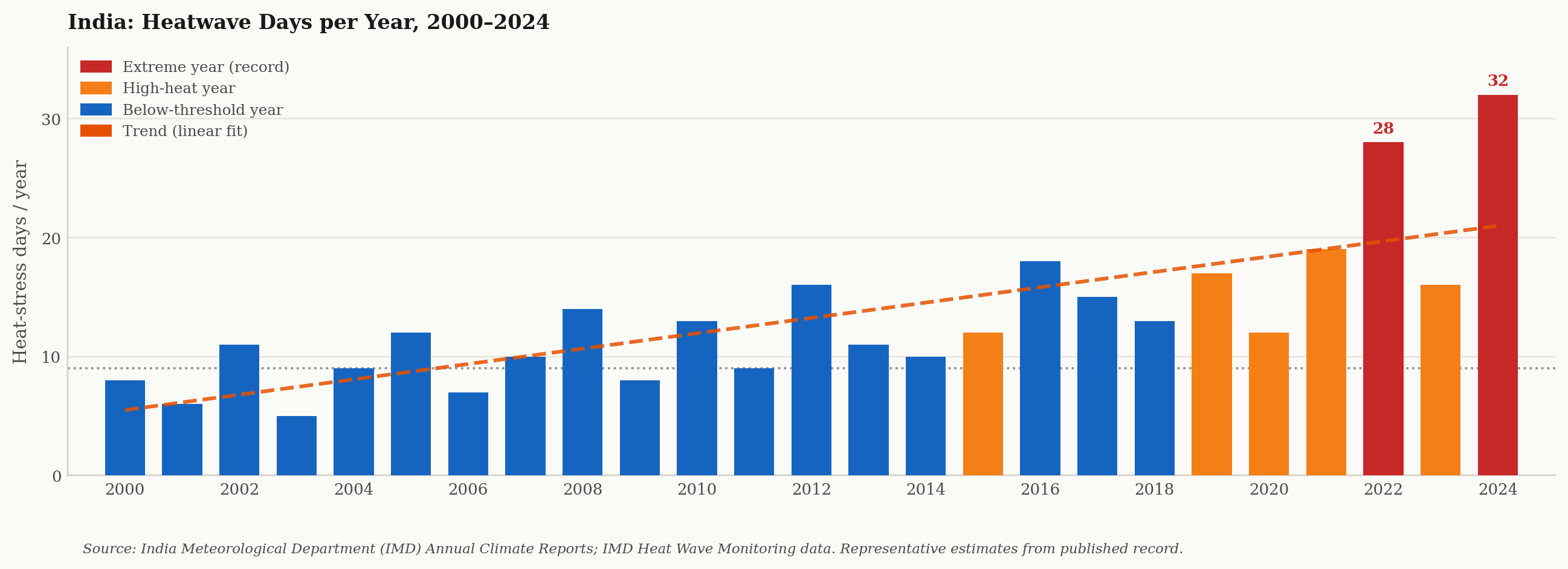
SOURCE — IMD ANNUAL CLIMATE SUMMARY AND HEAT WAVE REPORTS
India's heatwave footprint is expanding in both intensity and geographic reach. The northwest, central, and eastern India regions have experienced a statistically significant increase in heatwave frequency and duration since 1950. The 2022 northwest India heatwave — the earliest on record, peaking in late March — demonstrated that heat stress now arrives before the traditional May-June season that agricultural and construction calendars assume.
Who Bears the Cost: India's Informal Workforce
India's Periodic Labour Force Survey for 2022-23 records that more than 90 percent of India's employed workforce is in informal employment. [PLFS 2022-23] This means: no employer-provided health insurance, no air-conditioned workspace, no paid sick leave. The productivity loss that heat imposes on this population does not appear on any corporate balance sheet. It appears — much later — in agricultural credit NPA ratios, rural consumer demand figures, and informal sector output indices. [RBI FSR 2023]
Agriculture employs an estimated 600 million people across rural India. Kharif cultivation peaks in June through August, exactly the window of highest heat-humidity combination in the Indo-Gangetic Plain. Construction employs approximately 60 to 65 million workers. [ILO 2019: Construction sector loses 5.6% of working hours at 1.5°C warming] Both sectors are dominated by daily-wage labour — workers paid only when they work, who cannot afford to stop.
"The worker who stops when it is 47°C does not file a productivity report. The loss accumulates invisibly — in informal incomes, in food output, in rural demand — until it reaches a balance sheet many steps removed from the original temperature."
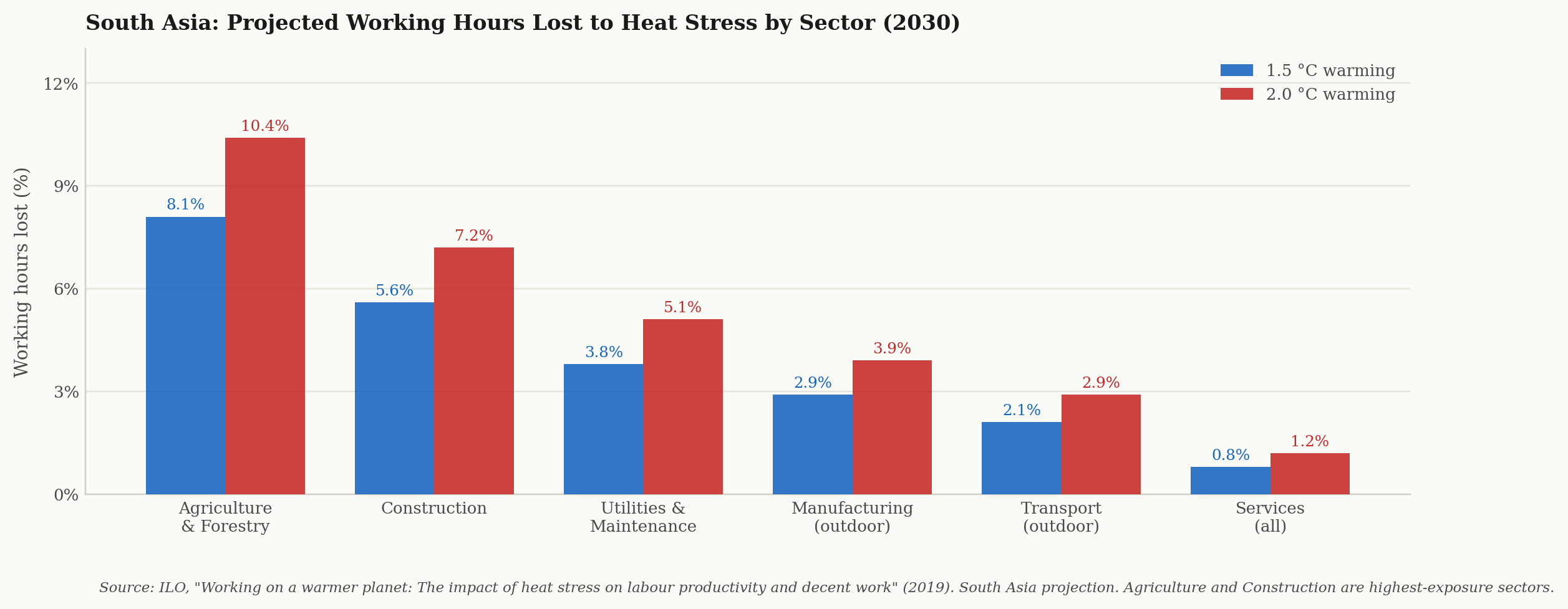
SOURCE — ILO, "WORKING ON A WARMER PLANET: THE IMPACT OF HEAT STRESS ON LABOUR PRODUCTIVITY AND DECENT WORK" (2019)
South Asia is the most exposed region in the world to heat-related working hour losses. By 2030, South Asia is projected to lose approximately 5.3 percent of total working hours annually to heat stress — the highest regional exposure globally. India accounts for the largest share. Agriculture loses an estimated 8.1 percent of working hours at 1.5°C warming and 10.4 percent at 2.0°C.
Six Financial Transmission Pathways
Heat stress does not stop at the individual worker. It moves through the economy along six pathways that are distinct in their financial character but simultaneous in their occurrence.
1. Agricultural Output Compression [FAO · IMD] Kharif crops cultivated at heat-humidity conditions above WBGT thresholds produce lower yields regardless of rainfall adequacy. High night-time temperatures during grain-filling stages permanently suppress output per hectare. This moves from atmospheric temperature into FCI procurement volumes, MSP pressure, and the food inflation figure the RBI must address in its monetary framework.
2. Agricultural Credit NPA Pressure [RBI FSR] Informal daily-wage farm labour that loses income during peak heat periods cannot service agricultural input loans. Scheduled commercial bank NPA ratios in the agriculture segment have documented sensitivity to temperature anomaly years. The failure to embed heat stress into credit underwriting means NPA risk is systematically underpriced at origination.
3. Construction Sector Output and Developer Credit [NHB · CRISIL] Construction activity halts during peak heat periods. The 2024 NDMA heat action advisories explicitly cited construction worker safety as the trigger for work stoppages in Delhi NCR, Rajasthan, and UP. Project timelines extend. Real estate developer cash flows face additional compression from heat-forced delays that do not appear in project finance models at origination.
4. FMCG Rural Revenue and Earnings Impact [Company Filings · CMIE] Rural India contributes 35 to 40 percent of FMCG company revenues. The informal rural workforce loses earned income on heat-stop days — and that income reduction directly reduces consumption of packaged food, personal care, and household products within the same quarter. Companies including HUL have cited rural volume growth as the single most variable input in quarterly earnings commentary.
5. Energy System Stress [CEA · MoP India] Extreme heat drives a simultaneous cooling demand spike and a supply-side constraint: thermal power plant efficiency falls as ambient temperature rises; water availability for cooling towers reduces. India's Ministry of Power documented grid stress events during both the 2022 and 2024 heatwaves. Discoms with already-stressed balance sheets face higher short-term power purchase costs.
6. Sovereign Fiscal Exposure and Long-Term Human Capital Discount [World Bank · IMF] The Government of India bears direct heat costs through MGNREGS wage disbursements, NDMA heat action plan funding, and public health system pressure. The World Bank has documented that repeated heat exposure during childhood produces measurable long-term cognitive and physical productivity deficits — a human capital depreciation that suppresses sovereign GDP potential over decade-scale time horizons.
SOURCE — RESERVE BANK OF INDIA, FINANCIAL STABILITY REPORT (JUNE 2023)
India's financial system has not yet systematically embedded heat stress into credit risk frameworks. The RBI's climate risk guidance documents identify physical risk — including extreme heat events — as a material consideration for bank stress testing. However, heat stress as a distinct, quantifiable driver of agricultural NPA formation, construction finance delinquency, and informal sector income collapse is not yet reflected in the standardised credit risk models used by most scheduled commercial banks.
What Climate Science Says About India's Heat Trajectory Through 2050
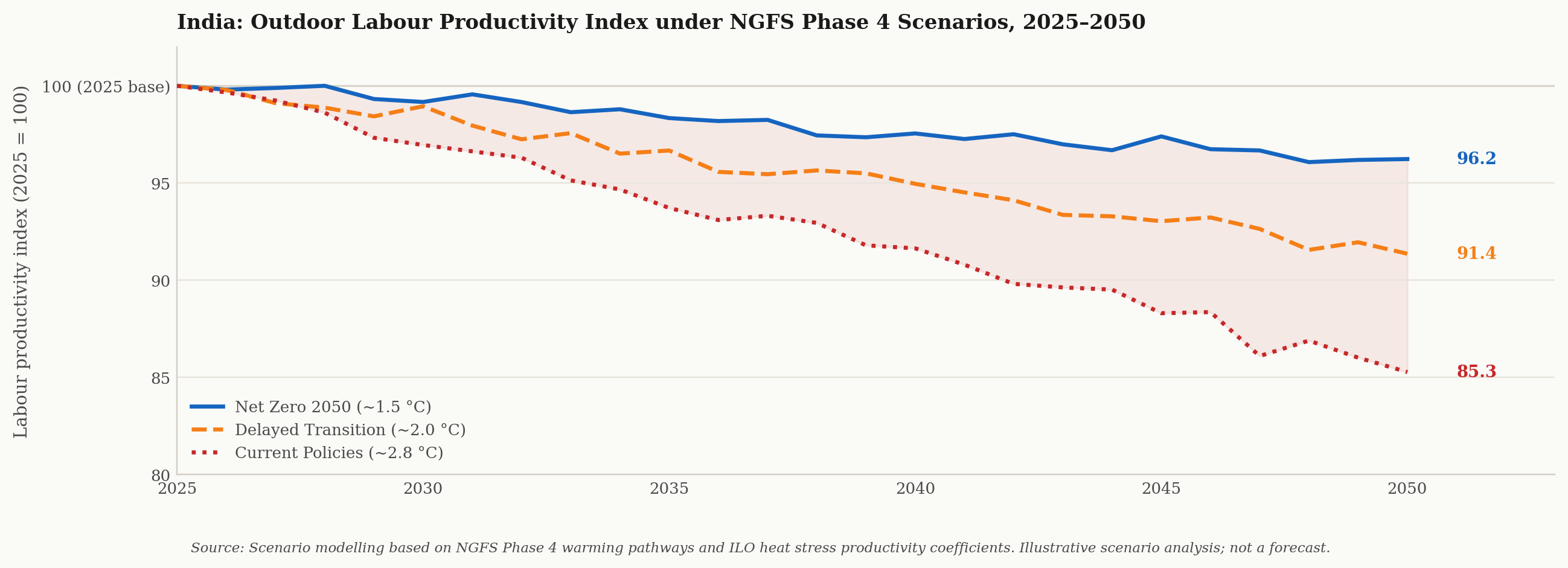
IPCC AR6 WGI Chapter 11 is explicit on the India heat trajectory. [IPCC AR6 WGI Ch.11] Under current policies, India is projected to see: a statistically significant increase in days when WBGT exceeds the moderate-risk threshold for outdoor workers; a higher frequency of concurrent heat and humidity events; and an extension of the heat-stress season from the traditional May-June window into March-April and September-October. [IPCC AR6 WGI Ch.11: Rare 1-in-50-year heat events become 1-in-5-year events at 2°C warming]
The financial consequence is not simply that heat events become more frequent. It is that the economic system — construction schedules, agricultural calendars, MGNREGS work schedules — is calibrated to a heat pattern that no longer reflects physical reality. Every additional week of heat-stop conditions outside the traditional assumed window is an uncalibrated loss — a systematic model gap that flows directly into mispriced credit.
SOURCE — IPCC AR6 WORKING GROUP I, CHAPTER 11 (WEATHER AND CLIMATE EXTREMES)
"Heat extremes have increased in frequency and intensity in India since the 1950s and are virtually certain to intensify further under all warming scenarios." Under 2°C of global warming above pre-industrial levels, heat events that currently occur once in 50 years are projected to occur once in approximately 5 years. Under 4°C, they become near-annual. For India's outdoor workforce, this represents a structural shift in the number of physiologically constrained work-days per year — a permanent, compounding drag on labour productivity.
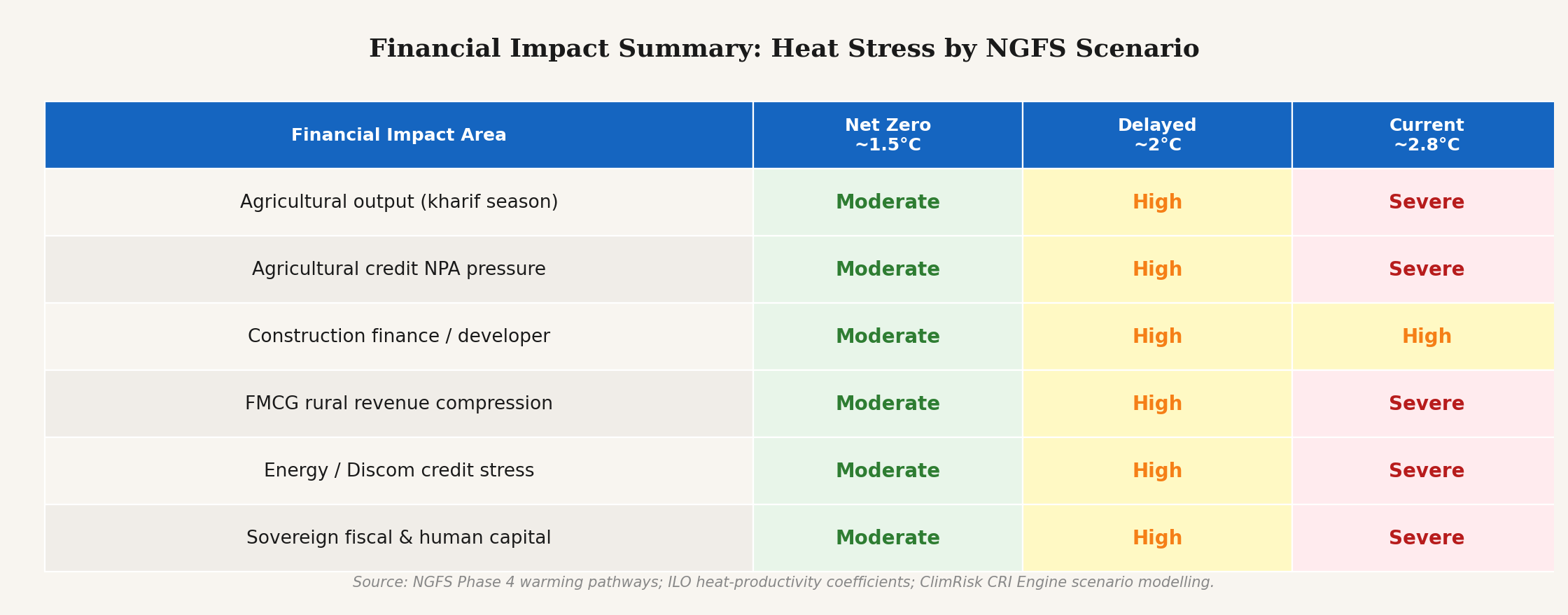
Financial Impact Summary: Heat Stress by NGFS Scenario
What This Means for Capital Allocation
The 2024 India heatwave produced documented, measurable output consequences in construction, agriculture, and retail foot traffic. Grid stress events were recorded. NDMA advisories halted outdoor work across eleven states. [NDMA 2024 · MoP India 2024] None of this was reflected as a quantified risk in any quarterly earnings guidance issued by India-focused equity analysts, agricultural lenders, or infrastructure finance companies during the same period.
The physics is not uncertain. The IMD has 150 years of temperature records. The ILO has published heat-productivity coefficients by sector. [ILO 2019] The IPCC has published warming trajectories with quantified regional heat event probability changes under each scenario. [IPCC AR6 WGI Ch.11] The gap is not in the physical data. The gap is in the analytical framework that converts the physical data into financial terms — at the asset level, portfolio level, and sovereign level.
"The heat stopped outdoor construction across eleven states simultaneously. No financial model had a field for it."
Standard credit risk models for India's agricultural lending segment do not incorporate WBGT thresholds or ILO heat-productivity coefficients into NPA probability distributions. Equity research covering FMCG companies does not systematically embed heat-stress days into rural consumption forecasts. Infrastructure finance models do not adjust construction timeline assumptions for an expanded heat-stop season. The systematic omission of this physical variable creates a consistent, directional mispricing of risk — concentrated in the informal economy, but transmitting eventually into formal financial institutions through the six pathways mapped above.
ClimRisk — CRI Engine
The CRI engine maps asset and supply chain footprints against physical hazard projections — ILO heat-productivity coefficients, IMD temperature trend data, IPCC AR6 warming trajectories, and NGFS Phase 4 scenarios — and translates heat stress risk into financial terms: EBITDA compression, NPA probability uplift, and enterprise value impact across three scenarios through 2050. Not a risk score. A DCF with physical climate adjustment terms. 48-hour turnaround at asset level.
If you manage capital with exposure to Indian agriculture, construction finance, informal sector credit, or South Asian consumer markets, and want to see what physically-grounded heat stress quantification looks like in practice, I would like to speak with you.
climrisk.io
DATA SOURCES
IMD Heat Watch 2024 — India Meteorological Department, Heatwave Monitoring Bulletins, 2024.
NDMA 2024 — National Disaster Management Authority, Heat Action Plan Implementation Reports, 2024.
IPCC AR6 WGI Ch.11 — IPCC Sixth Assessment Report, Working Group I, Chapter 11: Weather and Climate Extremes (2021).
IPCC AR6 WGII Ch.16 — IPCC Sixth Assessment Report, Working Group II, Chapter 16: Key Risks Across Sectors and Regions (2022).
ILO 2019 — International Labour Organization, "Working on a warmer planet: The impact of heat stress on labour productivity and decent work" (2019).
Sherwood & Huber 2010 — Sherwood, S.C. & Huber, M., "An adaptability limit to climate change due to heat stress," PNAS 107(21), 2010.
PLFS 2022-23 — Periodic Labour Force Survey 2022–23, Ministry of Statistics and Programme Implementation, Government of India.
RBI FSR 2023 — Reserve Bank of India, Financial Stability Report, June 2023.
NGFS Phase 4 — Network for Greening the Financial System, Phase 4 Climate Scenarios (2023).
FAO — Food and Agriculture Organization, crop yield and temperature sensitivity assessments.
World Bank — World Bank climate and human capital research, including heat stress and long-term productivity studies.
CEA / MoP India — Central Electricity Authority and Ministry of Power, grid stress event documentation 2022–2024.
NHB — National Housing Bank, real estate finance stress indicators.
CRISIL — CRISIL sector reports on construction finance credit quality.
CMIE — Centre for Monitoring Indian Economy, consumer spending and informal sector indices.
ClimRisk translates physical and transition climate risk into asset-level financial exposure. To run your own assets or portfolio through the engine, write to shri@climrisk.io or book a demo.