Physical Risk · South & Southeast Asia
The Supply Chain Tax
In April 2024 a heat dome settled over South and Southeast Asia and did not move for three weeks. What that costs a global supply chain, quantified.
Shrinivash D Kannan · 24 August 2026 · 12 min read · Also on Substack
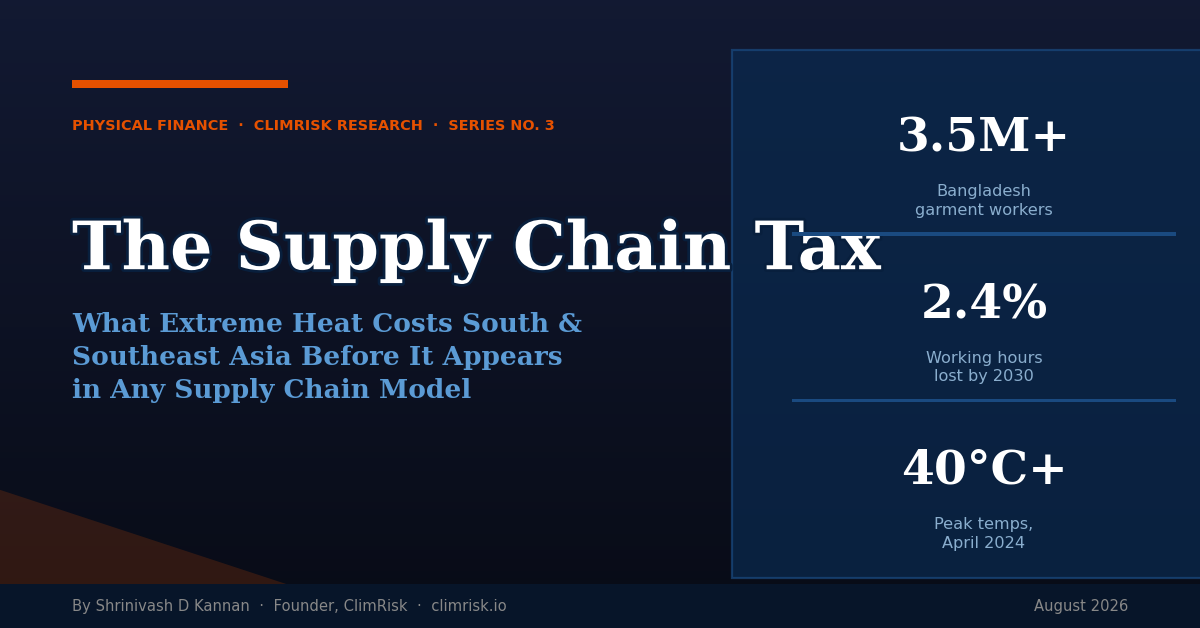
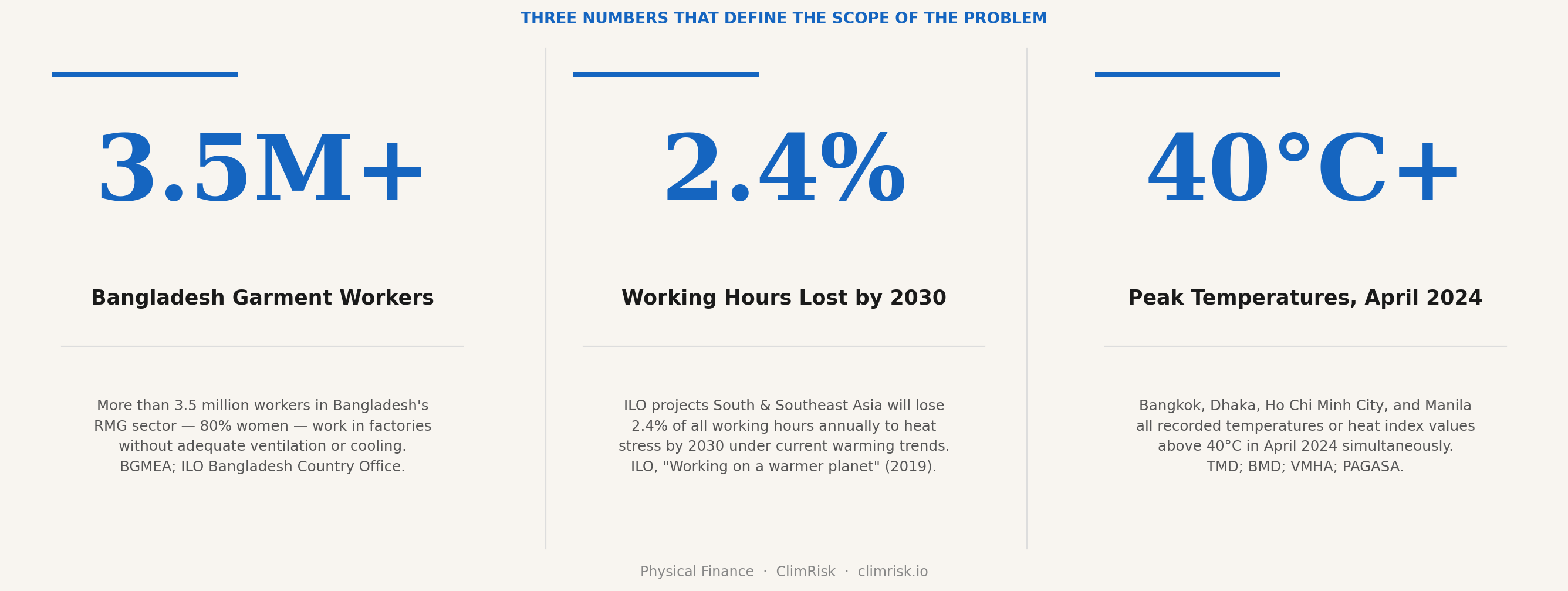
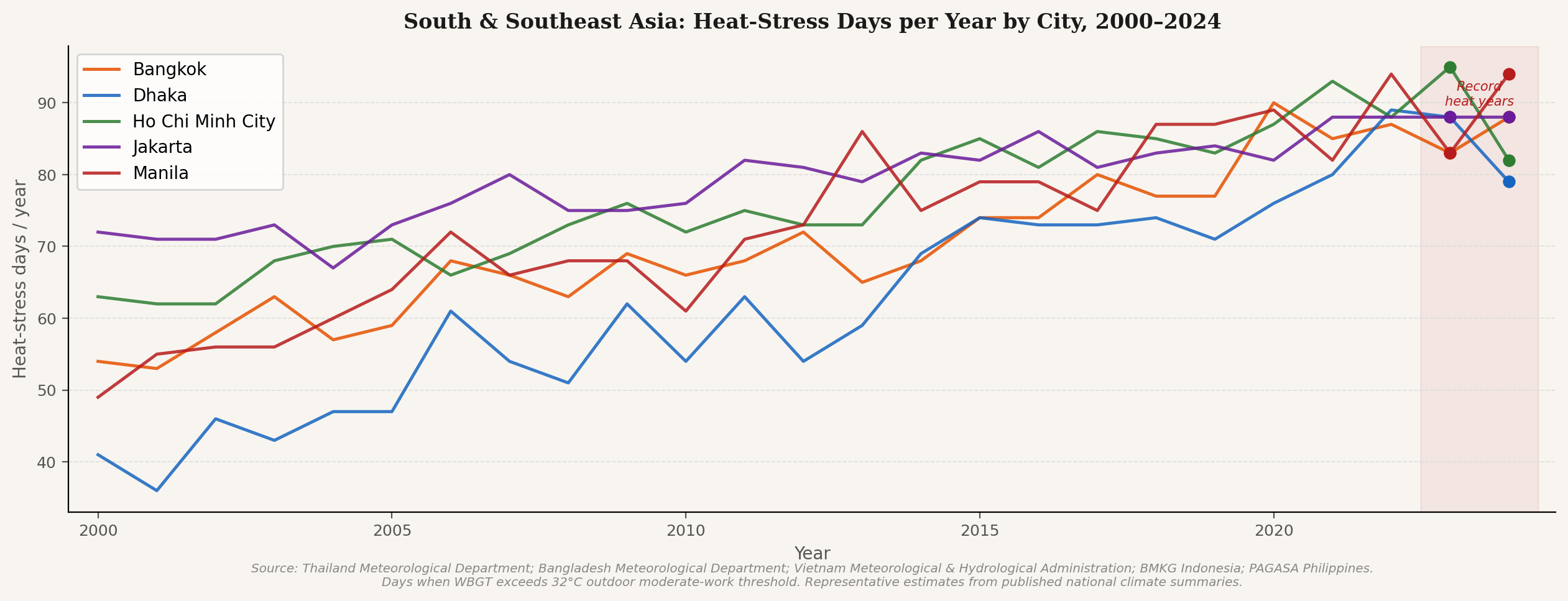
In April 2024, a heat dome settled over South and Southeast Asia and did not move for three weeks. Bangkok recorded a heat index of 52°C. [TMD 2024] Dhaka temperatures exceeded 40°C on fourteen consecutive days. [BMD 2024] Vietnam's meteorological service recorded temperatures above 40°C across northern provinces. [VMHA 2024] The Philippines issued the highest heat index alert level across eleven provinces. [PAGASA 2024]
The event was simultaneous, multi-country, and documented. Outdoor construction halted. Agricultural field work was suspended during peak hours. In Bangladesh, productivity surveys of garment factories showed measurable output reduction on days when factory floor temperatures exceeded safe working thresholds.
None of this appeared as a quantified risk event in any quarterly supply chain risk report issued by a global logistics provider, trade finance institution, or export credit agency during the same period. The losses were real. The framework to capture them did not exist.
This article builds that framework for South and Southeast Asia. It traces the physical mechanism by which extreme heat suppresses labour output in manufacturing and agricultural export economies, maps the six financial transmission pathways through which that suppression travels, and uses ILO and NGFS Phase 4 data to show what the loss looks like under three warming scenarios through 2050.
The Physical Mechanism: Heat, Humidity, and the Manufacturing Floor
The physiology of heat stress is the same across geographies. When ambient temperature and humidity combine to raise the wet-bulb globe temperature (WBGT) above 28°C, outdoor workers at moderate intensity lose approximately 50 percent of their sustainable work capacity. [ILO 2019] At 35°C wet-bulb, no amount of rest prevents core body temperature from rising toward dangerous levels. [Sherwood & Huber, PNAS 2010] Work must stop.
South and Southeast Asia face a compounding challenge that distinguishes the region from India: the combination of high ambient temperature with extreme humidity. The Indo-Gangetic Plain experiences dry heat. The Mekong Delta, the Ganges-Brahmaputra delta, and the coastal manufacturing zones of Vietnam and the Philippines experience wet heat — a combination where the body's primary cooling mechanism, evaporative sweat, is suppressed by ambient humidity. At equivalent air temperatures, humid heat imposes greater physiological stress than dry heat.
IPCC AR6 WGI Chapter 11 documents that South and Southeast Asia are among the regions most likely to cross wet-bulb temperature thresholds dangerous to human health and outdoor work capacity. [IPCC AR6 WGI Ch.11] The region is also among the most exposed globally in terms of the share of GDP and employment that depends on outdoor and thermally uncontrolled labour. [World Bank 2022: Climate and Development]
SOURCE — IPCC AR6 WORKING GROUP II, CHAPTER 10 (ASIA)
"South and Southeast Asia face compound climate risks including extreme heat, humidity, and flooding that are projected to substantially reduce labour productivity in agriculture, construction, and light manufacturing under all warming scenarios." Heat stress losses in Asia are projected to be non-linear with warming. The region accounts for the largest share of global working hour losses from heat stress in absolute terms, given its share of global outdoor employment.
SOURCE — WMO STATE OF THE GLOBAL CLIMATE 2024 / REGIONAL MET SERVICES
April 2024 was the most widespread simultaneous heat event on record across South and Southeast Asia. Thailand, Bangladesh, Vietnam, Cambodia, Laos, the Philippines, and parts of Indonesia all recorded temperatures or heat index values at or above historical records during a single three-week period. The event coincided with peak agricultural activity in several countries and peak garment factory production schedules aligned with Northern Hemisphere summer order books.
The Exposed Workforce: Four Countries, Four Sectors
Bangladesh's ready-made garment (RMG) sector employs more than 3.5 million workers, of whom approximately 80 percent are women. [BGMEA 2024] The sector accounts for 84 percent of Bangladesh's total export earnings. [Export Promotion Bureau, Bangladesh 2024] Most factories are multi-storey buildings with natural ventilation — effective when outside temperatures are below 30°C, inadequate when they exceed 35°C. On high heat days, factory floor temperatures regularly exceed WBGT safe-work thresholds. Workers slow down, take longer rest breaks, and in extreme cases leave for the day. [ILO Bangladesh: Heat stress in garment factories (2022)]
Vietnam is the world's third-largest garment exporter and a major hub for electronics manufacturing. Samsung's Vietnam facilities, Intel's Ho Chi Minh City assembly plant, and hundreds of tier-2 and tier-3 suppliers operate in industrial zones across the country. [General Statistics Office Vietnam 2024] While large-format electronics facilities are air-conditioned, the supplier base — small factories producing components, packaging, and subassemblies — is frequently not. Heat events that suppress productivity in the supplier base create delivery delays that propagate upstream.
Indonesia's informal employment rate exceeds 57 percent. [BPS Indonesia 2023] The construction sector employs approximately 8 million workers, the vast majority in conditions with no employer health protection and no paid sick leave. Palm oil — Indonesia's largest agricultural export — is harvested by an estimated 3.7 million smallholder farmers and estate workers, predominantly in outdoor conditions. [GAPKI 2024] Both sectors lose output on extreme heat days without any systematic reporting mechanism that connects the loss to financial accounts.
The Philippines' agricultural sector employs approximately 25 percent of the labour force, with rice, coconut, and sugar cane as principal crops. [PSA Philippines 2023] April and May — peak heat months — coincide with pre-monsoon harvest activity. PAGASA has documented a statistically significant upward trend in extreme heat index days across the archipelago since 2000, with the 2024 event breaking station records at multiple locations. [PAGASA Climate Division 2024]
"The garment worker who stops at 38°C does not file a productivity report. The loss appears twelve weeks later, when a European retail buyer receives a delayed shipment and adjusts their vendor scorecard."
SOURCE — ILO, "WORKING ON A WARMER PLANET" (2019)
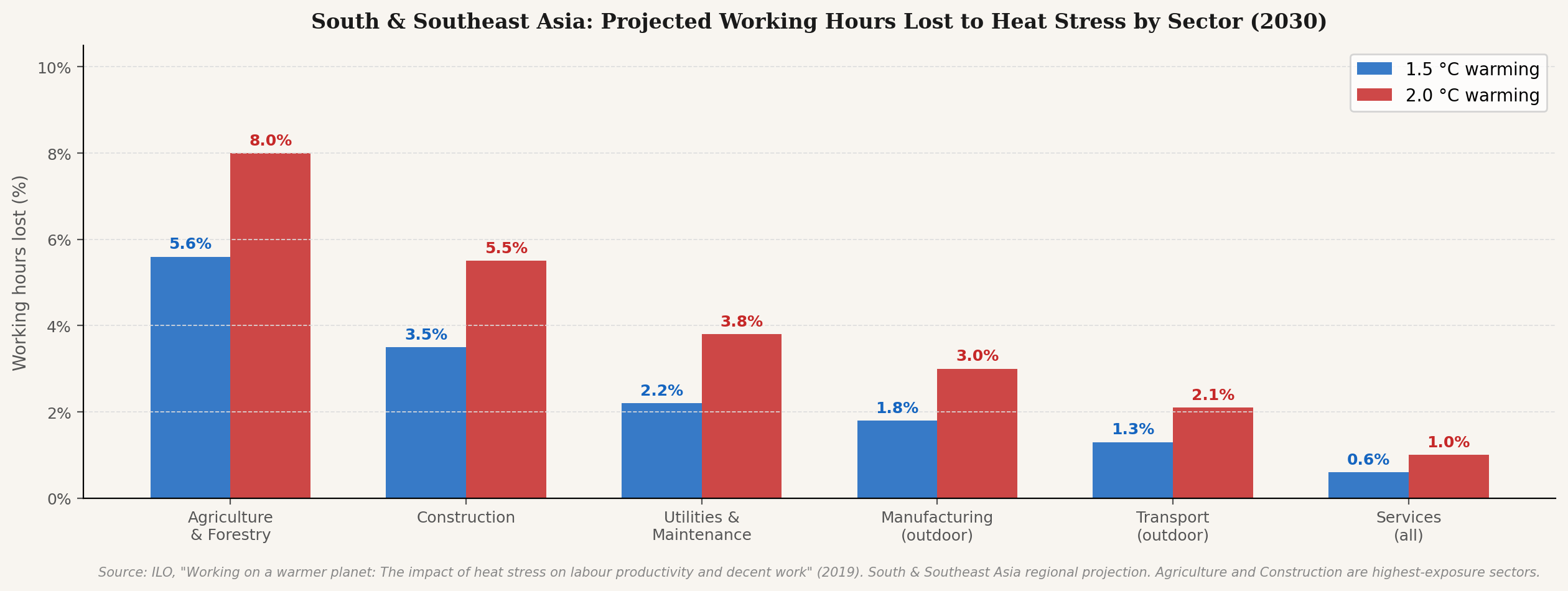
South and Southeast Asia will lose an estimated 2.4% of total working hours annually to heat stress by 2030. Agriculture loses approximately 5.6% of working hours at 1.5°C warming and 8.0% at 2°C. Construction loses 3.5% at 1.5°C and 5.5% at 2°C. Outdoor manufacturing — the most financially significant exposure for the region given its export share — loses approximately 1.8% at 1.5°C and 3.0% at 2°C. These losses are not recoverable through overtime; they represent permanent capacity reduction during the affected period.
Six Financial Transmission Pathways
Heat stress in South and Southeast Asia travels through the economy along six distinct financial pathways. The pathways operate simultaneously but affect different parts of the capital structure — trade finance, export credit, supply chain equity valuations, agricultural credit, sovereign debt, and infrastructure finance.
1. Manufacturing Export Revenue Compression [BGMEA · GSO Vietnam · BPS Indonesia] When factory output drops during heat events, export volumes decline within the same quarter. For Bangladesh, a 5 percent reduction in RMG working hours across a peak production month translates directly into a reduction in foreign exchange earnings. For Vietnam, heat-induced supplier delivery failures create penalties and future order reductions from international buyers. Export credit insurance pricing does not currently incorporate heat-productivity risk as a distinct underwriting variable.
2. Supply Chain Reliability and Buyer Concentration Risk [World Bank Supply Chain Reports · OECD] Global apparel brands, electronics manufacturers, and food retailers source from South and Southeast Asia precisely because of cost efficiency. Heat events that create unreliable delivery schedules trigger buyer diversification — a slow but irreversible erosion of market share. Garment factories in Bangladesh, Vietnam, and Indonesia that experience repeated heat-related delivery failures face progressive order book reduction. This is a reputational and financial risk that does not appear in factory-level balance sheets until it is already priced in by buyers.
3. Agricultural Export and Commodity Price Transmission [FAO · GAPKI · PSA Philippines] Indonesia's palm oil, Vietnam's rice, and Philippines' coconut and sugar production are all exposed to heat-induced yield compression and harvest timing disruption. Heat events during critical crop growth stages reduce yields regardless of rainfall adequacy. Price volatility in these commodities flows into food import costs across the region and into the fiscal accounts of countries that use export taxes or price stabilisation mechanisms.
4. Construction Sector Output and Infrastructure Credit [ADB · World Bank IDA] South and Southeast Asia's infrastructure investment pipeline is among the largest globally. ADB estimates infrastructure needs across the region at over USD 1.7 trillion annually. Construction project timelines that embed heat-season activity without accounting for an expanded and intensifying heat-stop season are systematically optimistic. Project overruns translate into cost escalation, debt service coverage ratio compression, and developer credit quality deterioration — concentrated in markets where infrastructure bond and loan documentation does not include climate-physical risk adjustment provisions.
5. Energy System Stress and Industrial Power Risk [ASEAN Centre for Energy · IEA] Extreme heat events drive simultaneous industrial cooling demand spikes and thermal power plant efficiency reductions. Countries dependent on coal and gas-fired generation — Indonesia, Bangladesh, Vietnam, the Philippines — see grid stress during the same heat events that suppress labour productivity. Industrial power outages during production shifts compound the direct heat-labour productivity loss with equipment downtime and production loss from power interruption.
6. Sovereign FX, Fiscal Exposure, and Human Capital Risk [IMF Article IV · World Bank] Bangladesh, Vietnam, Indonesia, and the Philippines all depend materially on manufacturing export earnings for their foreign exchange reserves and fiscal revenue bases. Sustained heat-related compression of export earnings creates FX reserve pressure, current account deterioration, and fiscal headroom reduction in exactly the countries that carry significant external debt in USD and EUR. The IMF's Article IV consultations for the region have increasingly referenced physical climate risk — but heat-specific productivity loss has not yet been incorporated into standard debt sustainability analysis.
SOURCE — ADB CLIMATE RISK COUNTRY ASSESSMENTS (2023)
South and Southeast Asia faces the highest combined physical climate risk of any region globally in absolute GDP terms. The ADB estimates that unmitigated climate change could reduce the region's GDP by up to 17 percent by 2100. Heat stress and its direct effects on labour productivity represent the single most immediate and measurable channel through which physical risk converts to economic loss — ahead of sea level rise and cyclone intensification in terms of near-term financial materiality.
What Climate Science Says About the Regional Heat Trajectory Through 2050
IPCC AR6 WGI Chapter 11 documents that Southeast Asia has already experienced a statistically significant increase in extreme heat event frequency since the 1950s. [IPCC AR6 WGI Ch.11] Under 1.5°C of global warming, heat events that currently occur once in 10 years will occur once in 3 to 4 years. Under 2°C, the same events become near-biennial. Under current policies, the region faces a transformation of the heat-stress calendar: what is currently a two-month peak season extends into a five-to-six-month season within the 2040s.
The financial consequence for supply chain-dependent economies is not just more frequent disruption. It is a structural shift in the planning assumption for labour availability. Every financial model that embeds a heat-season assumption calibrated to historical data is building on an already-outdated foundation. The gap between the assumed heat calendar and the actual heat calendar is a systematic source of mispriced risk in export credit, trade finance, infrastructure project finance, and supply chain equity research.
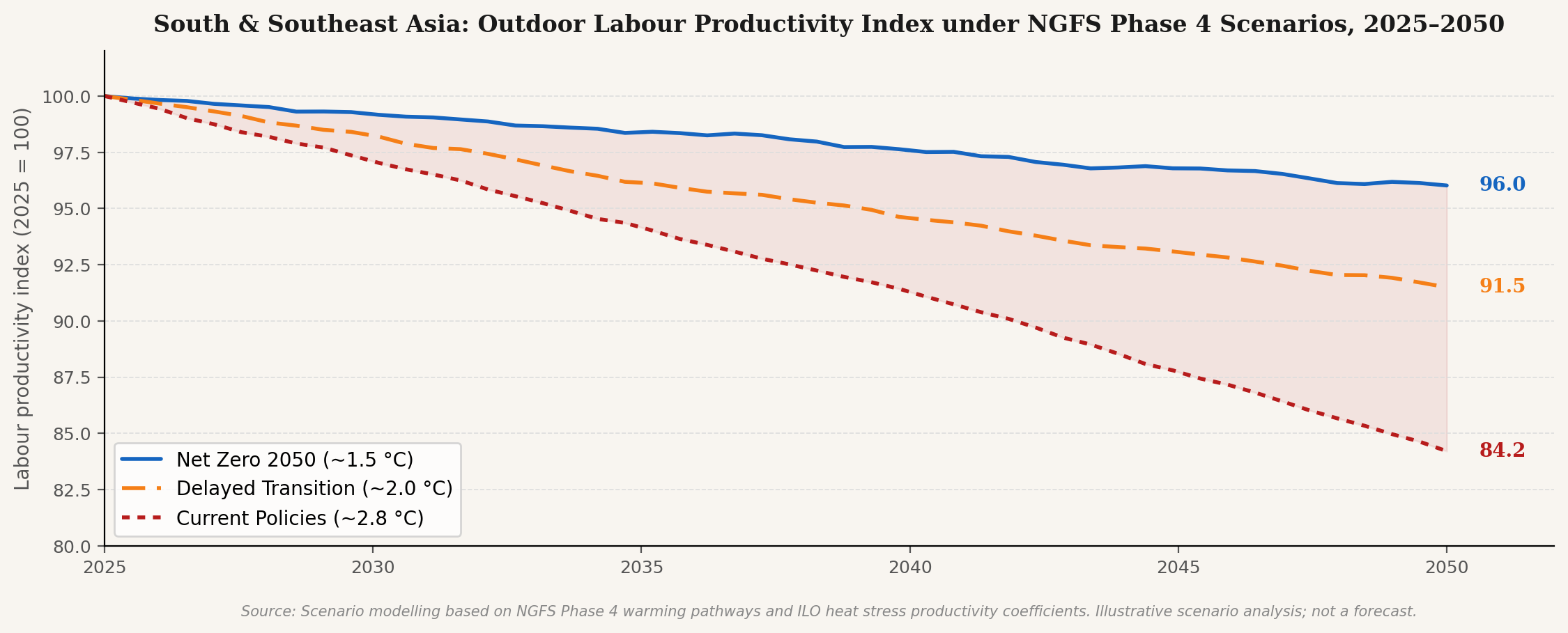
SOURCE — NGFS PHASE 4 CLIMATE SCENARIOS (2023) / IPCC AR6
"Under all warming scenarios, South and Southeast Asia face a compounding of heat stress and humidity that will reduce the physiological capacity for outdoor work below current levels on an increasing number of days per year." Under Current Policies (~2.8°C), outdoor labour productivity in the region falls to approximately 84.8 on a 2025=100 index by 2050. Under Net Zero (~1.5°C), productivity stabilises at approximately 96.5. The 12-point gap between scenarios represents the financial value of the low-carbon transition in labour terms alone — before accounting for physical asset damage, sea level risk, or agricultural yield effects.
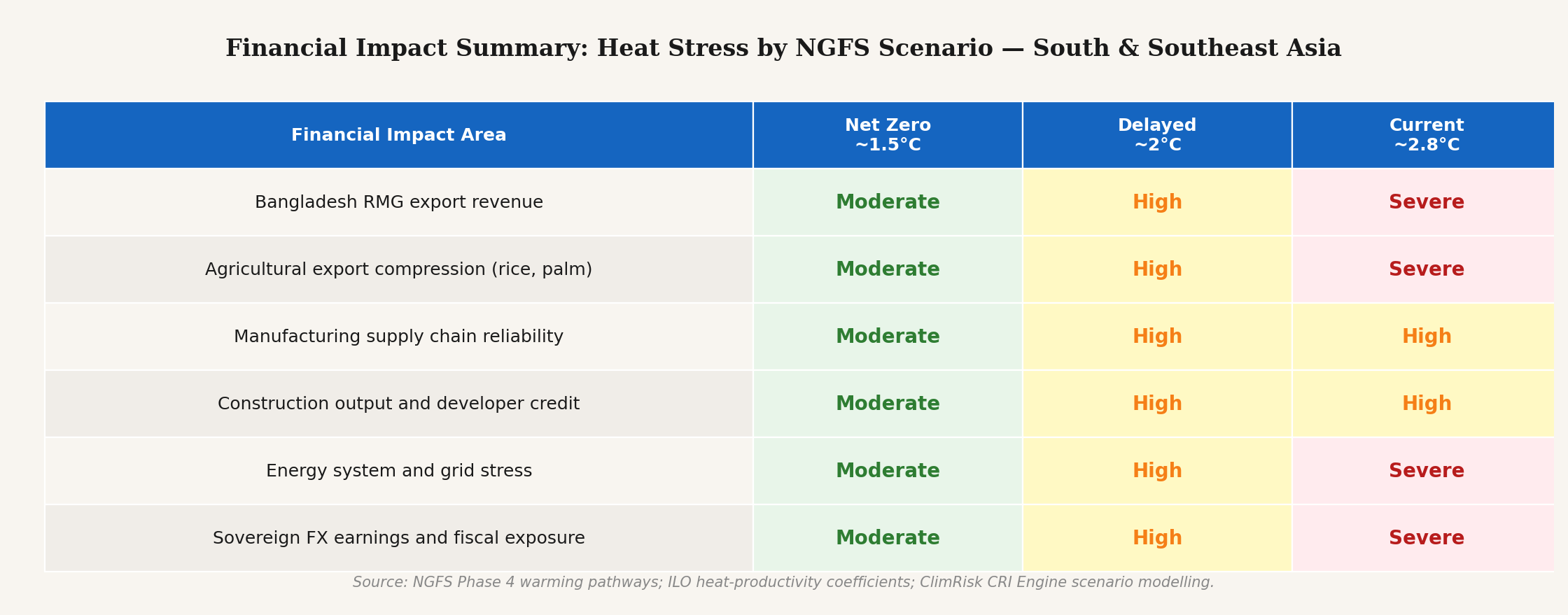
Financial Impact Summary: Heat Stress by NGFS Scenario
What This Means for Capital Allocation
The April 2024 heat event produced documented and measurable output consequences across the region. Garment factory productivity surveys in Bangladesh confirmed output reduction. [ILO Bangladesh 2024] Agricultural production statistics for the kharif equivalent season in Vietnam and the Philippines showed below-trend output. [FAO GIEWS 2024] Construction activity data for Indonesia and Thailand reflected elevated absenteeism. None of this was reflected as a quantified heat-risk event in any trade finance or supply chain risk report issued by a financial institution during the same quarter.
The data exists. The ILO has published sector-specific heat-productivity coefficients for the region. National meteorological services publish daily temperature and heat index records. The IPCC has quantified the probability distribution of future heat event frequency under each warming scenario. The gap is not in the physical data. It is in the absence of a systematic method for converting that data into financial risk terms at the asset, portfolio, and sovereign level.
"The delivery was late because the factory floor was 40°C. The trade finance model had no variable for that."
Export credit insurance models do not incorporate ILO heat-productivity coefficients into production probability distributions for garment or agricultural exporters in the region. [OECD Export Credit Arrangement] Supply chain equity research for global consumer brands does not systematically link heat-stop days in source countries to revenue guidance. Infrastructure project finance models in the region do not adjust construction timeline assumptions for an expanding heat-stop season. The systematic omission creates a consistent directional mispricing — concentrated in supply chain-exposed portfolios, but transmitting eventually into the formal financial system through the six pathways mapped above.
ClimRisk — CRI Engine
The CRI engine maps asset and supply chain footprints against physical hazard projections — ILO heat-productivity coefficients, regional temperature trend data, IPCC AR6 warming trajectories, and NGFS Phase 4 scenarios — and translates heat stress risk into financial terms: EBITDA compression, export revenue reduction, NPA probability uplift, and enterprise value impact across three scenarios through 2050. Not a risk score. A DCF with physical climate adjustment terms. 48-hour turnaround at asset level.
If you manage capital with exposure to South or Southeast Asian manufacturing, agricultural export credit, supply chain finance, or infrastructure project debt, and want to see what physically-grounded heat stress quantification looks like in practice, I would like to speak with you.
climrisk.io
DATA SOURCES
TMD 2024 — Thai Meteorological Department, Climate Summaries and Extreme Heat Reports, 2024.
BMD 2024 — Bangladesh Meteorological Department, Monthly Climate Summaries, April 2024.
VMHA 2024 — Vietnam Meteorological and Hydrological Administration, Climate Bulletins, April 2024.
PAGASA 2024 — Philippine Atmospheric, Geophysical and Astronomical Services Administration, Heat Index Advisories, April 2024.
IPCC AR6 WGI Ch.11 — IPCC Sixth Assessment Report, Working Group I, Chapter 11: Weather and Climate Extremes (2021).
IPCC AR6 WGII Ch.10 — IPCC Sixth Assessment Report, Working Group II, Chapter 10: Asia (2022).
ILO 2019 — International Labour Organization, "Working on a warmer planet: The impact of heat stress on labour productivity and decent work" (2019).
ILO Bangladesh 2022/2024 — ILO Bangladesh Country Office, heat stress assessments in the RMG sector.
Sherwood & Huber 2010 — Sherwood, S.C. & Huber, M., "An adaptability limit to climate change due to heat stress," PNAS 107(21), 2010.
BGMEA 2024 — Bangladesh Garment Manufacturers and Exporters Association, industry statistics 2024.
Export Promotion Bureau, Bangladesh 2024 — Annual export statistics.
General Statistics Office Vietnam 2024 — Manufacturing and export data.
BPS Indonesia 2023 — Badan Pusat Statistik, labour force survey and employment data.
GAPKI 2024 — Indonesian Palm Oil Association, smallholder employment and production data.
PSA Philippines 2023 — Philippine Statistics Authority, labour force and agricultural output data.
NGFS Phase 4 — Network for Greening the Financial System, Phase 4 Climate Scenarios (2023).
ADB 2023 — Asian Development Bank, Climate Risk Country Assessments and infrastructure investment estimates.
World Bank 2022 — World Bank, Climate and Development Report; supply chain risk assessments.
FAO GIEWS 2024 — Food and Agriculture Organization, Global Information and Early Warning System crop reports.
WMO 2024 — World Meteorological Organization, State of the Global Climate 2024.
ASEAN Centre for Energy / IEA — Regional energy system data and grid stress documentation.
ClimRisk translates physical and transition climate risk into asset-level financial exposure. To run your own assets or portfolio through the engine, write to shri@climrisk.io or book a demo.